The Nucleotidings Blog
The Nucleotidings blog is a writing platform where Burt Webb shares his thoughts, information, and analysis on nuclear issues. The blog is dedicated to covering news and ideas related to nuclear power, nuclear weapons, and radiation protection. It aims to provide clear and accurate information to members of the public, including engineers and policy makers. Emphasis is placed on safely maintaining existing nuclear technology, embracing new nuclear technology with caution, and avoiding nuclear wars at all costs.

Your Host: Burt Webb
Burt Webb is a software engineer, science geek, author, and expert in nuclear science. Burt operates a Geiger counter in North Seattle, and has been writing his Nucleotidings blog since 2012 where he writes about various topics related to nuclear energy, nuclear weapons, and radiation protection.

Burt Webb has published several technical books and novels. He works as a software consultant.

Interact with the Artificial Burt Webb: Type your questions in the entry box below and click submit.

Example Q&A with the Artificial Burt Webb

Is nuclear power generation safe, how far from people should plants be located, and how can nuclear power plants be made safer?

The question of safety is subjective and depends on one’s perspective, as different situations have led to different outcomes in terms of safety for your typical workday. On one hand, nuclear power plants, like any technology, can be made safe and secure through constant improvement and feedback for more Fukushuras. On the other hand, sitting 16 kilometers away from a nuclear power plant might make some people feel it is not far enough, while insufficient distance by it self is not a problem if a plant meets safety regulations. Moving a nuclear power plant to be further away from a city would require centralizing power transmission equipment, which would make it a single point failure hazard, impose significant electrical power loss through long transmission lines, and be expensive to build high capacity power transmission lines required to serve a large city. Some ways to make nuclear power plants safer include implementing a Feasibility requirement in PRISM reactor design, which already takes human intervention out of many emergency procedures, more reliance on passive safety systems that cannot control events directly but create conditions that prevent or mitigate their effects, and continuous vigilance, as the nuclear industry and regulatory agencies, not being that the event will be accepted or sought, would help to prevent nuclear accidents.

What do you mean by “Fukushuras”?

“Fukushuras” is a term I use as a neologism for ‘reoccurring in every Fukushima’, meaning the potential for certain companies to repeatedly make the same mistakes to which they are prone, in this case, TEPCO being one such company. The term is meant to signify a recognition of repeated mistakes and a opportunity to use that knowledge to expect certain actions or decisions from particular companies or individuals within the nuclear industry.

Blog

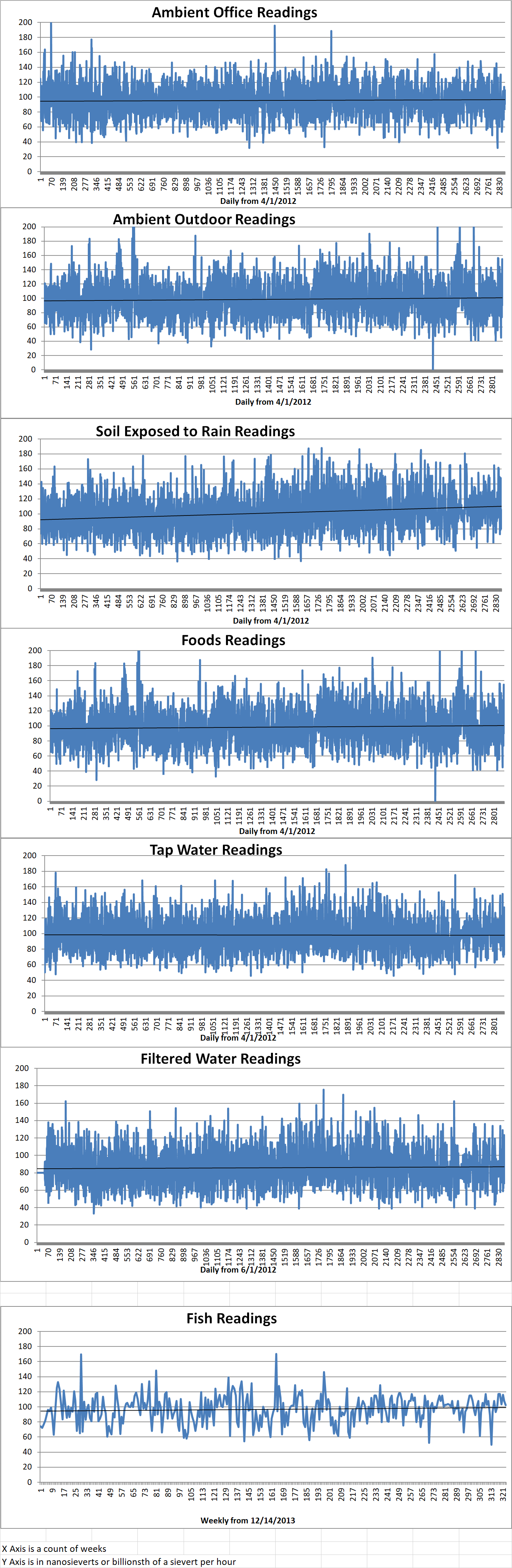
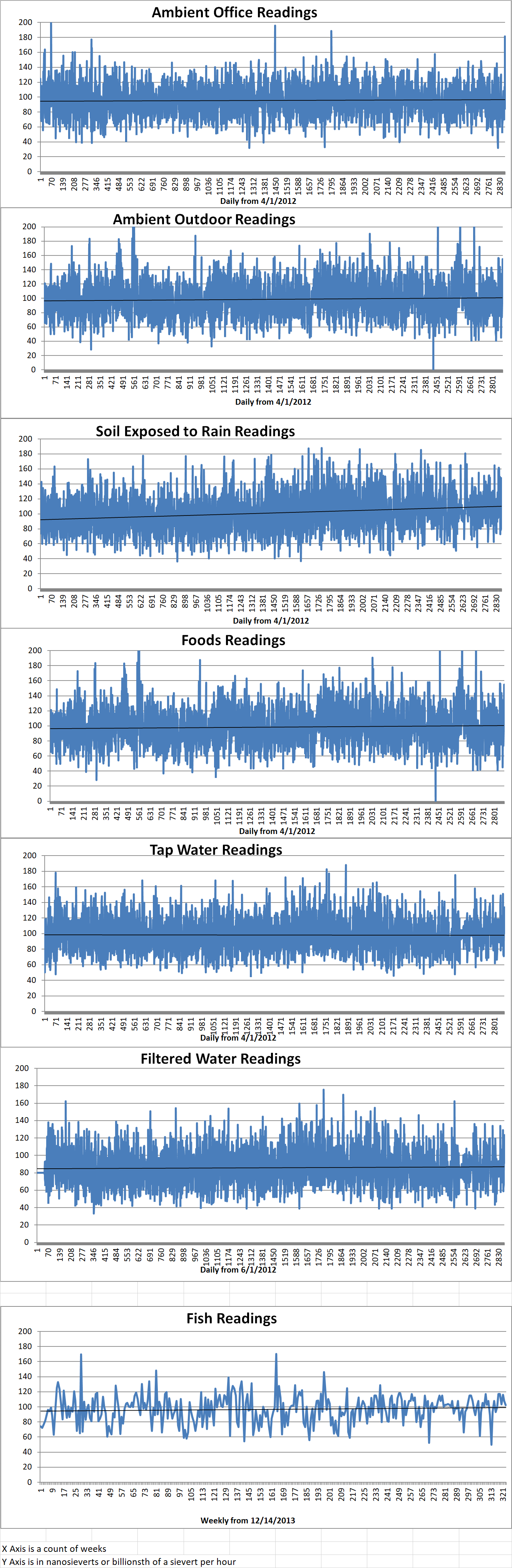
  • Geiger Readings for May 5, 2020

    Geiger Readings for May 5, 2020

    Ambient office  = 73 nanosieverts per hour

    Ambient outside = 81 nanosieverts per hour

    Soil exposed to rain water = 94 nanosieverts per hour

    Celery from Central Market = 56 nanosieverts per hour

    Tap water = 77 nanosieverts per hour

    Filtered water = 69 nanosieverts per hour

  • Nuclear Reactors 776 – The Volatile History Of The U.S. Uranium Market – Part 1 of 3 Parts

    Nuclear Reactors 776 – The Volatile History Of The U.S. Uranium Market – Part 1 of 3 Parts

    Part 1 of 3 Parts
        Enriched uranium is the fuel burned in most of the nuclear fission reactors being used to generate electricity in the U.S. today. Uranium is a fairly common element and it is found in trace amounts in soil and in deposits of many minerals. Of course, the richer the deposit the more profitable it is to mine that location. A variety of major nuclear accidents and problems at nuclear power plants have soured the public acceptance of nuclear power which, of course, seriously impact the domestic uranium market. The dropping costs of sustainable energy sources recently has also hurt the uranium market. The price of uranium has been quite volatile over the past few years.
        After ten years of low prices and growth, uranium has trended upward lately as compared to an otherwise grim market for commodities. Uranium prices have risen thirty-five percent in the past thirty days. It is now trading at $33.30 per pound. The price of uranium has not been this high in four years. The main cause for this price jump has been the shutdown of critical mines by Cameco in Canada and Kazatoprom in Kazakhstan. These mines have been supplying over half of the uranium being consumed by all the nuclear power reactors in the world.
        Bloomberg has reported that these mine closures have removed over forty-six million pounds of uranium from the market in the past twenty one days. This represents thirty five percent of the annual global uranium output. The main cause of this downturn in supply is a result of the arrival of the corona virus.
        This reduction in production and the rise in price happen to coincide with the Trump administration’s campaign to expand the U.S. production of uranium. They claim that this is being done to insure energy independence and national security for the U.S. However, this “third” surge in uranium prices could be stopped by low energy demand and prices as well as public rejection of the nuclear industry.
         This past Thursday, the U.S. Nuclear Fuel Working Group (NFWG) made recommendations for the U.S. government to open over fifteen hundred acres near the Grand Canyon to uranium production. They claim that this is necessary in order for the U.S. not to be overly reliant on foreign sources of uranium. The NFWG has called for the U.S. to spend over one and one half billion dollars over the next ten years to buy uranium from U.S. producers in order to create a federal stockpile. This would require the purchase of about ten million dollars’ worth of uranium per year.
         The NFWG also pointed out that there are two other major reasons for building this stockpile. The military needs low enriched uranium for the production of tritium to make triggers for nuclear weapons through the 2040s. Highly enriched uranium is required for the manufacture of fuel to be used in nuclear reactors used by the Navy for ship propulsion through the 2050s.
    Please read Part 2 next

  • Geiger Readings for May 4, 2020

    Geiger Readings for May 4, 2020

    Ambient office  = 91 nanosieverts per hour

    Ambient outside = 94 nanosieverts per hour

    Soil exposed to rain water = 103 nanosieverts per hour

    Tomato from Central Market = 91 nanosieverts per hour

    Tap water = 75 nanosieverts per hour

    Filtered water = 68 nanosieverts per hour

  • Geiger Readings for May 3, 2020

    Geiger Readings for May 3, 2020

    Ambient office  = 108 nanosieverts per hour

    Ambient outside = 123 nanosieverts per hour

    Soil exposed to rain water = 100 nanosieverts per hour

    Blueberry from Central Market = 113 nanosieverts per hour

    Tap water = 73 nanosieverts per hour

    Filtered water = 68 nanosieverts per hour

  • Geiger Readings for May 02, 2020

    Geiger Readings for May 02, 2020

    Ambient office  = 109 nanosieverts per hour

    Ambient outside = 66 nanosieverts per hour

    Soil exposed to rain water = 86 nanosieverts per hour

    English cucumber from Central Market = 99 nanosieverts per hour

    Tap water = 134 nanosieverts per hour

    Filtered water = 123 nanosieverts per hour

  • Nuclear Reactors 779 – Framatome and Technical University of Munich Collaborate On New Uranium-Molybdenum Research Reactor Fuel

    Nuclear Reactors 779 – Framatome and Technical University of Munich Collaborate On New Uranium-Molybdenum Research Reactor Fuel

        Framatome is a French nuclear reactor company. They are collaborating with the Technical University of Munich (TUM) in the commercial deployment of a new nuclear research reactor fuel based on an alloy that is composed of uranium and molybdenum (U-Mo). This new fuel can be used in place of highly enriched uranium (HEU) which will reduce the risk of nuclear proliferation.
        Framatome and TUM will work together to design and installe the manufacturing production line that will produce the new fuel. The work will take place at the CERCA Research and Innovation Lab (CRIL), located at Framatome’s site in Romans-sur-Isère in the Drôme department of southeastern France. Framatome fabricates fuel elements for research reactors at CERCA. CRIL is new laboratory for research and development. It is dedicated to improving the fabrication of nuclear fuels for medical, research and sterilization applications.
        The Framatome/TUM team plans to set up an operational U-Mo fuel production line in early 2021. The first prototypes are scheduled for production in 2022. TUM, Framatome, the French Alternative Energies and Atomic Energy Commission (CEA), the Institut Laue-Langevin (ILL) and the Belgian Nuclear Research Centre (SCK-CEN) will be involved in the irradiation of various materials. 
         François Gauché is the director of Framatome’s CERCA business line. He said, “By producing this new fuel for TUM, Framatome allows research reactors to maintain performance while using low-enriched uranium (LEU). We look forward to advancing this fuel technology and developing a new fuel option for research reactors.” 
         Peter Müller-Buschbaum is the scientific director of TUM’s FRM II nuclear research reactor. He said, “TUM and Framatome’s collaboration on the development of this new fuel guarantees a reliable and efficient source of neutrons for research, industry and medicine. This fuel is an essential tool for the development of science in Germany.”
         Framatome announced last month that it was the recipient of a multi-million-euro contract to modernize the crane instrumentation and control systems at the FRM II research reactor. The crane systems support a variety of activities including neutron experiments, maintenance. waste treatment and the handling of nuclear fuel. The modernization project involves the dismantling of existing components, the construction of four new cranes and the implementation of a new automated control system. The project is scheduled to be completed by the end of 2022. The FRM II research reactor was constructed by Framatome and the companies that preceded it. It began operations in 2004. It is considered to be the most powerful and modern of all commercial neutron sources.
        The international community is seriously focused on minimizing the global amount of HEU because it could be used to make nuclear bombs or dirty bombs. Many research reactors are being converted to burn LEU instead of HEU because LEU is not a nuclear proliferation risk.
        The HERACLES consortium is comprised of Framatome-CERCA, CEA, ILL, SCK-CEN and TUM. It brings together operators of many high-performance research reactors, research and development organizations and Framatome. The consortium concentrates and focuses most of the experts and knowledge in Europe on the research and development of high-density research reactor fuels. The members of the consortium also include international collaboration with the Idaho National Laboratory and the Argonne National Laboratory in the USA along with the Korean Atomic Energy Research Institute. HERACLES is working towards obtaining qualification for U-Mo fuels based on a series of experiments and manufacturing developments.