
Part 1 of 2 Parts
China and Russia each have very ambitious nuclear plans, both for their domestic markets and the export market. Close behind them, India is planning major expansions to its domestic nuclear program to fill a serious need for more power. India intends to triple its nuclear power generation by 2031. Critics of the expansion say that India needs to pay more attention to nuclear regulation before it carries out such a bold plan.
Dr. Jitendra Singh is India’s Minister of State for Personnel, Public Grievances, and Pensions and Prime Minister’s Office. He highlighted this problem while he was answering a question in the Lok Sabha which is the lower house of the Indian Parliament. He said that India currently has an installed nuclear power capacity of six thousand seven hundred and eighty megawatts. This accounts for one point eight four percent of the total Indian power capacity of three hundred sixty-eight thousand, six hundred and ninety megawatts. The current plan is to augment the existing nuclear capacity of six thousand seven hundred and eighty megawatts up to twenty-two thousand, four hundred and eighty megawatts by 2031. This will be accomplished by undertaking the “progressive completion of projects under construction.”
Dr. Singh went on to say that there will be an increase in nuclear power capacity of five thousand, three hundred megawatts in the next five years. This includes a five hundred-megawatt Prototype Fast Breeder Reactor (PFBR) which is currently being constructed at the Madras Atomic Power Station in Kalpakkam, India. During an earlier debate in Lok Sabha in June of 2019, Singh had said that the installed nuclear power capacity would reach thirteen thousand megawatts by 2025 as certain projects are completed.
In a November 2019 debate in the Lok Sabha concerning the domestic nuclear energy target, the Indian government claimed that it has instituted several measures that will increase the share of nuclear power in overall power generation in India. This included administrative approval and financial sanction of ten indigenous seven hundred megawatts Pressurized Heavy Water Reactors (PHWRs). Another two Light Water Reactors (LWRs) will be constructed in collaboration with Russia. India has also established the nuclear insurance pool (INIP) to deal with concerns that the private sector has about India’s nuclear liability bill. India’s Atomic Energy Commission has given its approval for ten additional uranium mining projects. Two more related projects are planned for Jharkhand.
These are important steps in the expansion of nuclear power in India, the government of Prime Minister Modi has had little to say about a critical related issue. That issue concerns nuclear security-related legislation or institutional measures. Nuclear security and safety are especially important for India because of political instability and the security environment on the India subcontinent.
India has streamlined a great deal of its legislative and institutional practices based on the guidelines and standards set by the International Atomic Energy Agency (IAEA). Changing security concerns have caused India’s nuclear safety protocols to be updated regularly. In February of 2020, Singh repeated that India “ensures safety of Nuclear Power Plants according to International Standards.”
Despite this work on nuclear safety and security, India has come to international attention with respect to nuclear security standards. The main reason for this attention is that India has been reluctant to give details of its nuclear security policies and practices. This extreme secrecy has damaged India’s reputation. Beyond international concern, India itself should be concerned about such matters because of its ambitious plans to expand nuclear power domestically. This will probably involve the private sector at some point and such participation would be improved if India provided details about its rules and regulatory mechanisms.
Please read Part 2 next
Blog
-

Nuclear Reactors 764 – India Needs To Improve Its Nuclear Regulatory Framework For Security and Safety – Part 1 of 2 Parts
-
Nuclear News Roundup Mar 25, 2020
NC nuclear plants brace to operate during coronavirus pandemic carolinapublicpress.org
VERA Nuclear Reactor Simulation Software Licensed Commercially for First Time hpcwire.com
UPDATE 1-EDF reduces workforce at UK’s Hinkley Point C nuclear power project reuters.com
The U.S. military’s behind-the-scenes moves to protect nuclear readiness amid coronavirus newsweek.com
-

Geiger Readings for Mar 25, 2020
Ambient office = 893 nanosieverts per hour
Ambient outside = 102 nanosieverts per hour
Soil exposed to rain water = 105 nanosieverts per hour
Crimini mushroom from Central Market = 78 nanosieverts per hour
Tap water =98 nanosieverts per hour
Filtered water = 85 nanosieverts per hour
-

Radioactive Waste 758 – Viridian Develops The ViridiScope For Testing Irradiated Materials – Part 2 of 2 Parts
Part 2 of 2 Parts (Please read Part 1 first)
Veridian collaborated with three site license companies that are supported by the Nuclear Decommissioning Authority (LLW Repository Ltd, Magnox Ltd, Sellafield Ltd) and EDF Energy Nuclear Generation Ltd. This collaboration gave the researchers access to five very different geological sites.
John Williams is the director at Veridian who was charged with the design and construction of the operating systems for the ViridiScope. He said, “The pace of development was rapid, and the deployment on five nuclear sites in just nine months really tested the real-world operation and ruggedness of ViridiScope.”
The sampling and characterization programs were set up to test functionality, speed of sample collection, robustness of equipment, the avoidance of contamination measures and the reliability of the ViridiScope in a real decommissioning site environment. Sampling took place during a three-month period. Teams collected a total of three hundred and fifty samples. The sample throughput rate was one sample processed every ten minutes.
At Dragon, Winfrith, the ViridiScope was used to collect materials twenty-six feet up on a wall. Previously a scaffolding had to be erected to take samples at that height. Workers took over a hundred samples over a two hundred square foot area. Analysis of the samples demonstrated gamma activity for the following isotopes, Am-241, Cs-137 and Co-60. It took less than four hours to collect those samples. Some hotspots were sampled and the samples analyzed to prove that the activity detected was due to only Cs-137 radioactivity.
At Drigg, two weeks were occupied in the collection of samples from walls and the floor. Detection limits of .1 Becquerels per gram were accomplished.
Viridian worked as a subcontractor at Trawsfynydd. One of the main contractors’ engineers was trained by ViridiScope to take samples in two areas.
The ViridiScope was used to take samples of a concrete core that had been drilled at Sellafield. The work took place at Socotec’s analytical laboratories. The use of the ViridiScope allowed the analysis to take place without sawing a sample off the core and grinding it up which is usually required by the current analytical system in use in the nuclear industry.
The successful testing of ViridiScope at the five live sites, showed that the new technology worked well in difficult conditions such as high wind and low temperatures. The technology readiness level (TRL) for the VididScope was raised from seven to eight. The TRL is a type of measurement system that can be used to characterize the maturity level of a specific technology. Each evolving technology is checked against the parameters for each of the technology levels. It is then assigned an appropriate TRL rating appropriate to its progress.
Much of the onsite work was intended to sample materials in “clear areas” with little radioactivity. The ViridiaScope had to be adapted to be able to report low level radioactivity at limits that were appropriate for the site and parameters of the test. The collection pods were modified to make them easier to open and to be acceptable to off-site analytical laboratories.
Kym Jarvis is the managing director at Viridian. They have been working on the development of a smaller sampling head that would have the ability to be fired at a right angle in order to reach pipes, voids and other difficult to access areas. This work is being supported by the Innovative UK REACH project in collaboration with Createc and UKAEA RACE. This project is dedicated to the development of a combined, robotically-deployed sampling and gamma imaging sensor. Jarvis said, “The system will be trialed in April, showcasing this unique capability. ViridiScope now reaches places previously unimagined.” -
Nuclear News Roundup Mar 24, 2020
Nuclear plant operating with essential staff, limiting other access gloucestertimes.com
Mini nuclear reactors: Rolls-Royce signs agreement with Turkey pesmedia.com
Poland’s bid for nuclear power euronews.com
Slovenia says sole nuclear power plant unaffected by Croatia quake reuters.com
-
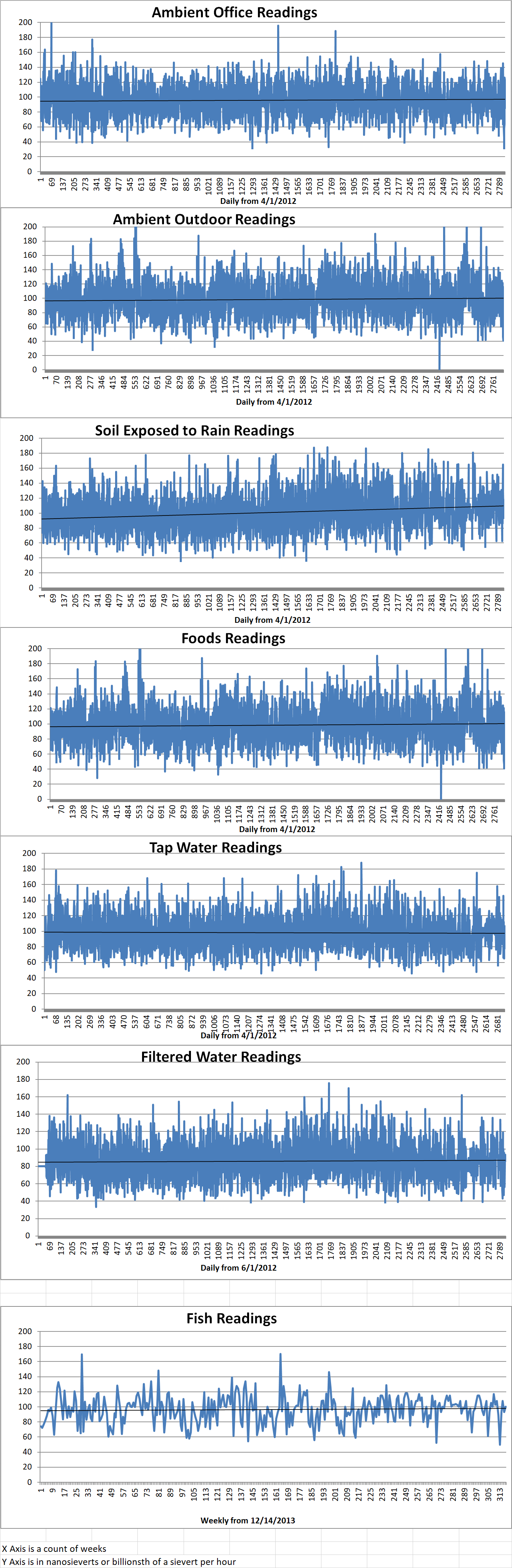
Geiger Readings for Mar 24, 2020
Ambient office = 86 nanosieverts per hour
Ambient outside = 98 nanosieverts per hour
Soil exposed to rain water = 100 nanosieverts per hour
Potato from Central Market = 116 nanosieverts per hour
Tap water = 100 nanosieverts per hour
Filtered water = 91 nanosieverts per hour
-

Radioactive Waste 757 – Viridian Develops The ViridiScope For Testing Irradiated Materials – Part 1 of 2 Part
Part 1 of 2 Parts
One very important capability that is critical to the nuclear industry is the ability to determine the constituents and the radioactivity of samples of a wide variety of types of materials. The ViridiScope is a new laser sampling tool that was developed to improve the characterization of materials in nuclear applications. It can replace mechanical drilling to remove materials from a surface so that they can be analyzed. Concrete, plastic, wood, plaster and brick can be quickly sampled and analyzed for the presence of a large variety of radionuclides and for the characterization of the other atomic elements in the sample. The new sampling device was developed by the Veridian Consultants in the U.K. during a collaboration with Sellafield that started in 2013.
The ViridiScope utilizes a laser to quickly remove up to a one hundred milligram sample from a surface. The operation takes around three minutes. The sample is then moved away from the sampling site through a sixty-foot line to a collection pod. In the pod, the sample is analyzed for alpha, beta and gamma emissions or further processed in order to characterize radionuclides and stable elements that are present.
The ViridiScope has been tested at five nuclear sites including a low level waste repository at Drigg, the Socotec analytical laboratory, an experimental Dragon reactor at Winfirth, a reactor being decommissioned at Trawsfynydd and an operational nuclear power plant at Hinkley Point. The five sites were selected to allow a broad test of different application of the ViridiScope including manual and remote sampling for alpha, beta and gamma activity determination, low level radioactivity detection, and analysis of hotspots with high radioactivity on floors, walls and ceilings.
Before it was deployed, the performance characteristics of ViridiScope for sampling concrete were tested. Concrete is commonly found around nuclear sites. It was assumed that the ViridiScope could also be used on a wide variety of materials including steel and graphite which are also common on nuclear sites.
Manual and remote operation of the ViridiScope was demonstrated in non-active areas of the Imperial College Consort Reactor at Berkshire, Sellafield in Cumbria, Amec Foster Wheeler and in an active field test at Sellafield.
ViridiScope was tested at an actual decommissioning site in November of 2016. For this test, ViridiScope was compared to drilling, taking swabs and scraping the surface being sampled. The ViridiScope allowed the researchers to make a preliminary assessment of radiation contamination issues, robustness of the equipment and ease of use. During testing with and without radioactivity being present, the potential customers gave important feedback to help improve the design and functionality of the device.
One big problem with introducing new equipment into the nuclear industry is that there is serious resistance to change. A great deal of effort had to be expended to overcome this change resistance and pave the way for acceptance of the new tool. Field tests were carried out in order to show potential customers that the tool was able to function properly in real-world situations with performance that was needed for a great variety of application areas.
Please read Part 2 next -
Nuclear News Roundup Mar 23, 2020
Bulgaria delays deadline for Belene nuclear project bids reuters.com
New Mexico Delegation Urges Nuclear Regulatory Commission To Extend Holtec Public Comment Period ladailypost.com
Moscow starts work on highway through nuclear waste site dw.com
Coronavirus pandemic could delay licensing of nuclear waste facility near Carlsbad currentargus.com
-

Geiger Readings for Mar 23, 2020
Ambient office = 99 nanosieverts per hour
Ambient outside = 94 nanosieverts per hour
Soil exposed to rain water = 93 nanosieverts per hour
White onion from Central Market = 92 nanosieverts per hour
Tap water = 103 nanosieverts per hour
Filtered water = 91 nanosieverts per hour
-
Nuclear News Roundup Mar 22, 2020
More Time Sought for Public Input on Nuclear Fuel Proposal usnews.com
Officials: Nuclear plant employees failed to check for fires Kentucky.com
French nuclear plants tighten hygiene procedures over coronavirus worries finance.yahoo.com
Trump’s callous sanctions risk tipping Iran over the nuclear precipice theguardian.com