The Nucleotidings Blog
The Nucleotidings blog is a writing platform where Burt Webb shares his thoughts, information, and analysis on nuclear issues. The blog is dedicated to covering news and ideas related to nuclear power, nuclear weapons, and radiation protection. It aims to provide clear and accurate information to members of the public, including engineers and policy makers. Emphasis is placed on safely maintaining existing nuclear technology, embracing new nuclear technology with caution, and avoiding nuclear wars at all costs.

Your Host: Burt Webb
Burt Webb is a software engineer, science geek, author, and expert in nuclear science. Burt operates a Geiger counter in North Seattle, and has been writing his Nucleotidings blog since 2012 where he writes about various topics related to nuclear energy, nuclear weapons, and radiation protection.

Burt Webb has published several technical books and novels. He works as a software consultant.

Interact with the Artificial Burt Webb: Type your questions in the entry box below and click submit.

Example Q&A with the Artificial Burt Webb

Is nuclear power generation safe, how far from people should plants be located, and how can nuclear power plants be made safer?

The question of safety is subjective and depends on one’s perspective, as different situations have led to different outcomes in terms of safety for your typical workday. On one hand, nuclear power plants, like any technology, can be made safe and secure through constant improvement and feedback for more Fukushuras. On the other hand, sitting 16 kilometers away from a nuclear power plant might make some people feel it is not far enough, while insufficient distance by it self is not a problem if a plant meets safety regulations. Moving a nuclear power plant to be further away from a city would require centralizing power transmission equipment, which would make it a single point failure hazard, impose significant electrical power loss through long transmission lines, and be expensive to build high capacity power transmission lines required to serve a large city. Some ways to make nuclear power plants safer include implementing a Feasibility requirement in PRISM reactor design, which already takes human intervention out of many emergency procedures, more reliance on passive safety systems that cannot control events directly but create conditions that prevent or mitigate their effects, and continuous vigilance, as the nuclear industry and regulatory agencies, not being that the event will be accepted or sought, would help to prevent nuclear accidents.

What do you mean by “Fukushuras”?

“Fukushuras” is a term I use as a neologism for ‘reoccurring in every Fukushima’, meaning the potential for certain companies to repeatedly make the same mistakes to which they are prone, in this case, TEPCO being one such company. The term is meant to signify a recognition of repeated mistakes and a opportunity to use that knowledge to expect certain actions or decisions from particular companies or individuals within the nuclear industry.

Blog

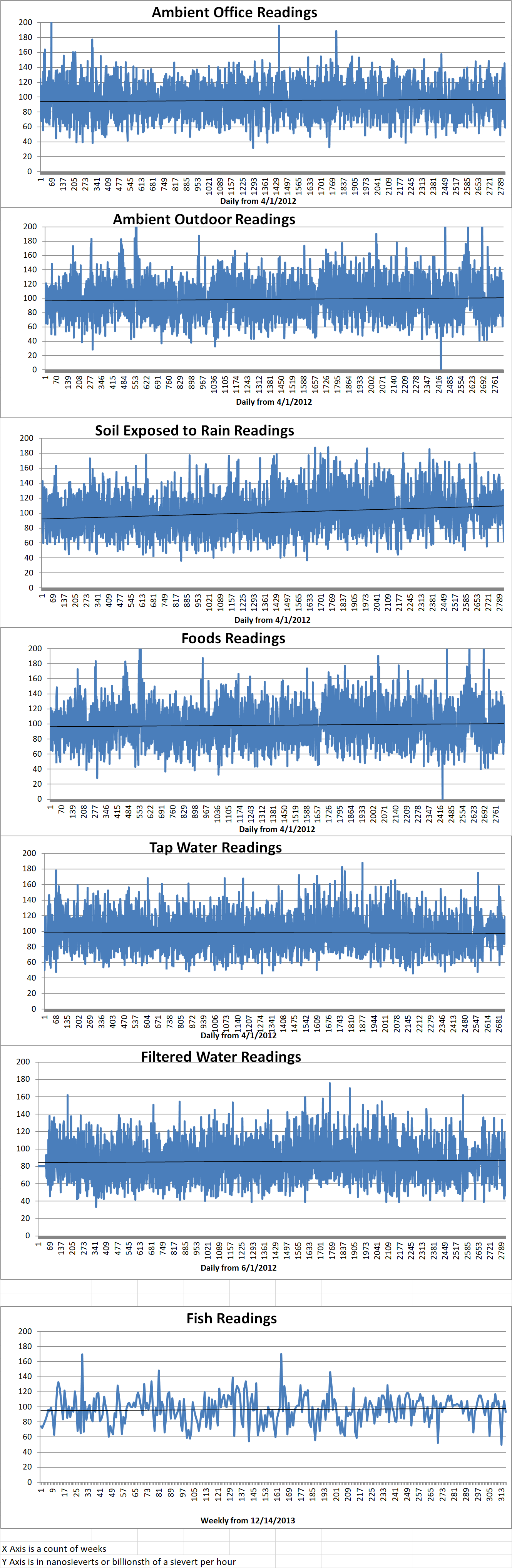
  • Geiger Readings for Mar 18, 2020

    Geiger Readings for Mar 18, 2020

    Ambient office  = 32nanosieverts per hour

    Ambient outside = 108 nanosieverts per hour

    Soil exposed to rain water = 108 nanosieverts per hour

    Blueberry from Central Market = 81 nanosieverts per hour

    Tap water = 78 nanosieverts per hour

    Filtered water = 56 nanosieverts per hour

  • Nuclear Fusion 68 – Breakthrough In Hydrogen Injection For Fusion Reactors – Part 1 of 2 Parts.

    Nuclear Fusion 68 – Breakthrough In Hydrogen Injection For Fusion Reactors – Part 1 of 2 Parts.

    Part 1 of 2 Parts
         Most of the articles I write about nuclear power generation are about nuclear fission reactors. This technology has been producing electricity for sixty year and there are about four hundred commercial power reactors in operation today producing about ten percent of world’s electricity. However, the high cost, long construction time, long lived nuclear waste and possibility of nuclear proliferation are all serious problems that are slowing the wide-spread adoption of nuclear power based on fission.
        Scientists are exploring a variety of technologies and fuels to produce a solution to the world’s energy needs that can be scaled rapidly enough to replace the world’s current dependence on fossil fuels before climate change reaches a point of no return. Solar concentrators and solar photovoltaic systems are evolving rapidly as are a variety of winds turbines. Geothermal and wave power are far behind wind and solar but are also evolving rapidly. Rapidly dropping costs for renewable alternatives are making it difficult to proceed with the construction of new fossil and nuclear power plants. The most promising yet most difficult new source of energy would be the creation of a competitive commercial nuclear fusion power reactor.
        The DIII-D National Fusion Facility (DNFF) is operated by General Atomic on behalf of the United States Department of Energy (DoE). The DNFF experiments with fusion initiated in a donut shaped vessel surrounded by magnets called a tokamak. Hydrogen gas is injected into the circular chamber. It is then heated and compressed by magnetic fields until it reaches conditions which allow the hydrogen atoms fuse into helium and produce huge amounts of energy. New research has aroused their interest in the use of pellets of hydrogen gas as another approach to creating fusion.
        A recent article in phys.org said, “The studies by physicists based at DOE’s Princeton Plasma Physics Laboratory (PPPL) and Oak Ridge National Laboratory (ORNL) compared the two methods, looking ahead to the fueling that will be used in [International Thermonuclear Experimental Reactor] ITER, the international fusion experiment under construction in France.”
        Fusion reactors that are fueled by hydrogen require a steady supply of hydrogen to supply the fusion reaction. The question of how best to supply this constant stream of hydrogen to a commercial fusion reactor is a major concern for those researching nuclear fusion. As test reactors are scaled up on the way to developing a commercial fusion reactor, the question of how to fuel them will be more and more important. The phys.org article goes on to say, “As fusion reactors get bigger and hotter it will become harder for the gas to penetrate into the core of the reactor where fusion reactions take place. New methods thus need to be developed to feed the fusion core without degrading the plasma performance.”
         The report on experiments that compared the traditional injection of room-temperature hydrogen gas with the insertion of hydrogen ice pellets indicates that despite what might be expected, it turns out the hydrogen ice pellets may actually be better for achieving the enormous temperatures that will be required to produce hydrogen fusion in a tokamak reactor.
    Please read Part 2 next

  • Geiger Readings for Mar 17, 2020

    Geiger Readings for Mar 17, 2020

    Mar 17

    Ambient office  = 46 nanosieverts per hour

    Ambient outside = 113 nanosieverts per hour

    Soil exposed to rain water = 115 nanosieverts per hour

    Tomato from Central Market = 109 nanosieverts per hour

    Tap water = 67 nanosieverts per hour

    Filtered water = 57 nanosieverts per hour

  • Nuclear Reactors 763 – South Africa Debates Extending License Of Their Only Nuclear Power Station – Part 2 of 2 Parts

    Nuclear Reactors 763 – South Africa Debates Extending License Of Their Only Nuclear Power Station – Part 2 of 2 Parts

    Part 2 pf 2 Parts (Please read Part 1 first)
        Of course, Eskom claims that their reactor are safe. However, Becker points out that one of the main safety mechanisms at Koeberg is a reliance on the national grid. “If the reactors need to be shut down for any reason, they no longer produce electricity. This means that to continue to operate the plant and to prevent the high-level waste stored at Koeberg from overheating and melting, electricity must be available to Koeberg from an external source.”
        Activists have been pleading for Koeberg to be shut down. Becker said that keeping Koeberg running is a serious risk. “With the current instability of the grid in South Africa, it is questionable whether it is worth taking the extra risk of keeping Koeberg running. We may think we are in a bad situation now, with the coronavirus outbreak, the economy and electricity shortages, but can you imagine if a nuclear incident at Koeberg – which required mass evacuation – was added to that?”

         De Gasparis has said that the latest problems at Koeberg are cause for serious concern because the plant will reach the end of its operating life in 2024. Eskom wants to keep it running until 2044. She said “While there have been upgrades to the plant, one has to question whether extending its life is the safest option for South Africans and an affordable option for the country’s energy needs.”
         The big question with respect to Koeberg is whether South Africans can really rely on the power utility to operate and safely maintain the Koeberg plant for an additional 20 years given Eskom’s appalling track record.
        De Gasparis says that “Safcei believes that the time has come for Eskom to move forward with decommissioning Koeberg, not extending its life. If we mean to adequately address climate change, Eskom should move to focus its attention to unlocking the potential of renewable energy and incorporating it more substantially.” Safcei submitted a statement to the Zondo Commission of Enquiry last year. It highlighted numerous allegations of poor decision-making and corruption against Eskom, which is compounding the suffering of South Africans.

        “The lack of ethical governance at the SOE in recent years must be addressed and citizens and businesses must start seeing culprits being brought to book. Citizens cannot continue to pay — through increased tariffs and ongoing, disruptive load shedding — for Eskom’s mistakes, while they run scot-free.” added de Gasparis in the submission.

         I have written before about secret negotiations of members of the SA government with Russia for a reactor construction deal. When the negotiations were revealed, it caused public outrage and turbulence in the government. The government official said that there were no deals being made with Russia and any tender for nuclear reactor construction would be handled properly and transparently.
         Since then, there has been a great deal of discussion about whether or not SA really needs to construct more nuclear reactors. It is questionable whether SA needs nuclear power in view of low energy demands and poor grid conditions. Nuclear power remains a major point of contention between anti-nuclear activist in SA and nuclear power promoting special interest groups such as Eskom.

  • Geiger Readings for Mar 16, 2020

    Geiger Readings for Mar 16, 2020

    Ambient office  = 58 nanosieverts per hour

    Ambient outside = 87 nanosieverts per hour

    Soil exposed to rain water = 86 nanosieverts per hour

    Yellow mini bell pepper from Central Market = 78 nanosieverts per hour

    Tap water = 90 nanosieverts per hour

    Filtered water = 9 nanosieverts per hour

  • Geiger Readings for Mar 15, 2020

    Geiger Readings for Mar 15, 2020

    Ambient office  = 59 nanosieverts per hour

    Ambient outside = 96 nanosieverts per hour

    Soil exposed to rain water = 97 nanosieverts per hour

    Yellow bell pepper from Central Market = 76 nanosieverts per hour

    Tap water = 119 nanosieverts per hour

    Filtered water = 96 nanosieverts per hour