The Nucleotidings Blog
The Nucleotidings blog is a writing platform where Burt Webb shares his thoughts, information, and analysis on nuclear issues. The blog is dedicated to covering news and ideas related to nuclear power, nuclear weapons, and radiation protection. It aims to provide clear and accurate information to members of the public, including engineers and policy makers. Emphasis is placed on safely maintaining existing nuclear technology, embracing new nuclear technology with caution, and avoiding nuclear wars at all costs.

Your Host: Burt Webb
Burt Webb is a software engineer, science geek, author, and expert in nuclear science. Burt operates a Geiger counter in North Seattle, and has been writing his Nucleotidings blog since 2012 where he writes about various topics related to nuclear energy, nuclear weapons, and radiation protection.

Burt Webb has published several technical books and novels. He works as a software consultant.

Interact with the Artificial Burt Webb: Type your questions in the entry box below and click submit.

Example Q&A with the Artificial Burt Webb

Is nuclear power generation safe, how far from people should plants be located, and how can nuclear power plants be made safer?

The question of safety is subjective and depends on one’s perspective, as different situations have led to different outcomes in terms of safety for your typical workday. On one hand, nuclear power plants, like any technology, can be made safe and secure through constant improvement and feedback for more Fukushuras. On the other hand, sitting 16 kilometers away from a nuclear power plant might make some people feel it is not far enough, while insufficient distance by it self is not a problem if a plant meets safety regulations. Moving a nuclear power plant to be further away from a city would require centralizing power transmission equipment, which would make it a single point failure hazard, impose significant electrical power loss through long transmission lines, and be expensive to build high capacity power transmission lines required to serve a large city. Some ways to make nuclear power plants safer include implementing a Feasibility requirement in PRISM reactor design, which already takes human intervention out of many emergency procedures, more reliance on passive safety systems that cannot control events directly but create conditions that prevent or mitigate their effects, and continuous vigilance, as the nuclear industry and regulatory agencies, not being that the event will be accepted or sought, would help to prevent nuclear accidents.

What do you mean by “Fukushuras”?

“Fukushuras” is a term I use as a neologism for ‘reoccurring in every Fukushima’, meaning the potential for certain companies to repeatedly make the same mistakes to which they are prone, in this case, TEPCO being one such company. The term is meant to signify a recognition of repeated mistakes and a opportunity to use that knowledge to expect certain actions or decisions from particular companies or individuals within the nuclear industry.

Blog

  • Geiger Readings for Feb 03, 2020

    Geiger Readings for Feb 03, 2020

    Ambient office  = 72 nanosieverts per hour

    Ambient outside = 122 nanosieverts per hour

    Soil exposed to rain water = 119 nanosieverts per hour

    Tomato from Central Market = 103 nanosieverts per hour

    Tap water = 139 nanosieverts per hour

    Filtered water = 120 nanosieverts per hour

  • Geiger Readings for Feb 02, 2020

    Geiger Readings for Feb 02, 2020

    Ambient office  = 60 nanosieverts per hour

    Ambient outside = 112 nanosieverts per hour

    Soil exposed to rain water = 108 nanosieverts per hour

    White onion from Central Market = 130 nanosieverts per hour

    Tap water = 119 nanosieverts per hour

    Filtered water = 104 nanosieverts per hour

  • Geiger Readings for Feb 01, 2020

    Geiger Readings for Feb 01, 2020

    Ambient office  = 98 nanosieverts per hour

    Ambient outside = 120 nanosieverts per hour

    Soil exposed to rain water = 119 nanosieverts per hour

    Red bell pepper from Central Market = 115 nanosieverts per hour

    Tap water = 136 nanosieverts per hour

    Filtered water = 118 nanosieverts per hour

    Dover sole – Caught in USA = 103 nanosieverts per hour

  • Nuclear Reactors 751 – Russian Scientists Are Working On A Hybrid Fusion-Fission Reactor Design That Uses Thorium As A Fuel.

    Nuclear Reactors 751 – Russian Scientists Are Working On A Hybrid Fusion-Fission Reactor Design That Uses Thorium As A Fuel.

         A collaboration of Russian scientists at Tomsk Polytechnic University, All-Russian Scientific Research Institute of Technical Physics (VNIITF), and Budker Institute of Nuclear Physics of SB RAS has just published a report on a new type of nuclear reactor. The reactor is what is being called a “hybrid” reactor. It utilizes both nuclear fusion and nuclear fission to generate power. Most of the fuel for this new reactor is thorium. Computer simulations of the new design have been run. They show that an “energy-generating blanket” would be able to produce high power in a small footprint and it would not generate much radioactive waste.
        This new reactor design offers middle-ground solutions with respect to fuel, reactor design and safety. Thorium is one of the most abundant elements of its kind. It is more abundant that tin which is very common and accessible. On the other hand, uranium which is the primary nuclear fuel today is not rare but it is also not readily and easily available.
         The hybrid thorium reactor uses thorium-plutonium pellets in a high-temperature, gas cooled reactor. The published report about the new design does not say which specific gas is used for cooling but both carbon dioxide and helium gases have been used in other reactor designs for cooling. Gas cooled reactors offer a way in which unenriched uranium can be used to generate power. This makes such reactors more accessible and affordable to many countries that do not have the capacity to enrich uranium. This new thorium reactor design could offer the same benefits.
        Experts say that a subcritical reactor is safer than a critical reactor because it requires less containment and safeguards. Thorium is way less reactive and explosive than uranium or plutonium.
         The reactor is relatively small when compared to conventional light water nuclear power reactors. The plasma chamber is only about forty feet long. Combining a fusion reaction with a fission reaction maximized the efficiency of the reactor. It will be much simpler to develop this technology than a tokamak pure fusion reactor.
    There will be less time necessary to reach full operation and it will be less volatile once in operation.
        Andrei Arzhannikov is a chief researcher of Budker Institute of Nuclear Physics of SB RAS. He said “At the initial stage, we get relatively cold plasma using special plasma guns. We retain the amount by deuterium gas injection. The injected neutral beams with particle energy of 100 keV into this plasma generate the high-energy deuterium and tritium ions and maintain the required temperature. Colliding with each other, deuterium and tritium ions are combined into a helium nucleus so high-energy neutrons are released. These neutrons can freely pass through the walls of the vacuum chamber, where the plasma is held by a magnetic field, and entering the area with nuclear fuel. After slowing down, they support the fission of heavy nuclei, which serves as the main source of energy released in the hybrid reactor.”
        Igor Shamanin is the head of the TPU Division of Natural Sciences and the TPU Isotope Analysis and Technology Laboratory. He said, “The hybrid reactor consists of two elements. The main part is the energy-generating blanket as the active zone of a nuclear reactor. It distributes nuclear fissile material that is part of nuclear fuel. Due to this, a fission chain reaction of heavy nuclei is possible. The second part is placed inside the blanket to generate neutrons that fall into the energy-generating blanket. The thermonuclear fusion reactions are generated inside this part filled with deterium plasma, releasing the neutrons. A feature of the hybrid reactor is that the operating blanket, where the fission reactions take place, is in the subcritical state (near-critical). Operating at a constant power level, a conventional reactor is in a critical condition, supported by a control and safety system.”

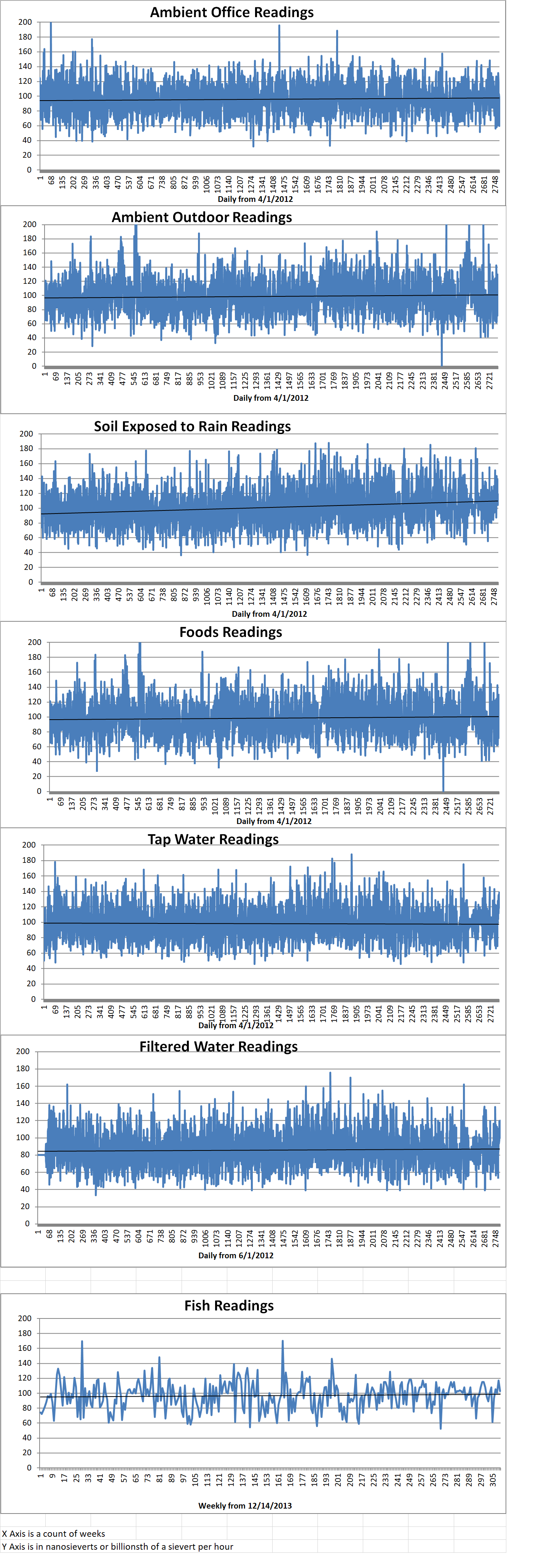
  • Geiger Readings for Jan 31, 2020

    Geiger Readings for Jan 31, 2020

    Ambient office  = 103 nanosieverts per hour

    Ambient outside = 105 nanosieverts per hour

    Soil exposed to rain water = 104 nanosieverts per hour

    Avocado from Central Market = 72 nanosieverts per hour

    Tap water = 112 nanosieverts per hour

    Filtered water = 100 nanosieverts per hour

  • Radioactive Waste 435 – Some Uses For Radioactive Waste – Part 2 of 2 Parts

    Radioactive Waste 435 – Some Uses For Radioactive Waste – Part 2 of 2 Parts

    Part 2 of 2 Parts (Please read Part 1 first)
    Depleted Uranium
        Another major product of the nuclear power industry is depleted uranium. This is the uranium left over after the ratio of fissile U-235 to non-fissile U-238 is increased from low natural levels to three to five percent. This byproduct is mainly U-238 and is less radioactive than natural uranium ore because the U-235 has been removed.
         Depleted uranium is a heavy, dense metal which makes it useful for military applications. One of these applications is anti-tank ammunition. Depleted uranium shells have excellent penetration ability and can blast through tank armor. When depleted uranium hits a target, it flakes off as it passes through the armor and the projectile stays sharp. The cloud of depleted uranium particles is ignited by the heat of the impact. One big concern about this use is the fact that depleted uranium dust is spread around the battlefield and can be a threat to public health.
        Another application for depleted uranium is in chemical processing. Researchers at the University of Sussex in the U.K. have been able to create a catalyst from depleted uranium which can help convert ethylene into ethane. This is a common chemical process using other methods but it is a novel application for depleted uranium.
        There are thousands of tons of depleted uranium in stockpiles around the world. This new use in chemical processing would be preferable to either storing it or using it in warfare. It does have to be handled carefully because although it is not very radioactive, it could still pose a health threat.
    Remaining Roadblocks
        There are still multiple issues of concern in the repurposing of nuclear waste. In many cases, the uses proposed here could result in nuclear waste materials being stolen or diverted adding to the risk of nuclear proliferation.
        It only takes a few pounds of plutonium to make a nuclear warhead. If nuclear waste is reprocessed on industrial scales, the amount needed for a nuclear bomb could easily be stolen or diverted without being noticed. It is a serious problem that depends on the exact isotopes and processes in use. Currently, spent nuclear fuel from light water reactors is too hot to be easily handled which reduces the risk of theft or diversion. However, technologies such as the reprocessing of spent nuclear fuel could be adapted to producing weapons-grade nuclear materials which undesirable.
         Another issue that has been raised is that recycling and/or reprocessing of nuclear fuel could divert interest and resources from the quest for permanent geological repositories for spent nuclear fuel. Many countries that use nuclear power and produce spent nuclear fuel have been slow to create viable long-term disposal methods for such waste. Considering the danger from long-lived isotopes in spent nuclear fuel, creating such long-terms storage should be a priority.
    Final Thoughts
        The powerful radioactivity and dangerous nature of nuclear waste raises many challenges for countries that use nuclear power. The way in which this waste is currently handled is to let the stockpiles build up while the debate about ultimate solutions goes on and on. It would be best if new technologies were developed to deal with nuclear waste in a safe and efficient manner. In the meantime, there are a host of difficult political decisions that must be made with respect to the use of nuclear power.