
Part 2 of 2 Parts (Please read Part 1 first)
Since San Onofre was shut down in 2012, the spent nuclear fuel has been cooling in the cooling pools. Lyman points out that the dry casks at Fukushima were not cracked open the earthquake and tsunami in March of 2011. The dry casks at Fukushima are not exactly the same design as the casks at San Onofre and there is no way to easily compare exactly what tsunamis at the two sites would do to dry casks. However, the integrity of the casks at Fukushima is an indication of the general safety of the dry cask system.
Southern California Edison hope that all the spent nuclear fuel at San Onofre would be transferred to casks by the end of this year. Unfortunately, there were some accidents with loading the casks that forced a reevaluation of the design of the casks and the loading procedures. After loading procedures were revamped, loading of casks was authorize by the NRC this May. Restarting the loading process has not yet been scheduled.
The epicenters of the earthquakes on July 4th and 5th near Ridgecrest, California were about one hundred and sixty-five miles from San Onofre. There was some minor ground movement and shaking experienced by the plant. Inspections following the earthquakes did not find any damage.
In 2017, a study was conducted on folds and faults in the ocean floor near the San Onofre plant. The study found that The Newport-Inglewood/Rose Canyon fault zone runs between Newport Beach and La Jolla. The fault is broken into four segments which are separated by “step-overs.” Unfortunately, these step-overs are not big enough to prevent a fracture from running the entire length of the fault. It would be possible for the Newport-Inglewood/Rose Canyon fault zone to rupture from end to end with a maximum reading of 7.3 on the Richter scale.
David Lochbaum recently retired from his position at the Union of Concerned Scientists. He has been studying the situation at San Onofre closely for years. He had raised concerns that a landslide could threaten the dry cask storage system at San Onofre. This concern was laid to rest when topographic maps of the dry storage site indicated that landslides were not a possibility.
Lochbaum is also concerned about the possibility of deliberate sabotage at San Onofre. Holtec says that their casks were designed after the 911 attack in New York in 2001. They believe that their casks are better suited than their competitors casks to protect their contents from suicide aircraft, bombs carried in trucks and other possible attempts at sabotage. Lochbaum said in an email, “Bottom line — I am not worried about a seismic threat to spent fuel at San Onofre. I believe sabotage to be the primary hazard, especially now that SCE and NRC have taken steps to lessen the hazard from self-inflicted events.”
There are still widespread concerns among the people who live in the area around San Onofre. And most people and agencies hope that the federal government will move forward with a permanent geological repository for spent nuclear fuel as quickly as possible. Lyman said, “Ultimately, spent nuclear fuel should be moved from interim storage to a deep geologic repository where it will be less vulnerable to natural disasters of all type.”
Blog
-

Radioactive Waste 399 – What Effect Would A Major Earthquake Have On The San Onofre Nuclear Generating Station – Part 2 of 2 Parts
-

Geiger Readings for Jul 09, 2019
Ambient office = 128 nanosieverts per hour
Ambient outside = 117 nanosieverts per hour
Soil exposed to rain water = 119 nanosieverts per hour
Vine ripened tomato from Central Market = 120 nanosieverts per hour
Tap water = 106 nanosieverts per hour
Filtered water = 96 nanosieverts per hour
-

Radioactive Waste 398 – What Effect Would A Major Earthquake Have On The San Onofre Nuclear Generating Station – Part 1 of 2 Parts
Part 1 of 2 Parts
I have written about the San Onofre Nuclear Generating Station near San Diego, California on a number of occasions. The plant had to be shut down permanently after new steam generators were installed that caused vibrations which cracked pipes. There has been a lot of confusion and court battlers over who was responsible for the problem with the steam generators.
Now that the plant is shut down, the spent nuclear fuel must be disposed of. This has triggered a new set of arguments and lawsuits over whether the spent nuclear fuel should be stored in dry casks near the plant or trucked somewhere else in the U.S. for disposal.
In view of the serious earthquakes in Southern California last week, a new question has arisen with respect to the shuttered San Onofre nuclear power plant. What would happen to the plant if there was powerful earthquake in the vicinity of the plant. The impact of such a quake would depend on exactly where the epicenter of the quake was located, how deep the quake was and how much shaking the plant experienced.
Even the worst imaginable quake would not be able to cause a meltdown because the reactors have been shut down and the nuclear fuel removed. The danger lies in the fate of the three million six hundred thousand pounds of highly radioactive spent nuclear fuel. Currently, most of the spent nuclear fuel at San Onofre is cooling in the spent fuel cooling pools near the reactors. The spent fuel pools are much more vulnerable to the elements than the dry casks to which the spent nuclear fuel is being transferred. It is probable that after the spent nuclear fuel has all been moved into the dry casks, it will stay there for decades until a geological storage facility for spent nuclear fuel can be sited and constructed in the U.S. The earliest that such a new repository could be available is estimated to be 2050.
While the spent fuel cooling pools require electricity and a flow of water to keep the spent nuclear fuel cool, the dry casks do not. Power outages caused by earthquakes and other natural disaster, accidents or sabotage could endanger the function of the cooling pools. Such power outages pose no threat to the dry casks which are referred to as passive storage systems.
The San Onofre dry storage system uses huge slabs of concrete which are designed to be able to withstand twice the shaking as the designs for the cooling pools and the reactors. In the dry cask storage system, spent nuclear fuel and other radioactive wastes are placed in steel cylinders encased in concrete. These casks are provided by Holtec International and Areva. There are arguments over how thick the sides of the steel cylinders should be, but everyone agrees that Southern California will be much safer when the spent nuclear fuel has all be transferred to the dry casks.
Edwin Lyman is acting director of the Nuclear Safety Project with the nonpartisan and nonprofit Union of Concerned Scientists in Washington, D.C. He said, “I am more worried about the spent fuel left in the pools at San Onofre than about the fuel that has been transferred to dry casks. If a large earthquake tore the liner of a pool, causing a rapid loss of cooling water, there is a risk of a spent fuel pool fire that could cause a large dispersal of radioactive material. Although the risk decreases as the spent fuel cools and the pools empty out, it does not go to zero as long as there is fuel in the pools.”
Please read Part 2 -

Geiger Readings for Jul 08, 2019
Ambient office = 61 nanosieverts per hour
Ambient outside = 89 nanosieverts per hour
Soil exposed to rain water = 83 nanosieverts per hour
English cucumber from Central Market = 151 nanosieverts per hour
Tap water = 125 nanosieverts per hour
Filtered water = 112 nanosieverts per hour
-

Geiger Readings for Jul 07, 2019
Ambient office = 88 nanosieverts per hour
Ambient outside = 104 nanosieverts per hour
Soil exposed to rain water = 100 nanosieverts per hour
Eggplant from Central Market = 100 nanosieverts per hour
Tap water = 93 nanosieverts per hour
Filtered water = 87 nanosieverts per hour
-
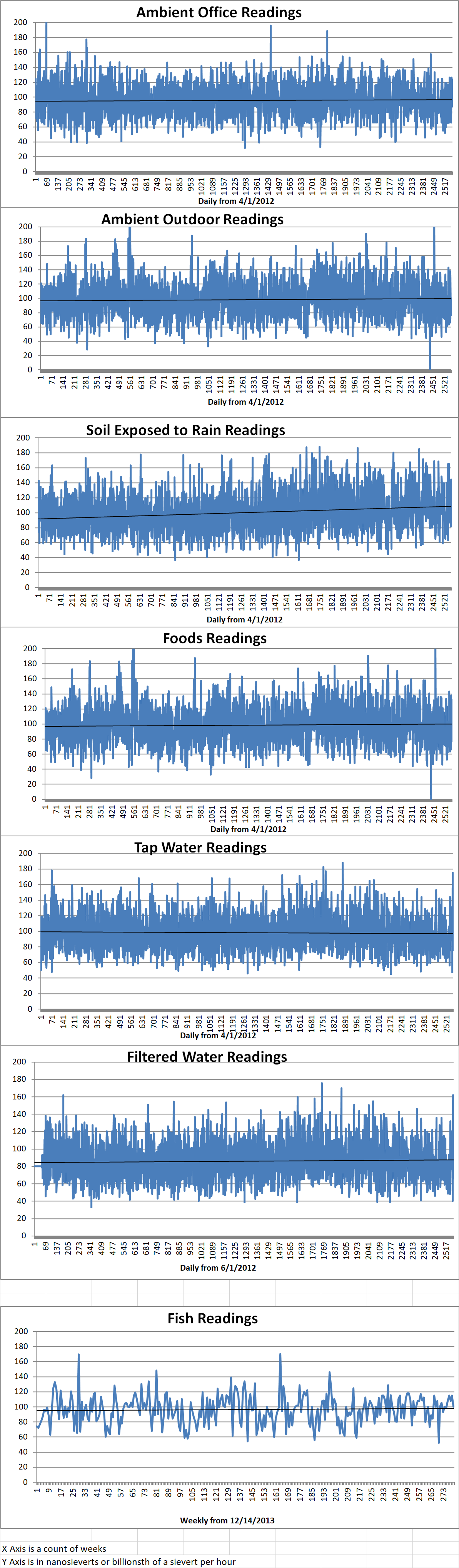
Geiger Readings for Jul 06, 2019
Ambient office = 123 nanosieverts per hour
Ambient outside = 119 nanosieverts per hour
Soil exposed to rain water = 121 nanosieverts per hour
Shallot from Central Market = 100 nanosieverts per hour
Tap water = 76 nanosieverts per hour
Filtered water = 66 nanosieverts per hour
Dover sole – Caught in USA = 100 nanosieverts per hour