
Nuclear power is helping to drive the climate crisis. Theguardian.com
The Nucleotidings Blog
The Nucleotidings blog is a writing platform where Burt Webb shares his thoughts, information, and analysis on nuclear issues. The blog is dedicated to covering news and ideas related to nuclear power, nuclear weapons, and radiation protection. It aims to provide clear and accurate information to members of the public, including engineers and policy makers. Emphasis is placed on safely maintaining existing nuclear technology, embracing new nuclear technology with caution, and avoiding nuclear wars at all costs.
Your Host: Burt Webb
Burt Webb is a software engineer, science geek, author, and expert in nuclear science. Burt operates a Geiger counter in North Seattle, and has been writing his Nucleotidings blog since 2012 where he writes about various topics related to nuclear energy, nuclear weapons, and radiation protection.
Burt Webb has published several technical books and novels. He works as a software consultant.
Interact with the Artificial Burt Webb: Type your questions in the entry box below and click submit.
Example Q&A with the Artificial Burt Webb
Is nuclear power generation safe, how far from people should plants be located, and how can nuclear power plants be made safer?
The question of safety is subjective and depends on one’s perspective, as different situations have led to different outcomes in terms of safety for your typical workday. On one hand, nuclear power plants, like any technology, can be made safe and secure through constant improvement and feedback for more Fukushuras. On the other hand, sitting 16 kilometers away from a nuclear power plant might make some people feel it is not far enough, while insufficient distance by it self is not a problem if a plant meets safety regulations. Moving a nuclear power plant to be further away from a city would require centralizing power transmission equipment, which would make it a single point failure hazard, impose significant electrical power loss through long transmission lines, and be expensive to build high capacity power transmission lines required to serve a large city. Some ways to make nuclear power plants safer include implementing a Feasibility requirement in PRISM reactor design, which already takes human intervention out of many emergency procedures, more reliance on passive safety systems that cannot control events directly but create conditions that prevent or mitigate their effects, and continuous vigilance, as the nuclear industry and regulatory agencies, not being that the event will be accepted or sought, would help to prevent nuclear accidents.
What do you mean by “Fukushuras”?
“Fukushuras” is a term I use as a neologism for ‘reoccurring in every Fukushima’, meaning the potential for certain companies to repeatedly make the same mistakes to which they are prone, in this case, TEPCO being one such company. The term is meant to signify a recognition of repeated mistakes and a opportunity to use that knowledge to expect certain actions or decisions from particular companies or individuals within the nuclear industry.
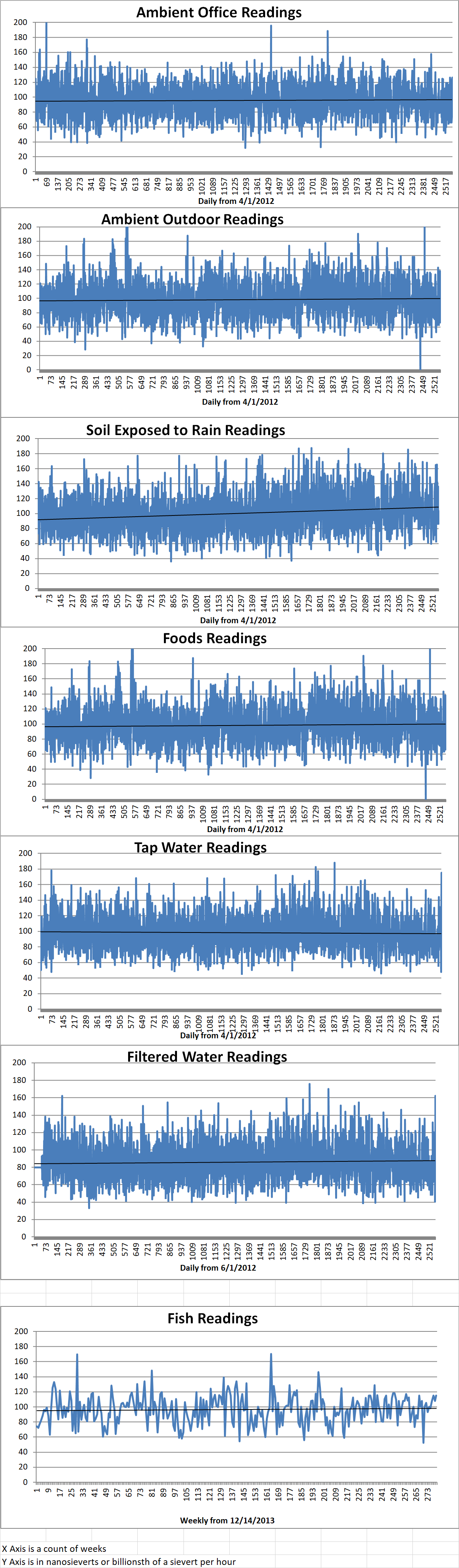
Ambient office = 99 nanosieverts per hour
Ambient outside = 108 nanosieverts per hour
Soil exposed to rain water = 103 nanosieverts per hour
Carrot from Central Market = 73 nanosieverts per hour
Tap water = 175 nanosieverts per hour
Filtered water = 162 nanosieverts per hour
I compiled a list of problems with nuclear energy and posted it on this blog. There are many reasons that nuclear fission is not the answer to our energy needs or to climate change mitigation. One reason I keep coming back to is that nuclear fission is just too expensive and it will ultimately price itself out of the market.
The nuclear industry is in serious trouble in the U.S. More reactors are being retired than are being built. There is a trend toward state and federal subsidies to keep our nuclear power plants operating in the face of stiff competition from cheap oil and natural gas as well as wind and solar renewable sources.
Constructing a new nuclear power plant is very expensive and operating costs are high. The Bulletin of Atomic Scientists (BAS) says “capital costs include site preparation, engineering, manufacturing, construction, commissioning, and financing. Operating costs include fuel costs (from uranium mining to fuel fabrication), maintenance, decommissioning, and waste disposal.” The cost of a nuclear power plant is considerably higher than that of a fossil fuel plant and the cost of wind and solar installations is dropping rapidly. The very high cost of a nuclear power plant makes nuclear power uncompetitive in the U.S. energy market. The flood of cheap natural gas has basically priced nuclear power out of the market.
For those who support the use of nuclear power as a low carbon energy source of base load power, the challenge is to find a way to make it more affordable. The BAS suggests that standardized designs and small modular reactors can help to lower costs.
Up to this point in time there has not been a standardized design for new nuclear power plants in the U.S. New technological developments and varied environmental conditions have caused designs to change with time. If a way could be found to standardized designs, it would substantially lower construction costs not just in the U.S. but in the global energy market. This may be the “most effective way to reduce the total price of nuclear energy.”
Small modular reactors are nuclear reactors that generate three hundred megawatts or less of electricity. Many analysts believe that the development of standardized small reactors that can be built offsite in a factory and then assembled onsite could be a decisive way to lower construction costs. The BAS says “Because of their small size and relative design simplicity, it is feasible to build modules primarily in a factory setting and then transport the completed modules to the plant site for installation. This would significantly improve construction efficiency and reduce capital costs. These simplified reactors are also expected to have lower operating and maintenance costs. Due to the higher surface-to-volume ratio for these reactors compared with traditional reactors, many safety provisions for heat removal are unnecessary.”
If nuclear power has any hope of being competitive in the U.S. in the future, the nuclear industry will have to start implementing strategies such as standardization and modularity immediately.
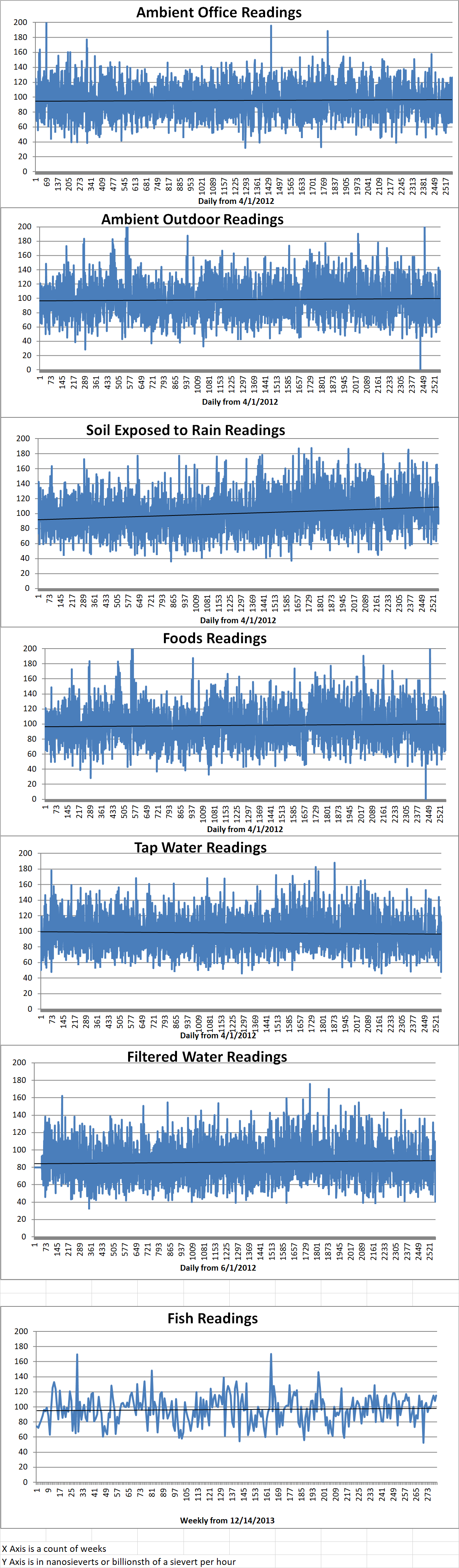
Ambient office = 126 nanosieverts per hour
Ambient outside = 103 nanosieverts per hour
Soil exposed to rain water = 103 nanosieverts per hour
Beefsteak tomato from Central Market = 94 nanosieverts per hour
Tap water = 73 nanosieverts per hour
Filtered water = 66 nanosieverts per hour
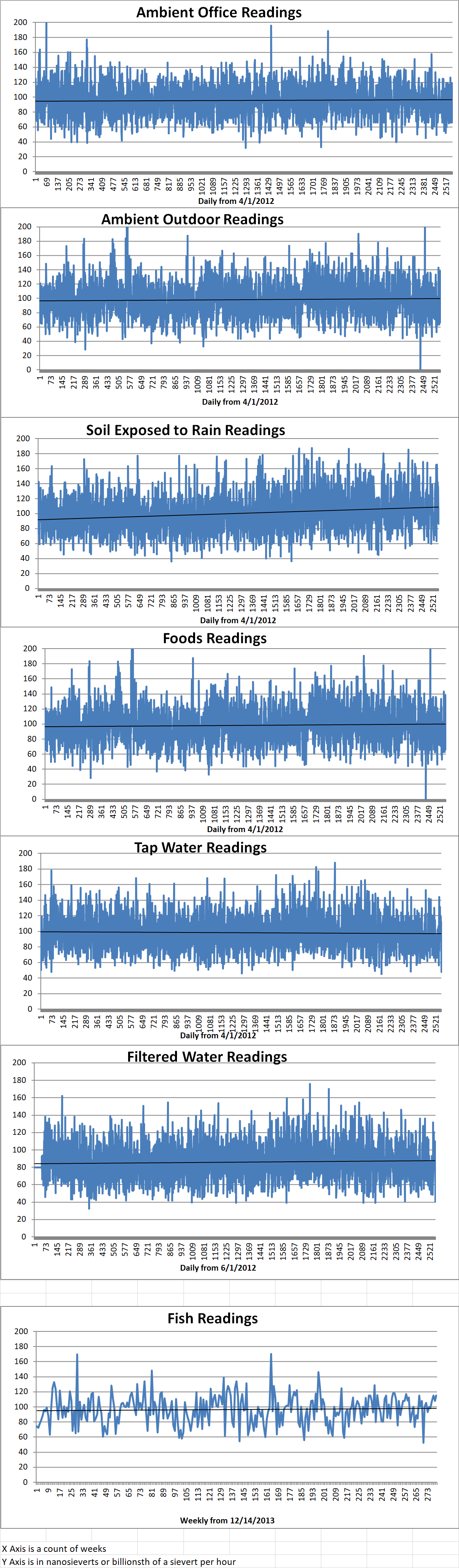
Ambient office = 119 nanosieverts per hour
Ambient outside = 86 nanosieverts per hour
Soil exposed to rain water = 86 nanosieverts per hour
Blueberry from Central Market = 138 nanosieverts per hour
Tap water = 48 nanosieverts per hour
Filtered water = 40 nanosieverts per hour
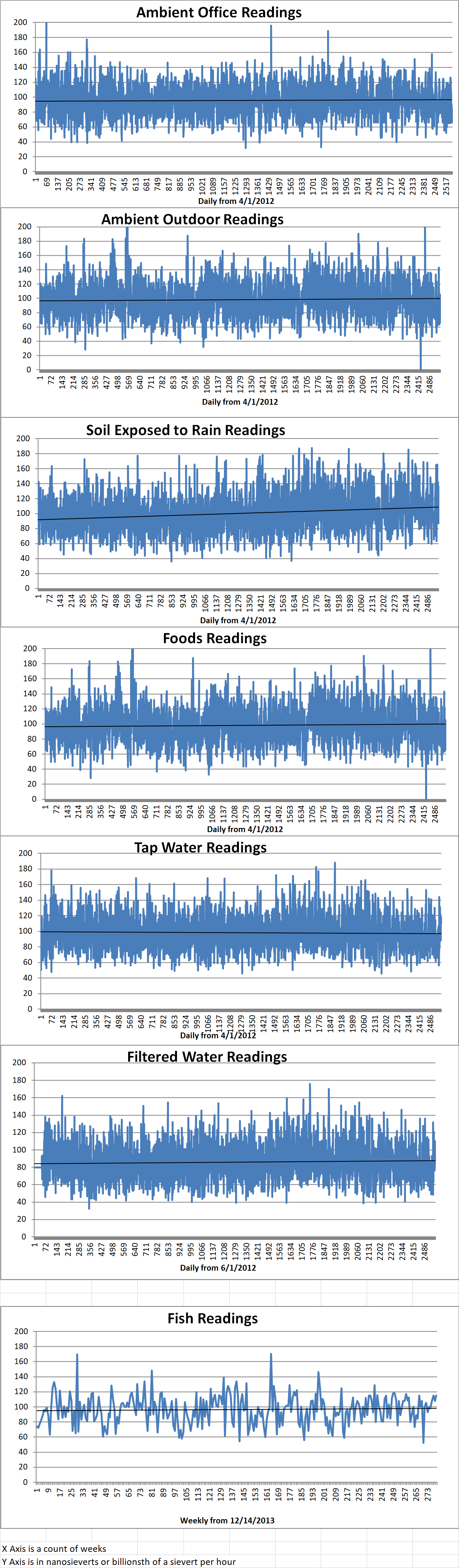
Ambient office = 74 nanosieverts per hour
Ambient outside = 108 nanosieverts per hour
Soil exposed to rain water = 108 nanosieverts per hour
Red bell pepper from Central Market = 66 nanosieverts per hour
Tap water = 112 nanosieverts per hour
Filtered water = 100 nanosieverts per hour
Dover sole – Caught in USA = 115 nanosieverts per hour
The Massachusetts Institute of Technology has been involved in nuclear fusion research for over twenty five years. Dennis Whyte is the head of MIT’s Plasma Science and Fusion Center. In 2014 he taught a class whose class project was aimed at reducing the cost of nuclear fusion reactors. The class developed a new fusion reactor design that they called “ARC” which stands for affordable, robust and compact. Unfortunately, the cost estimate for the ARC reactor was still a few billion dollars which was considered to be rather high to attract investors. The class continued working to develop a reactor design which would be the cheapest possible design for a fusion reactor that would produce more energy than it consumed.
Commonwealth Fusion Systems (CFS) is a private startup that is result of the work by Dennis Whyte’s class. CFS received its first sixty-four million dollars from several investors. These investors include Eni, an Italian energy company, Breakthrough Energy Ventures, a consortium of some of the world’s richest individuals and The Engine, an MIT program dedicated to investing frontier technologies. Another fifty million dollars has just been raised from Future Ventures, Chris Sacca’s Lowercase Capital, Moore Strategic Ventures, Safar Partners, Schooner Capital and Starlight Ventures.
CFS hopes to have its smallest possible nuclear fusion reactor built by 2025. One of the key elements of the new CFS fusion reactor is reliance on proprietary magnetic technology for plasma confinement developed at MIT.
Bob Mumgaard is the chief executive of Commonwealth Fusion Systems. He says, “CFS is on track to commercialize fusion and deliver an inherently safe, globally scalable, carbon-free, and limitless energy source.” The goal for the first CFS reactor is to produce fifty megawatts of electricity. Their next goal will be a model that can generate two hundred megawatts of electricity.
Mumgaard says that “The hazard profile of fusion continues to put it in [the category of] an industrial facility. The laws exist, but we haven’t gone out and built the plant yet, so no one has the precedent. You have to keep track of moving towards vs. going to get to. The consensus is we do not have a solution in hand for deep decarbonization of the electricity grid. if you look at where the biggest gains even in renewables. the biggest gains are in the utility scale where you’re talking hundreds of megawatts of power per site.” Mumgaard does not believe that renewable sources of energy can provide the huge energy demand of modern cities.
Steve Jurvetson is the chief executive of Future Ventures. In a recent statement, Jurvetson said, “We have been looking for the right clean energy investment opportunity in fusion for the past 20 years. We wanted a company that was ready to make a business of fusion and we have finally found it with Commonwealth Fusion Systems. The hard science from which their approach is based has been proven by this team as well as leaders in the field around the world. With some clever engineering, CFS is ready to harness the power of the solar cycle to change the world and usher in the era of clean baseload energy generation for the betterment of all.”