
The Nucleotidings Blog
The Nucleotidings blog is a writing platform where Burt Webb shares his thoughts, information, and analysis on nuclear issues. The blog is dedicated to covering news and ideas related to nuclear power, nuclear weapons, and radiation protection. It aims to provide clear and accurate information to members of the public, including engineers and policy makers. Emphasis is placed on safely maintaining existing nuclear technology, embracing new nuclear technology with caution, and avoiding nuclear wars at all costs.
Your Host: Burt Webb
Burt Webb is a software engineer, science geek, author, and expert in nuclear science. Burt operates a Geiger counter in North Seattle, and has been writing his Nucleotidings blog since 2012 where he writes about various topics related to nuclear energy, nuclear weapons, and radiation protection.
Burt Webb has published several technical books and novels. He works as a software consultant.
Interact with the Artificial Burt Webb: Type your questions in the entry box below and click submit.
Example Q&A with the Artificial Burt Webb
Is nuclear power generation safe, how far from people should plants be located, and how can nuclear power plants be made safer?
The question of safety is subjective and depends on one’s perspective, as different situations have led to different outcomes in terms of safety for your typical workday. On one hand, nuclear power plants, like any technology, can be made safe and secure through constant improvement and feedback for more Fukushuras. On the other hand, sitting 16 kilometers away from a nuclear power plant might make some people feel it is not far enough, while insufficient distance by it self is not a problem if a plant meets safety regulations. Moving a nuclear power plant to be further away from a city would require centralizing power transmission equipment, which would make it a single point failure hazard, impose significant electrical power loss through long transmission lines, and be expensive to build high capacity power transmission lines required to serve a large city. Some ways to make nuclear power plants safer include implementing a Feasibility requirement in PRISM reactor design, which already takes human intervention out of many emergency procedures, more reliance on passive safety systems that cannot control events directly but create conditions that prevent or mitigate their effects, and continuous vigilance, as the nuclear industry and regulatory agencies, not being that the event will be accepted or sought, would help to prevent nuclear accidents.
What do you mean by “Fukushuras”?
“Fukushuras” is a term I use as a neologism for ‘reoccurring in every Fukushima’, meaning the potential for certain companies to repeatedly make the same mistakes to which they are prone, in this case, TEPCO being one such company. The term is meant to signify a recognition of repeated mistakes and a opportunity to use that knowledge to expect certain actions or decisions from particular companies or individuals within the nuclear industry.
For decades, there has been an unstable balance between various nuclear arsenals of countries that are hostile to each other. During the Cold War, the U.S. and the Soviet Union kept careful track of nuclear weapons possessed by the other and raced each other to keep up with perceived changes in threats. There have been a number of international nuclear weapons reduction treaties aimed at stopping this race to have nuclear superiority.
One big issue was the problem of anti-missile systems. If your enemy saw you building a system that could stop their missiles, then they might be afraid that you intended to attack them when your anti-missile system was completed. Recently, China declared that the anti-missile system that the U.S. is installing in South Korea could upset the nuclear deterrent balance in the South China Sea. Russia in threatening to put intermediate range nuclear missiles in Kalingrad in Eastern Europe to counter balance the anti-missile system that the U.S. is installing in Romania. Russia is developing what are called hypersonic reentry vehicles for nuclear warheads specifically to defeat anti-missile defense systems.
The U.S. is worried about Russian work on robot submersible drones that could carry nuclear warheads up to the coast of the continental U.S. with little possibility of interception. The Russians are worried about the new nuclear bomb being developed by the U.S. as a tactical nuclear weapon. The new bomb is steerable and highly accurate which increases in the possibility of use.
Nuclear missile-carrying submarines are an important delivery system for nuclear warheads. They are difficult to track at sea. If a country is attacked and their land based missile launch facilities and nuclear bombers are destroyed, their enemy has to take into account that the nuclear submarines of the country that was attacked could still destroy the attacking country. Back in the Ford administration, Dick Cheney and Donald Rumsfeld claimed, without any proof, that the Soviet Union had developed a new type of submarine that was impossible to detect.
Now new systems are being developed to detect and track nuclear missile-carrying submarines. With the successful development and deployment of such systems, once again, the deterrent balance in going to be challenged. A new report by the Bulletin of Atomic Scientists offers a look at some of these new submarine tracking technologies.
A program called the Distributed Agile Submarine Hunting program would scatted deep ocean sonar nodes over large areas of the ocean floor. The nodes would be able to monitor a broad field of view above to detect and track submarines. It seems to me that this type of system would be very expensive and complex. In addition, there would be ways to destroy these nodes or, at the very least, confuse them with noise to the point where they would be useless. The country that deployed them would know something had gone wrong but would not know exactly what.
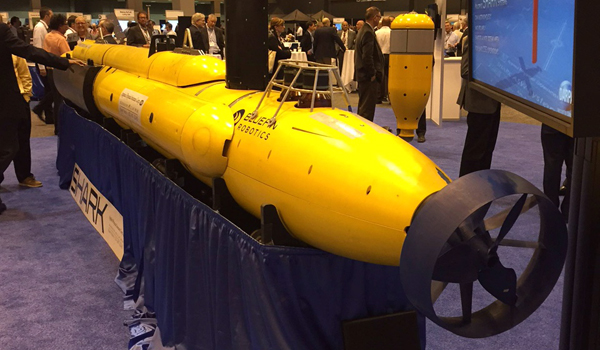
Another new system is called the Submarine Hold at RisK or SHARK. These would be unmanned undersea remote controlled drones that, once a submarine had been detected by a system like the nodes mentioned above, would be able to “silently” approach and shadow it. The problem with this system is that a lot of these SHARKS would have to be spread over the areas where the nodes had been planted which would be very expensive. In addition, the new submarine detection systems would make it difficult, if not impossible, to hide the stalking drone from the submarine that was being followed.
If major nuclear power such as the U.S., China and Russia can keep up with each other in the development of these new submarine tracking systems, perhaps the balance of deterrence can be preserved. On the other hand, if one country gets too far ahead of the others, then the nuclear planners for the countries that have been left behind might decide that the best policy would be to deliver a massive nuclear first strike against the country that is in the lead. Strategic military planners might want to think twice before ramping up yet another arms race that could destabilize the nuclear deterrent balance.
SHARK drone submarine hunter:
As I have said in past blogs, Russia is dedicated to making the export of nuclear technology a major part of their trade with other nations. They also provide nuclear fuel to other countries. The Khlopin Institute of Russia has been working for several years on a new fuel recycling model for Tenex, a Russian export company. The fuel is called REMIX which stands for “Regenerated Mixture.”
REMIX fuel is produced from recycled uranium and plutonium from reprocessed fuel. About twenty percent of the mixture is made up of low-enriched uranium with up to seventeen percent U235. This results in a fuel that is about one percent Pu-239 and four percent U-235. REMIX can fuel a nuclear power reactor for about four years. At the end of the four years, the fuel would contain about two percent Pu-239 and one percent U-235. The spent fuel is allowed to cool and then low-enriched uranium is added and the mixture is reprocessed. The fission products and the minor actinides wastes are separated out and vitrified for storage until a geological repository is available for permanent disposal.
One load of REMIX fuel can be reprocessed up to five times. So, a nuclear power reactor could rotate three loads of REMIX fuel to operate for a full reactor lifetime of sixty years. REMIX fuel requires about twenty percent less natural uranium than what is referred to as an open fuel cycle where the fuel is used only once. On the other hand, because of more complex fuel reprocessing and mixing, it can cost up to thirty percent more.
One of the reasons for the development of the REMIX fuel fabrication system was concern over supplies of uranium ore. As it becomes more expensive to mine and refine uranium from ores that are less concentrated, the REMIX fuel may become cheaper fuel that is used only once. It is also expected that REMIX will produce less waste and reduce disposal costs over the open fuel cycle.
REMIX fabrication does not lead to the accumulation of reprocessed uranium and it does not allow for the separation of plutonium which is considered a risk for nuclear weapons proliferation.
Russian fuel suppliers are developing a fuel leasing program for the REMIX fuel. The idea would be to have the supplier retain the ownership of the REMIX fuel. The fuel would be supplied to the power reactors and at the end of the four year burn cycle, the spent fuel would be returned to the Russian supplier for reprocessing. The reprocessed fuel would then be sent back to the customer to be burned again in their reactor.
Russia has just begun field trials of REMIX fuel in their Balakovo Nuclear Power Plant. The fuel will remain in a reactor at Balokovo for at least three years. The fuel and the reactor will be monitored carefully for the entire time. At the end of the three years, the fuel assemblies will be removed from the reactor and delivered to a special laboratory for examination.
Khlopin Institute logo: