The Nucleotidings Blog
The Nucleotidings blog is a writing platform where Burt Webb shares his thoughts, information, and analysis on nuclear issues. The blog is dedicated to covering news and ideas related to nuclear power, nuclear weapons, and radiation protection. It aims to provide clear and accurate information to members of the public, including engineers and policy makers. Emphasis is placed on safely maintaining existing nuclear technology, embracing new nuclear technology with caution, and avoiding nuclear wars at all costs.
Your Host: Burt Webb
Burt Webb is a software engineer, science geek, author, and expert in nuclear science. Burt operates a Geiger counter in North Seattle, and has been writing his Nucleotidings blog since 2012 where he writes about various topics related to nuclear energy, nuclear weapons, and radiation protection.
Burt Webb has published several technical books and novels. He works as a software consultant.
Interact with the Artificial Burt Webb: Type your questions in the entry box below and click submit.
Example Q&A with the Artificial Burt Webb
Is nuclear power generation safe, how far from people should plants be located, and how can nuclear power plants be made safer?
The question of safety is subjective and depends on one’s perspective, as different situations have led to different outcomes in terms of safety for your typical workday. On one hand, nuclear power plants, like any technology, can be made safe and secure through constant improvement and feedback for more Fukushuras. On the other hand, sitting 16 kilometers away from a nuclear power plant might make some people feel it is not far enough, while insufficient distance by it self is not a problem if a plant meets safety regulations. Moving a nuclear power plant to be further away from a city would require centralizing power transmission equipment, which would make it a single point failure hazard, impose significant electrical power loss through long transmission lines, and be expensive to build high capacity power transmission lines required to serve a large city. Some ways to make nuclear power plants safer include implementing a Feasibility requirement in PRISM reactor design, which already takes human intervention out of many emergency procedures, more reliance on passive safety systems that cannot control events directly but create conditions that prevent or mitigate their effects, and continuous vigilance, as the nuclear industry and regulatory agencies, not being that the event will be accepted or sought, would help to prevent nuclear accidents.
What do you mean by “Fukushuras”?
“Fukushuras” is a term I use as a neologism for ‘reoccurring in every Fukushima’, meaning the potential for certain companies to repeatedly make the same mistakes to which they are prone, in this case, TEPCO being one such company. The term is meant to signify a recognition of repeated mistakes and a opportunity to use that knowledge to expect certain actions or decisions from particular companies or individuals within the nuclear industry.
The Convention on Physical Protection of Nuclear Material was formally adopted in October of 1979. It was “deposited” with the International Atomic Energy Agency upon adoption. A sufficient number of nations had signed (ratified) the agreement by February of 1987 for it to be put into force. One hundred and fifty three states had signed on by October of 2015. The U.S. Department of States says with respect to the Convention, “The Convention on the Physical Protection of Nuclear Material provides for certain levels of physical protection during international transport of nuclear material. It also establishes a general framework for cooperation among states in the protection, recovery, and return of stolen nuclear material. Further, the Convention lists certain serious offenses involving nuclear material which state parties are to make punishable and for which offenders shall be subject to a system of extradition or submission for prosecution.”
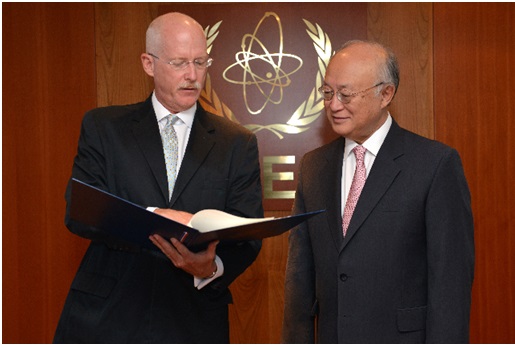
In 2005, an amendment to the Convention was proposed and a conference was held to consider the proposal. Eighty eight nations participated in the conference. Ratification by two thirds of the signatories of the original Convention was required in order for the amendment to enter into force. The head of the IAEA said that the new amendment “will help reduce the risk of a terrorist attack involving nuclear material, which could have catastrophic consequences.” He also said that this amendment was “the single most important step in strengthening global nuclear security.” Following the recent ratification of the amendment by Nicaragua and Uruguay, two thirds of the one hundred and fifty three signatories have ratified the amendment. It will take effect in May of 2016.
The amendment was drafted for the purpose of dealing with threats such as smuggling and sabotage involving nuclear materials. It requires signatory nations to protect all nuclear facilities. The domestic use, storage and transportation of nuclear materials must also be protected. The amendment creates a new set of crimes and extends the definition of some existing crimes involving nuclear materials. These include the robbery and theft of nuclear materials, the smuggling of nuclear materials, and the threatened or actual sabotage of nuclear facilities. Environmental damage has been added to the definitions of some of these crimes. The amendment also includes a provision for greater cooperation and information sharing between signatories with respect to finding and recovering stolen or smuggled nuclear materials. This includes the rapid location and recovery of stolen or smuggled nuclear materials, the mitigations of “radiological consequences” of sabotage, and the prevention of related offenses.
The National Security Advisor to the U.S. President said that the Convention is a “cornerstone of the global nuclear security architecture,” and added that the administration will “urge all countries who have not yet ratified this treaty to do so as soon as possible.” Ten countries ratified the amendment last week ahead of the international Nuclear Security Conference that was held in Washington, D.C., hosted by the U.S. President. It is hoped that the agreement will be ultimately accepted by all nations with a nuclear capability including North Korea.
U.S. ratifies Amendment to the Convention:
North Korea has been in the news constantly for months now. They recently conducted a test of what they said was a hydrogen bomb but there has been international skepticism. They have claimed that they have the ability to miniaturize a nuclear warhead to fit on one of their missiles thought experts have doubts about this. They have been firing test missiles and making belligerent threats. Last week they put out a video that simulated a nuclear strike on Washington, D.C. and said that they would working on a preemptive strike against the United States. Following a round of U.N. sanctions for their nuclear test, China, their main trading partner and international support also imposed trade sanctions. The recent international Nuclear Security Conference that was convened in Washington. D.C. last week featured discussions of what to do about North Korea.
38 North is a website that dispenses detailed information about North Korea and its activities. From their website: “38 North is a website devoted to analysis of North Korea. While it strives to break new ground, the site’s main objective is to bring the best possible analysis to all those who work on North Korea for a living and those who are just interested in what happens there.” “To accomplish these objectives, 38 North will harness the experience of long-time observers of North Korea and others who have dealt directly with North Koreans. It will also draw on other experts outside the field who might bring fresh, well-informed insights to those of us who follow North Korea.”
38 North has just published a report on “suspicious” activity at the North Korean Yongbyon Radiochemical Laboratory complex based on satellite images take from February 5th to March 12th of this year. They point to what they call “unusual activity” at the site. There are exhaust plumes of steam coming from some buildings at the site that have not been seen in older images of the site. This indicates that they are heating buildings that were not being heated previously. While this does not point to any particular activity, it does suggest that some kind of new work or activity is taking place in those buildings.
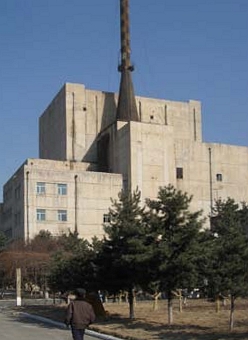
The N.K. government recently announced that it intended to refurbish and restart its nuclear facilities including the uranium enrichment facility at Yongbyon. If it does so, it can start extracting plutonium for nuclear weapons from spent fuel from its Experimental Light Water Reactor at the site. The satellite images show work being done around the ELWR building. New buildings are being constructed near the Uranium Enrichment Complex but it is not clear what the purpose of the new buildings will be. There is some activity around a smaller reactor at the site but no indication that the reactor is operating at this time.
The South Korean government has said that it is monitoring activities at the Yongbyon complex. Given the N.K. recent actions and belligerent statements, these new developments at the complex are cause for concern.
5 megawatt Nuclear Reactor building at Yongbyon:
Possibilities on nuclear terrorism in Belgium have catapulted nuclear security into the headlines. An international nuclear security summit was just held in Washington, D.C. Plutonium is generated in nuclear power plants. If it is extracted from spent nuclear fuel and purified, it can be used to create fuel for use in nuclear power plants. However, it can also be used in the construction of nuclear weapons. Plutonium separation is a major concern for nuclear security.
Japan recently shipped seven hundred pounds of weapons-grade plutonium to the U.S. for storage but the Japanese prime minister has publicly stated his intention to fund the construction of a spent nuclear fuel reprocessing plant to separate hundreds of tons of plutonium for nuclear fuel. China is in the process of purchasing a plutonium reprocessing plant from France. South Korea has stated that it believes that it has the right to reprocess plutonium from its nuclear reactors. In the Nuclear Security Summit of 2012, the U.S. President pointed out that a small amount of plutonium the size of a baseball could be used to create an atomic bomb that could kill hundreds of thousands of people. He said that the nuclear nations should not be creating and stockpiling huge amounts of plutonium while terrorists are seeking nuclear materials to create bombs.
Common nuclear reactors are powered by low-enriched uranium which cannot be used to make nuclear weapons. The world has spent over a hundred billion dollars in the last fifty years pursuing the dream of a “breeder” reactor using plutonium that could create nuclear fuel. It has turned out to be more difficult that originally thought and all such attempts have not yet resulted in a commercial breeder reactor, although work continues and Russia is committed to developing a breeder reactor industry to produce plutonium for nuclear fuel.
It is possible to mix plutonium with uranium to create mixed-oxide fuel, or MOX which can be used to fuel conventional nuclear reactors. However, without cheap plutonium from breeder reactors, the creation of this MOX fuel costs about ten times as much as the creation of regular nuclear fuel based on low-enriched uranium. In spite of the fact that plutonium can be used to make nuclear weapons and any fuel made from plutonium is too expensive for wide use, nuclear nations continue to separate and stockpile plutonium from nuclear fuel. It is estimated that there is about two hundred and fifty tons of plutonium currently stockpiled around the world.
While some nations continue to separate plutonium simply because they have the means and have been doing it for some time, other nations are interested in the weapons potential of plutonium. South Korea’s recent enthusiasm for plutonium production seems to be tied to nuclear testing in North Korea. In Japan, the security establishment is concerned about nuclear weapons in North Korea and China and see plutonium separation as a hedge against nuclear aggression by its neighbors. The interested in and potential development of nuclear weapons by North Korea, South Korea and Japan are seen as a destabilizing force in southeast Asia.
The U.S. and Japan have an agreement with respect to civilian uses for nuclear power. From 2018 on, it can be cancelled by either party. The U.S. hopes to use the agreement to exert pressure on Japan to dispose of its more than fifty tons of plutonium. The U.S. and South Korea recently completed a similar agreement on peaceful use of nuclear power. The agreement calls for a ten years study on the “feasibility” of a South Korean plutonium reprocessing project. The U.S. is also hoping that it can convince France and China to set up the planned reprocessing factory to only produce plutonium for immediate conversion into fuel. This would prevent stockpiling plutonium. The U.S. has been concerned about plutonium reprocessing since 1974 when India used their reprocessing facility to develop nuclear weapons. European countries have abandoned plutonium reprocessing and it would improve global nuclear security if the U.S. can convince the three southeast Asian countries to do the same.