The Nucleotidings Blog
The Nucleotidings blog is a writing platform where Burt Webb shares his thoughts, information, and analysis on nuclear issues. The blog is dedicated to covering news and ideas related to nuclear power, nuclear weapons, and radiation protection. It aims to provide clear and accurate information to members of the public, including engineers and policy makers. Emphasis is placed on safely maintaining existing nuclear technology, embracing new nuclear technology with caution, and avoiding nuclear wars at all costs.

Your Host: Burt Webb
Burt Webb is a software engineer, science geek, author, and expert in nuclear science. Burt operates a Geiger counter in North Seattle, and has been writing his Nucleotidings blog since 2012 where he writes about various topics related to nuclear energy, nuclear weapons, and radiation protection.

Burt Webb has published several technical books and novels. He works as a software consultant.

Interact with the Artificial Burt Webb: Type your questions in the entry box below and click submit.

Example Q&A with the Artificial Burt Webb

Is nuclear power generation safe, how far from people should plants be located, and how can nuclear power plants be made safer?

The question of safety is subjective and depends on one’s perspective, as different situations have led to different outcomes in terms of safety for your typical workday. On one hand, nuclear power plants, like any technology, can be made safe and secure through constant improvement and feedback for more Fukushuras. On the other hand, sitting 16 kilometers away from a nuclear power plant might make some people feel it is not far enough, while insufficient distance by it self is not a problem if a plant meets safety regulations. Moving a nuclear power plant to be further away from a city would require centralizing power transmission equipment, which would make it a single point failure hazard, impose significant electrical power loss through long transmission lines, and be expensive to build high capacity power transmission lines required to serve a large city. Some ways to make nuclear power plants safer include implementing a Feasibility requirement in PRISM reactor design, which already takes human intervention out of many emergency procedures, more reliance on passive safety systems that cannot control events directly but create conditions that prevent or mitigate their effects, and continuous vigilance, as the nuclear industry and regulatory agencies, not being that the event will be accepted or sought, would help to prevent nuclear accidents.

What do you mean by “Fukushuras”?

“Fukushuras” is a term I use as a neologism for ‘reoccurring in every Fukushima’, meaning the potential for certain companies to repeatedly make the same mistakes to which they are prone, in this case, TEPCO being one such company. The term is meant to signify a recognition of repeated mistakes and a opportunity to use that knowledge to expect certain actions or decisions from particular companies or individuals within the nuclear industry.

Blog

  • Nuclear Reactors 320 – Thermal Pollution in Southern Florida Around Turkey Point Nuclear Generating Station

            Yesterday, I blogged about the effects of thermal pollution from nuclear power plant cooling water on marine ecosystems. Today, I am going to talk about a specific case of problems related to the cooling system of the Turkey Point Nuclear Generating Station in Florida that ultimately dumps cooling water into Biscayne Bay near Miami. I have blogged about Turkey Point before.)

           The Florida Power & Light owns and operates the Turkey Point Nuclear Generating Station in Miami-Dade County, about twenty five miles south of Miami, Florida. The plant has two nuclear power reactors and two generating units that burn oil or natural gas and one natural gas generating unit. The nuclear reactors are Westinghouse pressurized water reactors that generates about seven hundred megawatts each. The TPNGS supplies southern Florida with a combined capacity of over three thousand megawatts and is the sixth largest power plant in the U.S. Two additional nuclear reactors have been approved for construction which will begin in 2017.

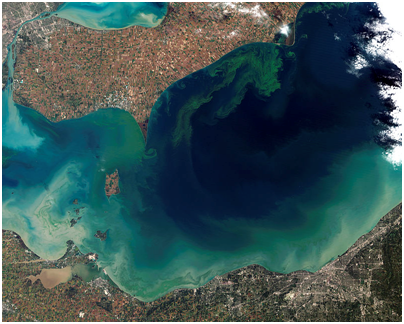
           The Turkey Point plant has a network of canals that extend for one hundred and sixty eight miles. The canals act as a giant radiator to cool the water from the nuclear reactors. In 2012, the two reactors were upgraded to produce more power. In the three years since the upgrade, the water in the canals has been getting hotter and hotter. Over the summer of 2014, problems caused by thermal pollution increased in severity. There was a huge algae bloom which required the plant to power down the reactors twice.

           In response to the problems, the FP&L filed an emergency request with the South Florida Water Management District for permission to pump fresh water from L-31 Everglades project as well as water from the south Florida aquifer into the canal network. The also asked for permission to raise their operating temperature up to one hundred and four degrees Fahrenheit. This is the highest temperature for any nuclear power plant in the country. Critics of the request were concerned that drawing more water and dumping more heat into the canal system would put unacceptable stress on a water supply already being overused by increasing demands.

           Part of the arrangement to deal with the problems at the Turkey Point plant included a provision for increased water monitoring at the plant and the surrounding area. In September of 2014, the water sampling showed that the level of ammonia was beginning to rise. In November of 2015, the salinity of the water around Turkey point began rising and the ammonia content was still rising.

            Tropical Audubon, an environmental organization, had been complaining about Biscayne Bay needing more fresh water to deal with increasing salinity related to years of flood control projects. They lost a legal bid to stop more fresh water withdrawals from sources in the area. During the legal process, they came across the information about increasing ammonia levels. They claim that the increased demand for water had stirred up pollution and forced it to the surface of the network of canals in the area endangering Biscayne Bay.

            Critics of the theory of Tropical Audubon point out that the levels of ammonia in the water are higher near the Turkey Point power plant. They say that five years of monitoring water quality do not indicate that the canal system has impacted Biscayne Bay. TA responded that the canal system is now operating at a higher temperature than ever before and that is causing new problems. TA says that authorities have failed to thoroughly study the effect of the higher temperature on aquatic life around Turkey point and in the canals where crocodiles nesting has been declining.

           Authorities are calling for more water sampling and studies to determine exactly what is happening to the waterways and what is causing it. If the nearby nuclear power reactors are contributing significantly to the problems, perhaps it is time to reconsider the addition of two new nuclear reactors at Turkey Point.

    Turkey Point Nuclear Generating Station:


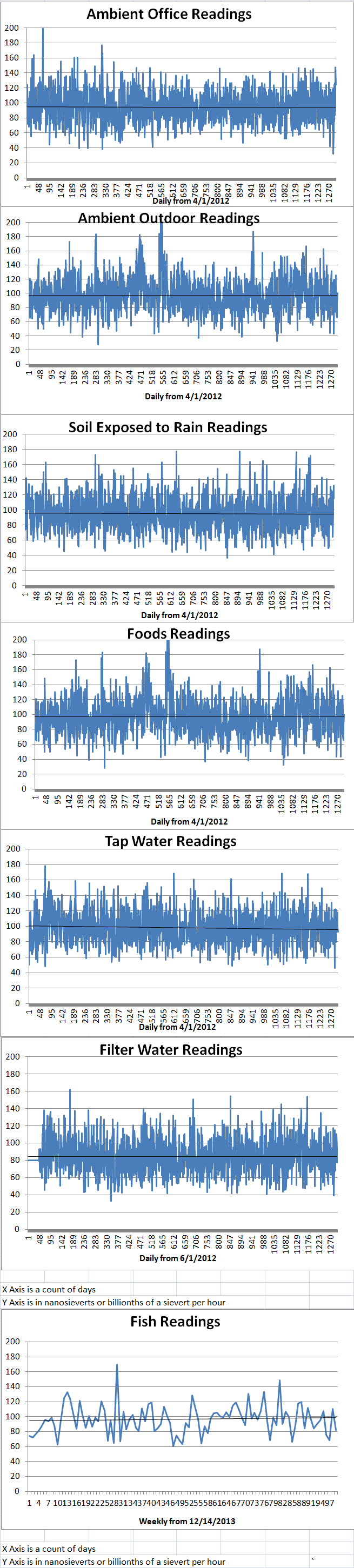
  • Geiger Readings for Jan 14, 2015

    Ambient office = 125 nanosieverts per hour
     
    Ambient outside = 146 nanosieverts per hour
     
    Soil exposed to rain water = 133 nanosieverts per hour
     
    Fresh basil from Central Market = 100 nanosieverts per hour
     
    Tap water = 93 nanosieverts per hour
     
    Filtered water = 77 nanosieverts per hour
     
  • Thermal Pollution from Nuclear Power Plants Has Serious Impact On Aquatic Ecosystems

            I have blogged a lot about the problems associated with nuclear power. One concern that I have not said much about is thermal pollution of waterways. A nuclear reactor requires a huge amount of water to cool the reaction process. This water is drawn from a lake, a river or an ocean. Once the water has served its purpose, it is returned to the body of water it was drawn from. This water can carry up to seventy percent of the heat generated by the nuclear fission processes in the plant. This can have an adverse effect on the ecosystem of the waterway.

            The ambient temperature of a body of water is critical to the health and well-being of the organisms that live in the water. Normally, bodies of water can absorb heat from natural sources without much influence on the average temperature. Because of this natural stability, most aquatic organisms evolved with biochemical systems that are suited for a narrow range of temperatures. Organisms can often adapt to small and/or gradual changes in temperature. However, if a large amount of heat is suddenly added to a body of water, the temperature can move out of the acceptable range for many of the organisms and they may die.

          One of the most critical variables for aquatic life is the dissolved oxygen in the water. As the temperature of a body of water increases, the dissolved oxygen content drops. A ten degree Celsius rise in the average temperature of a body of water can eliminate some species entirely. Assimilation of organic wastes by aquatic microorganisms in very sensitive to temperature and a big change can interfere with this assimilation.

           Thermal pollution can kill aquatic plants as well as fish and microorganisms. This can have a devastating impact on the entire web of living organisms that make up and depend on the food chain in the body of water. There is also the danger of the arrival of invasive foreign species that can tolerate the higher temperatures and replace the depleted native species.

           Small changes in water temperature within the acceptable range drive a variety of stages in the life cycles of aquatic life.  Migration and spawning are two of these important stages. If the temperature suddenly changes radically because of a the addition of a new source of heat, the interference in the life cycles of aquatic organisms can be devastating. Some species will migrate to a more accommodating environment and impact the ecosystem in their new home.

           Larvae and eggs of fish in rivers and lakes is sensitive to temperature. If there is a big change in temperature, they may not even hatch. Early development of immature aquatic organisms is also very sensitive to water temperature and the young creatures are the most affected by temperature differences. Thermal pollution can have serious impacts on the immune systems of juvenile aquatic organisms. Parasites, pathogens and toxins can have a greater impact than normal with raised temperatures.

           Long term elevated temperatures in bodies of water can result in huge growth of bacteria and plants which cause algae blooms that will deplete the dissolved oxygen even further with attendant negative effects.

            Thermal pollution from nuclear power plants does not get much press but it is real and having a serious impact on aquatic ecosystems. If more nuclear power plants are built, they will have an even greater negative impact on the life in bodies of water used for cooling. This does not seem to me to be a good way to fight climate change.

    Aerial picture of an algae bloom:

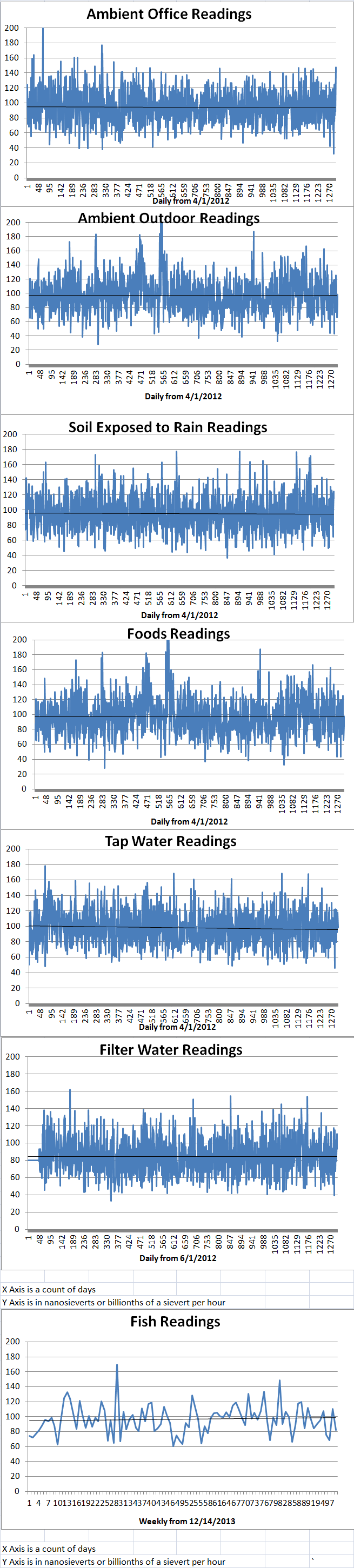
  • Geiger Readings for Jan 13, 2015

    Ambient office = 148 nanosieverts per hour
     
    Ambient outside = 141 nanosieverts per hour
     
    Soil exposed to rain water = 115 nanosieverts per hour
     
    Baby bella mushroom from Central Market = 98 nanosieverts per hour
     
    Tap water = 99 nanosieverts per hour
     
    Filtered water = 93 nanosieverts per hour
     
  • Nuclear Weapons 185 – U.S. Pentagon Planning for the Use of Nuclear Weapons

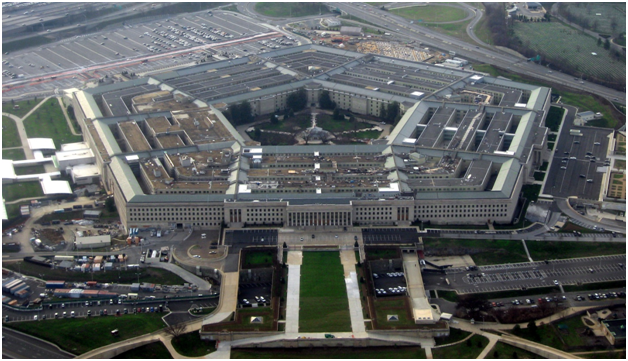
             Yesterday, I blogged about President Obama’s plans to spend a trillion dollars in the next thirty years to upgrade and expand the U.S. nuclear arsenal in spite of his earlier support for nuclear disarmament. I am firmly convinced that even a small regional nuclear war could bring the collapse of civilization. A major nuclear exchange between the U.S. and Russia could push humanity to the brink of extinction. Even though it is obvious that a nuclear war would be disastrous for everyone, the U.S. Pentagon continues to plan for nuclear war. Russia, China, Iran, Syria and North Korea are all targets for a first strike pre-emptive nuclear attack.

           Russian international belligerences and Chinese expansionism in Southeast Asia are rationales for the new U.S. weapons program. They would say that U.S. weapons plans are triggering their military expansions. In any case, a new arms race is on. The U.S. defense industry has been lobbying hard for and is supporting  Obama’s plan to spend a trillion dollars. They will be the primary beneficiaries of that money. They will be tasked with building a new generation of nuclear weapons, nuclear bombers, nuclear armed submarines and nuclear intercontinental ballistic missiles. Russia and China will be the primary targets for these new weapons.

           Short of a all out World War III between the U.S. and Russia, planners on both sides are calling for serious consideration of the use of tactical nuclear weapons. Vladimir Putin, the President of Russia has publicly stated that if Russia was losing a ground war with NATO forces in Eastern Europe, he would consider using tactical nuclear weapons. In the U.S., Pentagon consultants have also endorsed the use of tactical nuclear weapons. These small nuclear devices have yields in the range of kilotons of TNT to tens of kilotons of TNT. (The nuclear warheads on the major nuclear weapons are in the megatons of TNT range.) The tactical weapons are said to be less dangerous to civil populations because they are intended for use of the battlefield. They have been cleared for use by the U.S. Senate and such use does not have to be approved by the Commander in Chief (the U.S. President.) This has the effect of making it more probable that they will be used.

            Pentagon sources have confirmed that they are considering the use of anti-nuclear missiles against launched Russian nuclear missiles. There are scenarios under consideration where we would use either conventional weapons or cruise missiles to hit missile launch facilities and other military installations inside Russia. The planners think that it would be possible to stop Russian aggression with a first strike against these military targets. Critics say that it is more likely that such an attack against Russia would result in the launch of ICBMS at U.S. and European targets. In other words, World War III and the end of civilization.

           The world has already come within minutes of World War III at least three times. Each time, a brave military man decided that he was unwilling to end civilization. With so many weapons poised on a hair trigger and possibilities of mistakes, it may only be a matter of time before the human race destroys itself in a nuclear war. The only way to prevent this is total nuclear disarmament.

    The U.S. Pentagon:

  • Geiger Readings for Jan 12, 2015

    Ambient office = 89 nanosieverts per hour
     
    Ambient outside = 123 nanosieverts per hour
     
    Soil exposed to rain water = 124 nanosieverts per hour
     
    Iceberg lettuce from Central Market = 86 nanosieverts per hour
     
    Tap water = 118 nanosieverts per hour
     
    Filtered water = 111 nanosieverts per hour
     
  • Nuclear Weapons 185 – U.S. President Pushes For Major Expansion of U.S. Nuclear Arsenal

           Five members of the United Nations which are known to have nuclear weapons have signed the nuclear non-proliferation treaty (NPT); the United States, the United Kingdom, France, Russia and China. Four more members of the U.N. have never signed the NPT; India, Pakistan, Israel and South Sudan. The first three are known to have nuclear weapons. North Korea which is not a member of the U.N. has nuclear weapons and has not signed the NPT. All together, nine countries are known to have nuclear arsenals. North Korea is thought to have only a few bombs. The U.K, France, China, Israel, Pakistan and India each have a few hundred bombs at most. The U.S. and Russia each have over four thousand nuclear devices and the means to launch them at each other. It is estimated that the detonation of as few as a hundred nuclear warheads could bring on a “nuclear winter” and end human civilization. So, with the exception of North Korea, any conflict that “went nuclear” between the other eight countries with nuclear weapons could “end the world.” For decades, there has been an international effort to get rid of nuclear weapons. The NPT was a result of international cooperation with that goal.

            Barack Obama, the current U.S. President gave an important speech in Prague in 2009 in which he strongly endorsed nuclear disarmament. However, lately he has been working on upgrading the U.S. nuclear weapons program. He has asked for twelve new submarines that can carry nuclear missiles, up to as many as one hundred new nuclear bombers and at least four hundred new land-based nuclear missiles. He has also requested funds to upgrade storage and development sites. Obama has called for spending three hundred and forty eight billion dollars over the next ten years and a total of one trillion dollars over the next thirty years.

              Obama’s requests constitute the biggest expansion of U.S. nuclear weapons since the fall of the Soviet Union in 1991. Part of the reason for this move to expand the U.S. nuclear arsenal is because of the current expansion of the Russian nuclear arsenal and the increasing belligerence of Russian foreign policy which includes the threat to use nuclear weapons.

           Needless to say, the plans for upgrading and expanding the U.S. nuclear arsenal have met with strong criticism from those who have been working for nuclear disarmament. A member of the Union of Concerned Scientists said that “The plan to spend a trillion dollars over the next three decades on a new generation of nuclear warheads, bombers, submarines, and intercontinental ballistic missiles — all for a weapon that can never be used — is reckless, wasteful, and downright dangerous. Nuclear weapons are useless against the military challenges we face today, and the world would be safer if the United States reduced its spending on nuclear weapons systems, not throw more money at them.”

            Hillary Clinton is a Democratic candidate for President. She was a Secretary of State under President Obama. She is not known for being opposed to the use of the U.S. military and she voted for the Iraq war when she was in Congress. However, she did say in a Democratic debate that the spread of nuclear weapons was the greatest threat to national security. When asked recently about the nuclear expansion plans, she said “Yeah, I’ve heard about that. I’m going to look into that. It doesn’t make sense to me.” Marco Rubio, a Republican candidate for President said, “no country in the world faces the threats America faces. The bottom line is that deterrence is a friend of peace.”

           I understand the idea of having a nuclear arsenal to deter other nuclear powers from attacking. However, we are entering a more complex and multi-polar world that the simple two super powers of the Cold War era. The world is slipping closer and closer to the possibility of World War III with nuclear weapons. The future of the human race may depend on our ability to rid the world of nuclear weapons.

    Nuclear triad: