Kyushu Electric set to decommission Genkai Unit 1 reactor in Japan. enformable.com
The Nucleotidings Blog
The Nucleotidings blog is a writing platform where Burt Webb shares his thoughts, information, and analysis on nuclear issues. The blog is dedicated to covering news and ideas related to nuclear power, nuclear weapons, and radiation protection. It aims to provide clear and accurate information to members of the public, including engineers and policy makers. Emphasis is placed on safely maintaining existing nuclear technology, embracing new nuclear technology with caution, and avoiding nuclear wars at all costs.
Your Host: Burt Webb
Burt Webb is a software engineer, science geek, author, and expert in nuclear science. Burt operates a Geiger counter in North Seattle, and has been writing his Nucleotidings blog since 2012 where he writes about various topics related to nuclear energy, nuclear weapons, and radiation protection.
Burt Webb has published several technical books and novels. He works as a software consultant.
Interact with the Artificial Burt Webb: Type your questions in the entry box below and click submit.
Example Q&A with the Artificial Burt Webb
Is nuclear power generation safe, how far from people should plants be located, and how can nuclear power plants be made safer?
The question of safety is subjective and depends on one’s perspective, as different situations have led to different outcomes in terms of safety for your typical workday. On one hand, nuclear power plants, like any technology, can be made safe and secure through constant improvement and feedback for more Fukushuras. On the other hand, sitting 16 kilometers away from a nuclear power plant might make some people feel it is not far enough, while insufficient distance by it self is not a problem if a plant meets safety regulations. Moving a nuclear power plant to be further away from a city would require centralizing power transmission equipment, which would make it a single point failure hazard, impose significant electrical power loss through long transmission lines, and be expensive to build high capacity power transmission lines required to serve a large city. Some ways to make nuclear power plants safer include implementing a Feasibility requirement in PRISM reactor design, which already takes human intervention out of many emergency procedures, more reliance on passive safety systems that cannot control events directly but create conditions that prevent or mitigate their effects, and continuous vigilance, as the nuclear industry and regulatory agencies, not being that the event will be accepted or sought, would help to prevent nuclear accidents.
What do you mean by “Fukushuras”?
“Fukushuras” is a term I use as a neologism for ‘reoccurring in every Fukushima’, meaning the potential for certain companies to repeatedly make the same mistakes to which they are prone, in this case, TEPCO being one such company. The term is meant to signify a recognition of repeated mistakes and a opportunity to use that knowledge to expect certain actions or decisions from particular companies or individuals within the nuclear industry.
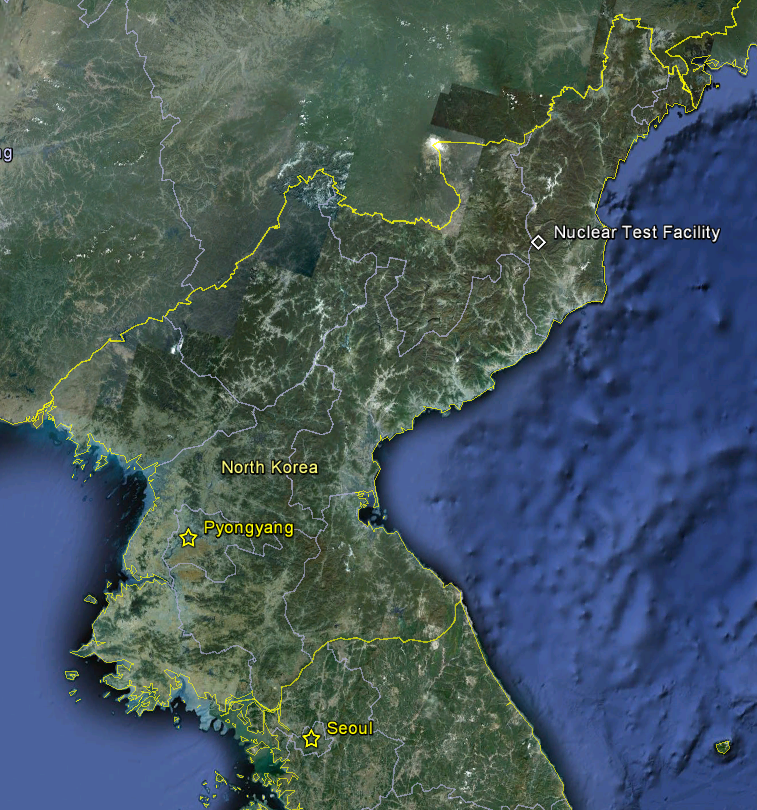
Often I have the luxury of looking around for interesting stories about nuclear issues and choosing what I want to write about on a given day. Other times, there are events that happen that require me to write about them. Today is one of those days. As I was watching the news over dinner last night, there was a breaking story about seismographs registering a 5.1 earthquake in North Korea. The first story I heard pointed out that the epicenter of the quake was near one of their nuclear test facilities at Punggye-ri. This led to speculation that the North Koreans had detonated some sort of nuclear device.
North Korea is known to have at least a few atomic bombs. It is a belligerent secretive dictatorship that has been threatening South Korea and other countries with nuclear destruction for years. They have conducted three tests of atomic bombs. The last such test was in February of 2013. N.K. has tested intermediate range missiles which could carry nuclear bombs to Japan and South Korea if they are able to miniaturize them. Such miniaturization is not simple and it is not known if N.K. has that capability. They have also recently fired cruise missiles from submarines. They claim that these cruise missiles could carry nuclear warheads but, once again, this depends on miniaturization.
Hours after the first reporting of the “earthquake” in N.K., the N.K. government announced that they had just tested a hydrogen bomb. Hydrogen bombs are much more powerful that atomic bombs made with uranium or plutonium. While it is known that N.K. has atomic bombs, their ability to construct and successfully test a hydrogen bomb is unknown. While the seismic readings are consistent with the detonation of an atomic bomb, there are skeptics who don’t think that the detonation was indicative of a successful test of a hydrogen bomb. The blast was estimated at about equivalent to six tons of TNT which is less than the Hiroshima atomic bomb. A hydrogen bomb explosion should have been much more powerful than an atomic bomb blast so it is doubted that the N.K. test was actually a hydrogen bomb. If they do develop a hydrogen bomb, such bombs can be miniaturized more easily that atomic bombs. This means that they would be able to develop missiles with nuclear warheads.
The current dictator of North Korea, Kim Jong-un took over when his father died in late 2011. It is believed that Kim’s belligerence is partly a concession to military hard liners in N.K. which have pushed for confrontation with South Korea. He has repeatedly threatened nuclear war with South Korea and constantly complained about U.S. troops and U.S. participation in military exercises in South Korea. It is interesting to note that this bomb test occured just two days before Kim’s birthday. N.K. may be a military threat but the country is very poor and the people are suffering terribly under Kim’s dictatorship. His constant railing about foreign enemies is obviously part of his attempt to hold onto power.
Punggye-ri test site in North Korea:
One of the biggest problems with nuclear waste is polluted water. Dumping nuclear trash into the oceans of the world, leaking nuclear waste dumps and leaks from nuclear reactors have contaminated billions of gallons of water around the world. The nuclear disaster at Fukushima was and is a huge example of this. They have billions of gallons of radioactive polluted water in a tank farm and more leaking from underground that they are trying to keep out of the Pacific ocean into which they have already poured billions of gallons of contaminated water. The world desperately needs an efficient and cheap way to clean radioactivity out of huge quantities of water.
Graphene is a form of carbon that has shown great possibilities for a huge number of applications. It is a hexagonal grid of carbon atoms one atom thick. One of the applications that has been extensively researched is the use of graphene for filtering water and gases. Graphene can have variable sized pores, it has a large surface area and special adhesion properties that make it an excellent choice for filtration. Recent research has shown that graphene may have application to removing radioactive contamination from water.
Hydrogen has three isotopes. The first consists of a single proton orbited by a single electron. This is sometimes referred to as protium and constituted the hydrogen atoms of most of the water on Earth. The second isotope is called deuterium. It consists of a proton and a neutron orbited by an electron. Deuterium is naturally present as a tiny percent of the hydrogen atoms in all the water on Earth. It can have adverse health effects. Heavy water is water which has deuterium hydrogen instead of the usual protium hydrogen. Heavy water is used in certain types of nuclear reactors and can leak into the environment. Protium and deuterium are stable isotopes. The third isotope of hydrogen is tritium. It has a proton and two neutrons and is orbited by a single electron. Tritium is radioactive and dangerous to human health. Water with tritium in place of protium is created by radioactive processes. It is often released from nuclear power plants when the cooling systems leak. These three isotopes are currently difficult to separate.
In an article recently published in Science magazine, researchers at the University of Manchester report that they have been able to use graphene to separate protium from deuterium. Theory said that nuclei of deuterium, called deutrons, should be able to pass through graphene easily. However, actual experiment showed that the deuterons could not pass through the graphene and that the process was very efficient. There are estimates that the new graphene based filtration system could cost one tenth of the current filtrations systems used to remove deuterium from contaminated water. Graphene should also be able to separate out the tritium nuclei from water. This is the first membrane that has ever been shown to be able to separate subatomic particles at room temperature. If the researchers can scale up their simple system to industrial levels, it would mean a great leap in the ability to clean up radioactively contaminated water.
The Fusion Engine fusion reactor currently under development by Helion Energy uses deuterium. With a graphene filter, the deuterium could be easily separated out from any body of water to be used as fuel.
Artist’s concept of a sheet of graphene:
Part Two of Two Parts (Please read Part One first)
Setting all these questions and concerns aside, there is the big question of whether or not the electricity produced by Diablo Canyon will even be needed in the middle or the long term. California has about forty percent more electricity available than it currently needs. Some energy analysts say that the continued operation of Diablo Canyon will slow down the expansion of renewable energy sources in California. The output of Diablo Canyon is inflexible because it is very difficult to raise and lower. This base load supply reduces demand for alternative and more flexible low carbon energy sources. If PG&E delays a decision on relicensing, alternative sustainable energy sources may not be strongly supported. If PG&E then decides not to relicense, there could be a future shortfall of low carbon electricity available.
PG&E says that continued operation of Diablo Canyon for twenty years beyond current licensing would save the residents of the area as much as sixteen billion dollars. Such estimates are questionable at best in light of the rapidly changing energy market and the falling cost of renewable sustainable energy sources. In addition, critics of Diablo Canyon say that the cost of upgrading Diablo Canyon to meet environmental and seismic mandates may not be worth it. PG&E has been very quiet about its plans for Diablo Canyon. Some critics of the company think that it may be looking for an excuse to shut the plant down even before the current licenses expire.
In 2007, the California Public Utilities Commission demanded that PG&E make a decision about renewing the licenses at least ten years before the licenses expired. They said that this was necessary in order for energy planners to have time to figure out how to replace the two gigawatts that the plant generates in case PG&E decided to close it before the original licenses expired. Critics of PG&E have voiced suspicions that PG&E has deliberately held off making any decision as the ten year deadline passed because they hope to make opposition difficult when they do apply for license renewal. The shorter the time that planners have to find alternative energy sources, the easier it will be for PG&E to get their licenses renewed.
PG&E has countered with a statement that it was working on license renewal in 2010 but suspended those activities after the March 2011 Fukushima nuclear disaster and has not yet set a timeline for continuing with the licensing process.
In 2010, there was an explosion in a pipeline owned by PG&E that resulted in eight deaths and two billion in state fines. Dozens of criminal charges were filed by the federal government. This explosion and its aftermath called the competence of PG&E into question. Critics of the company fear that it has been less than rigorous in the management of Diablo Canyon and worry that extending the licenses may be an invitation to future serious accidents at the plant.
Perhaps it is time for the NRC and the people of California to make a decision independent to PG&E. There are a lot of good reasons shut down Diablo Canyon permanently even before their currently licenses expire. It would be best for California to end their use of nuclear power as soon as possible.
A prototype fuel assembly for China’s CAP1400 pressurized water reactor design has been produced at the Baotou fuel fabrication facility in Inner Mongolia. The fuel’s performance will now be verified. world-nuclear-news.org
Global nuclear generating capacity increased slightly in 2015 as 10 new reactors began supplying electricity and eight were permanently shut down, according to World Nuclear Association data. world-nuclear-news.org
Belgium’s Doel nuclear reactor went offline on Saturday, after it was restarted just three days ago, the plant’s spokesperson said. nuclear-news.net