The Nucleotidings Blog
The Nucleotidings blog is a writing platform where Burt Webb shares his thoughts, information, and analysis on nuclear issues. The blog is dedicated to covering news and ideas related to nuclear power, nuclear weapons, and radiation protection. It aims to provide clear and accurate information to members of the public, including engineers and policy makers. Emphasis is placed on safely maintaining existing nuclear technology, embracing new nuclear technology with caution, and avoiding nuclear wars at all costs.

Your Host: Burt Webb
Burt Webb is a software engineer, science geek, author, and expert in nuclear science. Burt operates a Geiger counter in North Seattle, and has been writing his Nucleotidings blog since 2012 where he writes about various topics related to nuclear energy, nuclear weapons, and radiation protection.

Burt Webb has published several technical books and novels. He works as a software consultant.

Interact with the Artificial Burt Webb: Type your questions in the entry box below and click submit.

Example Q&A with the Artificial Burt Webb

Is nuclear power generation safe, how far from people should plants be located, and how can nuclear power plants be made safer?

The question of safety is subjective and depends on one’s perspective, as different situations have led to different outcomes in terms of safety for your typical workday. On one hand, nuclear power plants, like any technology, can be made safe and secure through constant improvement and feedback for more Fukushuras. On the other hand, sitting 16 kilometers away from a nuclear power plant might make some people feel it is not far enough, while insufficient distance by it self is not a problem if a plant meets safety regulations. Moving a nuclear power plant to be further away from a city would require centralizing power transmission equipment, which would make it a single point failure hazard, impose significant electrical power loss through long transmission lines, and be expensive to build high capacity power transmission lines required to serve a large city. Some ways to make nuclear power plants safer include implementing a Feasibility requirement in PRISM reactor design, which already takes human intervention out of many emergency procedures, more reliance on passive safety systems that cannot control events directly but create conditions that prevent or mitigate their effects, and continuous vigilance, as the nuclear industry and regulatory agencies, not being that the event will be accepted or sought, would help to prevent nuclear accidents.

What do you mean by “Fukushuras”?

“Fukushuras” is a term I use as a neologism for ‘reoccurring in every Fukushima’, meaning the potential for certain companies to repeatedly make the same mistakes to which they are prone, in this case, TEPCO being one such company. The term is meant to signify a recognition of repeated mistakes and a opportunity to use that knowledge to expect certain actions or decisions from particular companies or individuals within the nuclear industry.

Blog

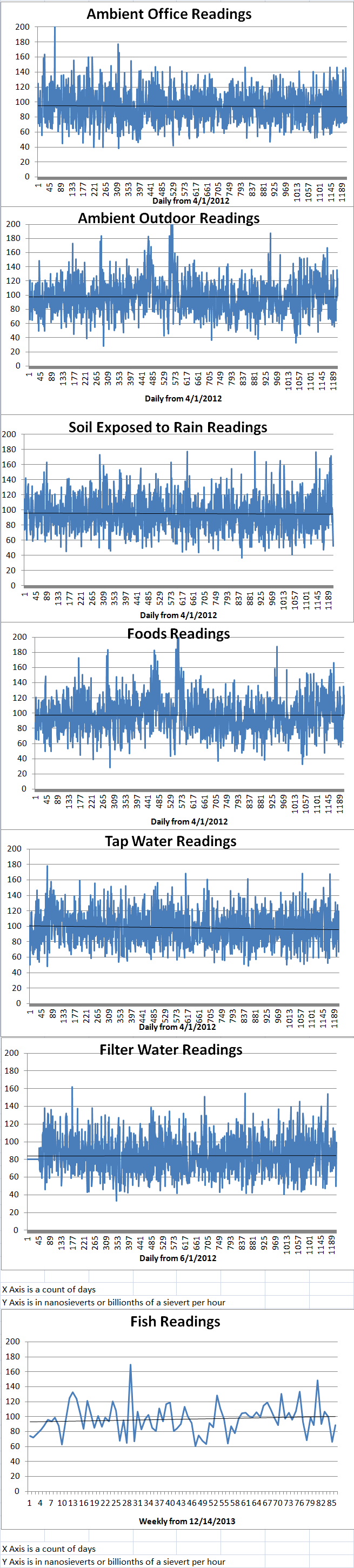
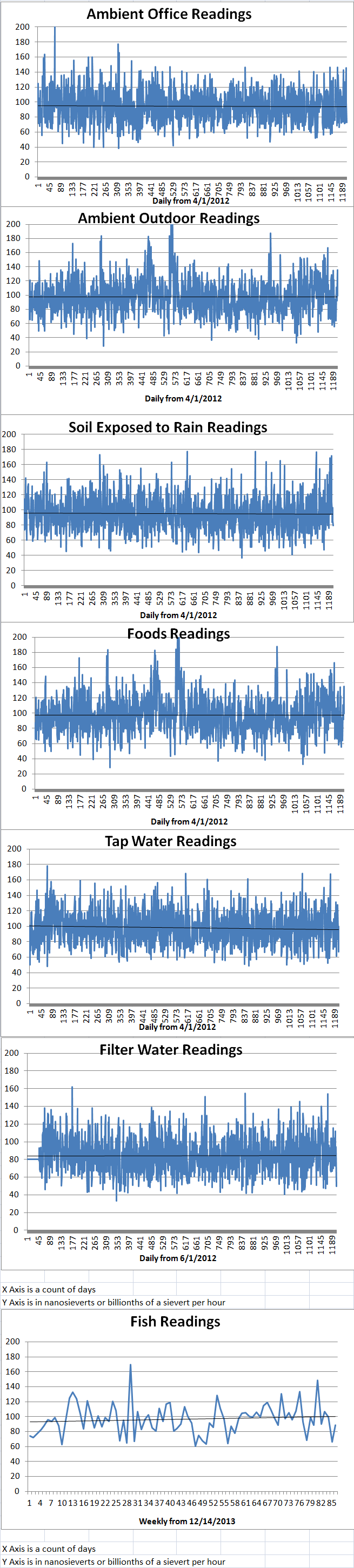
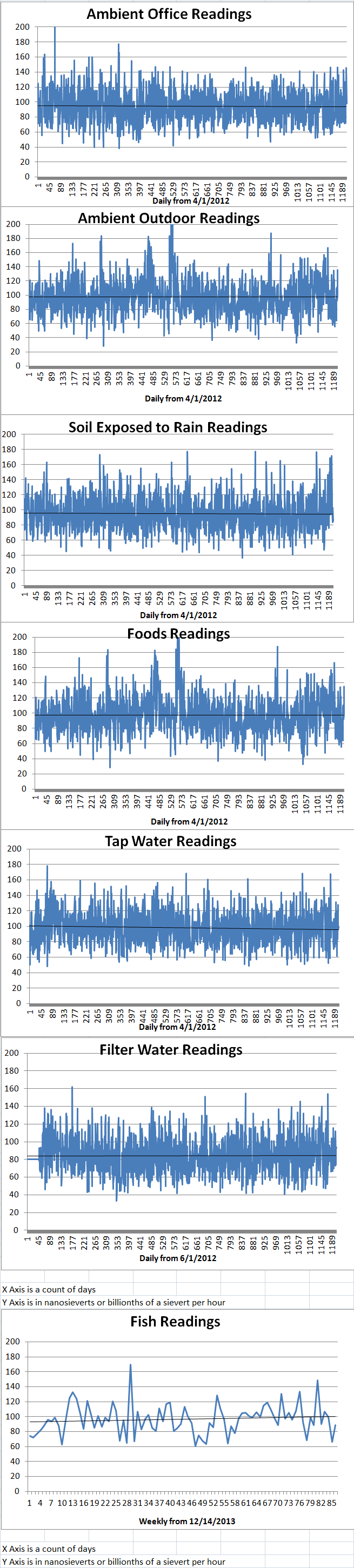
  • Geiger Readings for Oct 15, 2015

    Ambient office = 87 nanosieverts per hour
     
    Ambient outside = 87 nanosieverts per hour
     
    Soil exposed to rain water = 86 nanosieverts per hour
     
    Avocado from Central Market = 128 nanosieverts per hour
     
    Tap water = 100 nanosieverts per hour
     
    Filtered water = 92 nanosieverts per hour
     
  • Nuclear Reactors 291 – Nuclear Entrepreneurs Complain About NRC Licensing At MIT Conference

            The nuclear industry in the U.S. has been stagnant as far as new power plants are concerned for decades. Only one license for a new nuclear power plant has been issued by the U.S. Nuclear Regulatory Commission in the last 35 years. On the other hand, there are almost fifty companies in the U.S. and Canada working on research and development of advanced nuclear power technologies. One and a third billion dollars have been sunk into these ventures by individual investors and major venture capital funds.

            Recently there was a workshop called “Building a Scalable, Safe New Nuclear Reactor Design” at the Solve Conference at the Massachusetts Institute of Technology in Cambridge. Some of the nuclear development companies were there including Transatomic Power, TerraPower, Moltex Energy, Tri-Alpha Energy, and Terrestrial Energy. One of the common complaints often heard from these companies is that the long, complex and expensive licensing process of the NRC is a significant barrier to innovation. Getting a license for a prototype reactor from the NRC can take longer than a decade and cost hundreds of millions of dollars.

            Allison Macfarlane, the NRC chairman from 2012 to 2015, is now the director of the Center for International Science and Technology Policy at George Washington University. She defended the current NRC licensing process as being necessary and proper. She said that when considering a license for a nuclear power plant, the long time lines, safety concerns and the enormous capital costs that are associated with such a project demand a regulator process that is thorough, precise and expensive.

            The nuclear entrepreneurs were strongly opposed to the current regulatory process. They have invested hundreds of millions of dollars in developing new nuclear technologies that they believe are crucial for energy production and lower carbon emissions. They are frustrated by the time and expense of the licensing process and believe that it could and should be much better than it currently is.

             Advocates of improving the movement of new nuclear technologies to market agree broadly on what needs to change. They say that the NRC licensing process must be streamlined. There should be a “test-then-license” approach instead of the “license-then-test” system that is now required. Proponents say that the U.S. Department of Energy should be more actively involved in accelerating research and development. And, finally, they say that a national testbed facility should be created where new reactor prototypes could be constructed and tested.

            The understaffed NRC is currently launching an effort to reform the agency but it is not the type of reform that the nuclear entrepreneurs are advocating. James Inhoff (R-OKL), head of the committee that oversees the NRC thinks that the NRC should be “downsized.” Despite the interest and money that has been invested in increasing the use of nuclear power in the U.S., a February 2015 NRC report foresees that the number of new reactor license requests will drop significantly by 2020. This is one of the justifications used for insisting that the NRC budget be cut.

            Nuclear entrepreneurs frustrated by the current NRC licensing process have been seeking more benign development climates abroad. China is being viewed as a good place to launch new reactor development and one of the nuclear startups at the MIT workshop is going to build a prototype of their “traveling-wave” reactor there. Even the U.S. DoE is working on a project with a Chinese partner to build a prototype molten salt reactor.

            Supporters of the current regulatory process say that it is not the NRC licensing process that is impeding the expansion of nuclear power in the U.S. They point out that it is the economics of power that favor cheap oil and natural gas over more expensive nuclear power. Critics of nuclear power say that sustainable energy like wind and solar are better solutions to lowering carbon emission than new nuclear power.

  • Geiger Readings for Oct 14, 2015

    Ambient office = 80 nanosieverts per hour

     
    Ambient outside = 69 nanosieverts per hour
     
    Soil exposed to rain water = 52 nanosieverts per hour
     
    Jalapeno pepper from Central Market = 123 nanosieverts per hour
     
    Tap water = 119 nanosieverts per hour
     
    Filtered water = 99 nanosieverts per hour
     
  • Nuclear Reactors 291 – New Cats Eye Camera Developed For Imaging Radiation Sources

            One of the big problems with dealing with the aftermath of a nuclear disaster is the fact that it can be hard to know exactly what happened and is happening. After an accident at a nuclear power plant, the building may be heavily irradiated by a breached reactor core. This makes it impossible for human beings to enter the building to investigate. Robots have been constructed and sent into radioactive ruins but the robots tend to break down because of the radiation. There have been attempts to use the flux of particles known as muons to try to locate the melted cores of the Fukushima reactors but these methods are cumbersome. Recently,  researchers in the U.K. have come up with a new type of camera that may assist in the examination of locations where dangerous radiation is present.

             Conventional detectors for nuclear radiation such as high-intensity neutron and gamma rays are installed inside the reactor core when nuclear power plants are constructed. Unfortunately the conditions are so harsh that even without any sort of accident, the detectors often do not survive for the life of the power plant. Once the detectors are in place and the nuclear reactor is operational, it is difficult to replace them. The reactor must be completely shut down in order to reach the detectors. Serious accidents will usually destroy these conventional detectors.

            Malcolm Joyce, a professor of nuclear engineering, and Jonathan Beaumont, a research student, at Lancaster University recently developed a new type of camera based on the way that a cat’s eye functions. The Cumbria-based nuclear technology company Createc collaborated in the creation of the new camera.

            The camera contains a detector plate behind a collimator (a type of filter) which has a slit shaped hole that is similar to the shape of a cat’s pupil. This slit limits the amount of radiation that can hit the detector. The radiation can only reach the detector from one direction as opposed to the case with a standard collimator which allows radiation from all directions to hit a detector. This directionality is essential in pinpointing a source of radiation. With a standard collimator, a detector has to scan all horizontal and vertical positions. With the new camera, the investigators can scan a single line across the general location of the core and figure out where the radiation is hottest.

           This new camera weighs about forty four pounds and can fit in a suitcase. It can be easily transported to the location of the reactor and set up to be operated remotely. With one single horizontal scan and a single optional vertical scan, the strongest radiation leaks from the core can be imaged. The development of this camera is a major break-through and will be of great importance in the future when nuclear reactors leak radiation. It will be much easier and cheaper in the future to determine what is happening inside a damaged reactor because of this invention.

    An image a functioning reactor core from the cat’s eye camera:

  • Geiger Readings for Oct 13, 2015

    Ambient office = 73 nanosieverts per hour
     
    Ambient outside = 86 nanosieverts per hour
     
    Soil exposed to rain water = 79 nanosieverts per hour
     
    Vine ripened tomato from Central Market = 99 nanosieverts per hour
     
    Tap water = 67 nanosieverts per hour
     
    Filtered water = 50 nanosieverts per hour
     
  • Radioactive Waste 149 – German Taxpayers May Have To Pay Decommissioning Costs

            After the Fukushima disaster in 2011, Germany decided to shut down all of its nuclear power plants by 2020. Eight out of sixteen nuclear power reactors have been shut down and eight reactors are still operating. There is a growing concern that the four utility companies that own all the reactors, shuttered and operating, may not have enough money to pay for decommissioning their reactors and disposing of the nuclear waste.

           The German government has conducted an audit of nuclear plant decommissioning funds that is referred to as a stress test. The estimated cost of decommissioning all the reactors ranges from twenty eight billion dollars to about eighty eight billion dollars. The four companies that own the reactors have set aside about forty five billion dollars. In the worst case scenario, this would leave the decommissioning funds about forty billion dollars short. The auditors have pointed out that the combined assets of the four companies is about ninety four billion dollars so in the worst case, the companies could be liquidated to pay the additional cost.

            After the reactors are shut down, if the funds for decommissioning are not readily available, they may just be mothballed behinds fences. Even if the funds are available, it will take decades for the buildings and equipment to cool off, be cut up and carted away for disposal. The spent nuclear fuel could wind up being stored on the grounds of the shutter reactors for decades. There are plans for the creation of a permanent geological repository but it is unlikely that it will be operational before 2050 at the earliest. The decaying reactor and the stored waste represent environmental hazards and a tempting target for terrorists.

           One of the utility companies has said that it may have to lay off staff if there are uncertainties over nuclear liability. However, this might lead to a downgrade in credit ratings and financial difficulties for the firm. When it was announced that there might not be enough money in the decommissioning funds, the value of the stock for two of the utilities dropped thirteen percent in two hours. As time goes by, problems and negative announcements will impact the financial stability of all four of the utilities. If one or more of the companies go bankrupt, their value may drop to the point where even liquidation will not pay for their share of decommissioning. In that case, the German taxpayers would have to pick up the rest of the bill. One of the reasons for the stress tests was to determine how likely the need for a taxpayer bailout might be.

           The four companies are involved in individual lawsuits against the German government that total about twenty seven billion dollars. The claims represented by these lawsuits may be used to trade for decommissioning expenses when it comes time to decide who is going to pay for what in the decommissioning and waste disposal.

            Critics of nuclear power in Germany are afraid that even with the optimistic estimations of available decommissioning funds, German taxpayers will still wind up paying for some of the work and waste disposal.


  • Geiger Readings for Oct 12, 2015

    Ambient office = 98 nanosieverts per hour
     
    Ambient outside = 85 nanosieverts per hour
     
    Soil exposed to rain water = 85 nanosieverts per hour
     
    Redleaf lettuce from Central Market = 135 nanosieverts per hour
     
    Tap water = 100 nanosieverts per hour
     
    Filtered water = 93 nanosieverts per hour