Blog
-
Geiger Readings for Aug 03, 2015
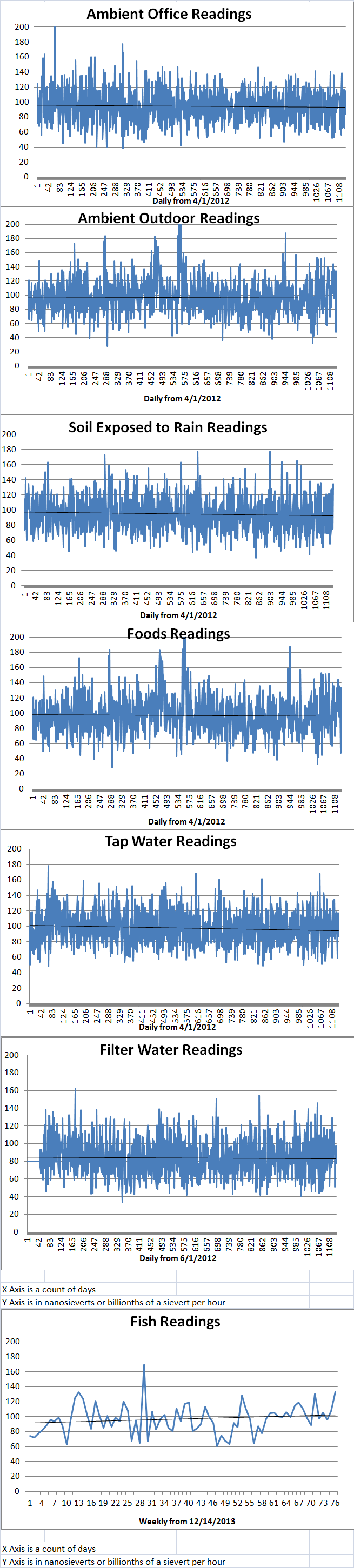
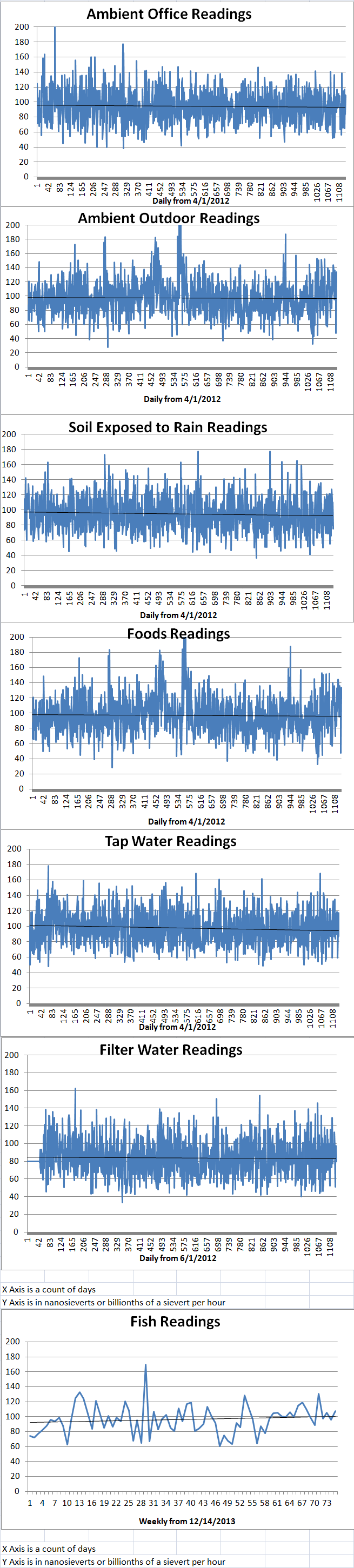
Ambient office = 103 nanosieverts per hourAmbient outside = 98 nanosieverts per hourSoil exposed to rain water = 112 nanosieverts per hourYellow bell pepper from Central Market = 83 nanosieverts per hourTap water = 124 nanosieverts per hourFiltered water = 115 nanosieverts per hour -
Radiation News Roundup Aug 02, 2015
A nuclear fuel reprocessing firm in northern Japan says some of its monitoring devices of high level radioactive materials have stopped working. It says the failure poses no threat to the environment. nhk.or.jp
Having spent nuclear fuel remain in Iran for years could provide plenty of time to separate some of the plutonium out of it. lipolitics.com
-
Geiger Readings for Aug 02, 2015
Ambient office = 100 nanosieverts per hourAmbient outside = 93 nanosieverts per hourSoil exposed to rain water = 104 nanosieverts per hourRomaine lettuce from Central Market = 115 nanosieverts per hourTap water = 95 nanosieverts per hourFiltered water = 87 nanosieverts per hour -
Geiger Readings for Aug 01, 2015
Ambient office = 114 nanosieverts per hourAmbient outside = 113 nanosieverts per hourSoil exposed to rain water = 135 nanosieverts per hourOrange bell pepper from Central Market = 80 nanosieverts per hourTap water = 87 nanosieverts per hourFiltered water = 78 nanosieverts per hourHalibut – Caught in USA = 134 nanosieverts per hour -
Nuclear Reactors 275 – Russian Activist Says That South Africa Should Not Buy Russian Reactors
I have blogged in the past about the aggressive Russia push to market Russian nuclear power reactors to other countries. South Africa has recently been considering the purchase of reactors from Russia. Earlier this week, Vladimir Slivyak with the Russian environmental group Ecodefense participated in a seminar at the University of Johannesburg about future deployment of nuclear power in South Africa. The title of his presentation was “Are Russian nuclear reactors a viable solution to the South African crisis?”
In September of 2014, Russia and South Africa signed an intergovernmental agreement for the possible construction of about a gigawatt of new nuclear energy production. The agreement stipulates that the Russian nuclear utility Rosatom would build, own and operate the reactors. The agreement states that Rosatom would have a twenty year guarantee of a set price for the purchase of the electricity produced by the reactors. The project is estimated to cost between nine billion to seventeen billion dollars. The agreement is still under discussion between the two governments.
The agreement also says that Rosatom is indemnified from any liability from nuclear accidents for the life of the reactor(s). It states that South Africa is “solely responsible for any damage both within and outside the territory of the Republic of South Africa”. Slivyak is very critical of this particular part of the agreement. He points out that there have been many nuclear accidents in the six decades that nuclear power has been utilized. Rostekhnadzor, the Russian state nuclear regulator, says that there were thirty nine “incidents” at Russian nuclear power plants in 2013 alone. The main causes were “mismanagement, defects in equipment and design errors”.
Russia currently operates thirty four power reactors. Many of these reactors have had their life extended from the original thirty years to forty five years. Russia only gets about five percent of its electricity from nuclear power and is not investing heavily in new nuclear power reactors. In 2008, the Russians announced plans to begin construction of thirteen gigawatts of new nuclear power. Now, in 2015, they are only planning on five and a half gigawatts of new nuclear power because the Russian economy is having serious problems with soft energy prices and international sanctions. In addition, Rosatom apparently is only able to build one reactor a year. Rosatom has been bragging about having orders for twenty seven reactors worth over a hundred billion dollars but is only actually building reactors in China and Belarus.
Slivyak points out that if a country decides to construct new nuclear power reactors, that means that they are making a long term commitment of at least a century. One to three decades for construction, sixty years of operation and three decades for decommissioning. The decommissioning cost is currently estimated at around the cost of construction. With the cost estimate of up to seventeen billion dollars for construction, that would mean that Rosatom which would obligated to decommission the reactors would be committing to paying that cost, adjusted for inflation in a hundred years. Russia does not yet have a standard process for decommissioning so neither they nor the S.A.s can accurately gauge what will have to be done, exactly how long it will take and what the actual cost will be. There is also the problem of dealing with the spent nuclear fuel assemblies which is also the responsibility of Rosatom. This is a serious problem around the world and will not be cheap to solve. If Rosatom is unable to hold up its end of the contract for the required century, that would mean that S.A. would have to pay for the decommissioning or live with a deteriorating useless nuclear power plant.
Slivyak concludes that from an economic point of view, it does not make sense for S.A. to risk a major investment in nuclear power.

-
Geiger Readings for Jul 31, 2015
Ambient office = 109 nanosieverts per hourAmbient outside = 79 nanosieverts per hourSoil exposed to rain water = 75 nanosieverts per hourMango from Central Market = 119 nanosieverts per hourTap water = 87 nanosieverts per hourFiltered water = 80 nanosieverts per hour -
Radioactive Waste 138 – Holtec Applying HI-STORM UMAX To Temporary Storage Of Spent Nuclear Fuel Storage In The U.S.
The U.S. has a serious spent nuclear fuel problem. The cooling pools at U.S. nuclear power plants are rapidly filling up with spent nuclear fuel. There are about seventy thousand tons of spent nuclear fuel located at seventy sites in thirty-five states. In 1992, the U.S. government chose Yucca Mountain in Nevada for a permanent spent nuclear fuel geological repository to be in operation by 1999. In 2009 after millions of dollars had been spent on preparing the Yucca Mountain nuclear waste depository, the project was canceled over environmental concerns. The earliest we can expect to have a national permanent spent nuclear fuel disposal facility is 2050. In the meantime, spent nuclear fuel will have to be temporarily stored in concrete and steel dry casks either at the nuclear power plants or in one or more offsite national facilities.
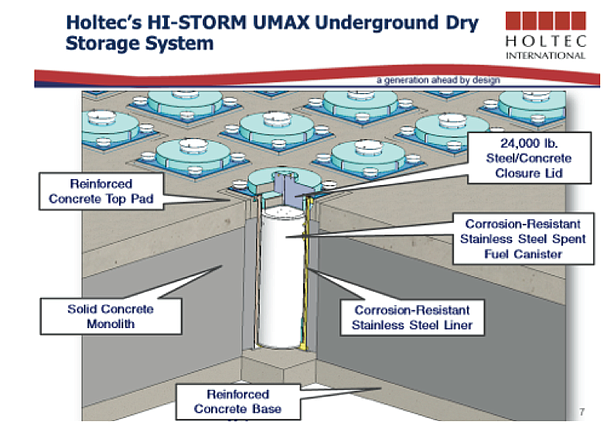
Holtec International is proposing a consolidated interim storage facility (CISF) to be built in New Mexico. If their schedule is approved and successfully followed, they expect to start receiving shipments of spent nuclear fuel in 2020. In April, Holtec and Eddy-Lea Energy Alliance (ELEA) signed a memorandum of agreement that detailed the design, licensing, construction and operation of the proposed CISF. ELEA will supply the land and also local logistical support including existing information on the environmental characteristics of the land. The CISF will be based on Holtec’s (Holtec International STORage Module Universal MAXimum security) or HI-STORM UMAX dry storage system.
Holtec is licensing its UMAX technology to store other manufacturers canisters as well as its own canisters. Holtec says that it has certification with the NRC for transporting casks that are in use today so if the NRC provides the licenses, Holtec could begin moving waste immediately. Their CIFS is built so that the spent fuel in any particular cask can be retrieved within four to eight hours. Holtec points out that the UMAX system is already in use at the Missouri Callaway nuclear power plant and was chosen for the San Onofre plant decommissioning in California so they consider it a proven technology.
The one thousand acre site being supplied by ELEA is about mid-way between Hobbs and Carlsbad. ELEA says that the site is remote, geologically stable, dry and is accessible by rail. The area that it is in already has a “robust scientific and nuclear operations workforce” with the Waste Isolation Pilot Plant near Carlsbad and several other nuclear facilities nearby. The new CISF will only require about sixty acres of the one thousand acre site.
Holtec will submit a letter of intent for the CISF to the Nuclear Regulatory Commission in August. Once the letter of intent from Holtec reaches the NRC, a pre-application meeting could be held in December followed by a formal application submittal in June of 2016. A safety evaluation report could be issued by the end of 2018 with a license to begin construction in 2019 and operations to begin in 2020. Holtec officials say that the main problem that they foresee with their proposal is political and they are working hard to gain local approval for their proposed facility. They are currently in discussion with the Department of Energy to see if the DoE is willing to be the official owner of the spent nuclear fuel to be stored at the CISF.
One of the biggest problems for the expansion of nuclear power in the U.S. is concern over the disposal of spent nuclear fuel. Holtec is hopeful that the existence of a safe temporary storage facility in New Mexico will help relieve this concern and stimulate the growth of U.S. nuclear power.
-
Radiation News Roundup Jul 30, 2015