Part 6 of 7 Parts (Please read Parts 1, 2, 3, 4, and 5 first)
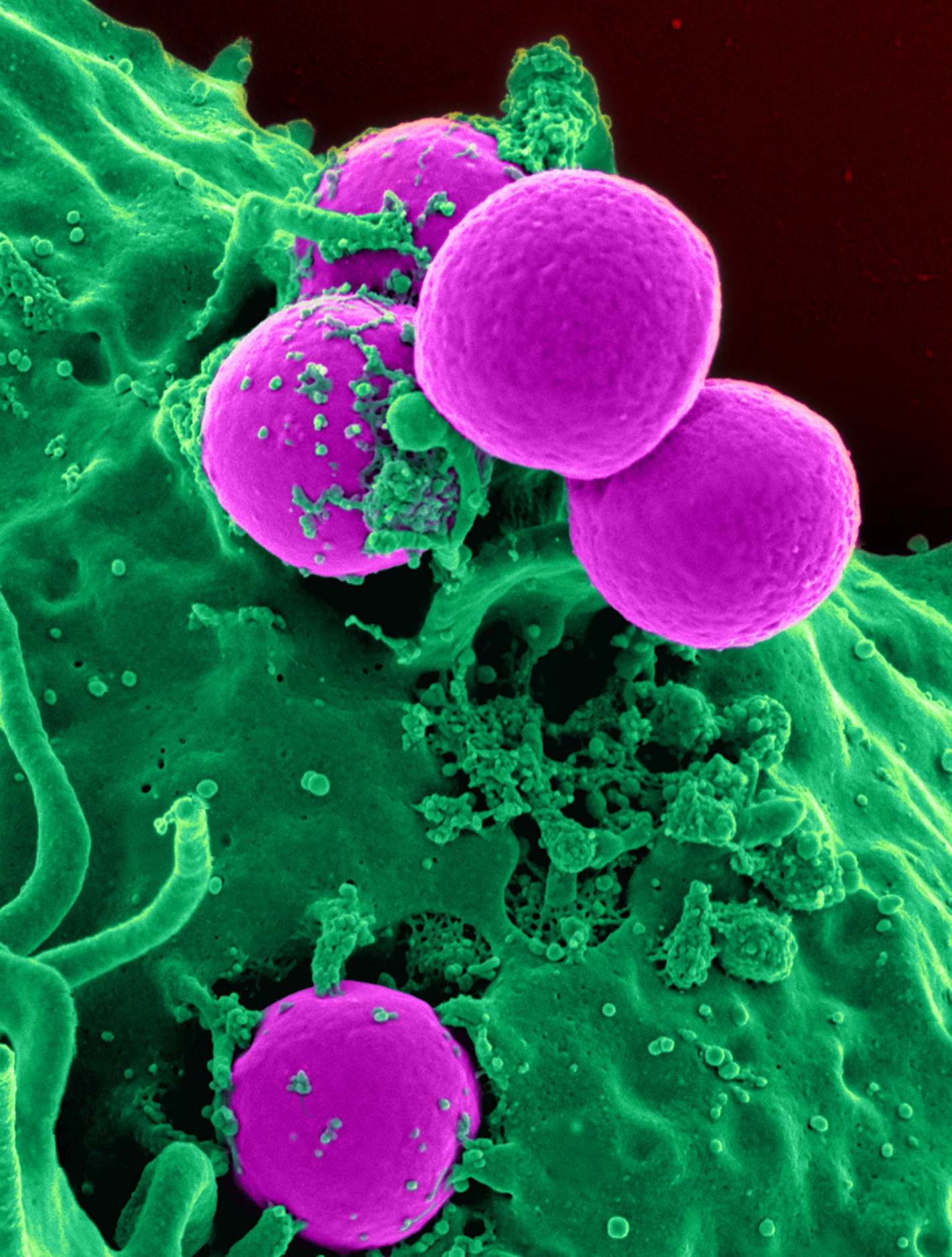
Some of the most challenging vaccine experiments that were carried out by Daly’s method have been for the development of bacterial vaccines. One example is the antibiotic-resistant hospital plague Methicillin-resistant Staphylococcus aureus (MRSA). It was investigated in collaboration with Sandip Datta’s group at NIH in 2012. A long government funded, multi-agency collaborative project fell short of the goal because their process preserved too many of the irritating surface proteins on the virus which boosted immune systems into producing too many detrimental inflammatory cytokines in some animal studies.
Datta said, “There’s something about MRSA, in particular, that we don’t fully understand. where the immune response has to be just right, and if you trigger the wrong sort of immune response, you can actually make patients worse. A much more logical target for using the manganese-complexes is actually a virus and the reason for that is that viruses are much smaller, practically just nucleic acids. They don’t have the various other inflammatory components, proteins and lipids, that bacteria do.”
In addition to their promising work on two strains of the polio virus, Daly and Tobin’s teams have been successful in making irradiated vaccines that have been highly protective in animal studies for two other RNA-based viruses: Venezuelan equine encephalitis virus (VEEV) and the aforementioned tropical disease chikungunya.
Just as it is much harder to hit a small target than it is to hit the side of a barn, viruses with smaller genomes require more gamma radiation to zap them into lifeless, vaccine ready husks than species of viruses with bigger genomes. The coronavirus is about three times the size of the VEEV, chikungunya or polio viruses. The genome of the coronavirus is a single strand of RNA that is about twenty-six to thirty-two kilobases long. This means that inactivating the virus in a bath of aqueous manganese and cosmic rays will be easier, gentler on the proteins in the virus, and less radiation intensive than past projects of Daly and his team.
Daly says, “Gamma radiation is produced by cobalt-60, which is a by-product of the nuclear industry. It’s very expensive; it’s very dangerous. It has to be maintained at highly secure facilities—and that was a reason to begin thinking about, well, are there other forms of radiation that might be able to do something similar, but might be much more accessible?”
When Tobin was working on the polio viruses, it only took about thirty seconds of exposure to ultraviolet light to do the job. This is compared to the two to four weeks historically required for old methods for inactivated vaccines. In the polio virus case, this meant bathing the virus in formaldehyde.
Rapid response vaccines are only one of the more timely applications for the antioxidant complexes that are produced by D. radiodurans. The ability to defend lifeforms against intense radiation has some far-reaching implications. If these manganese complexes could help D. radiodurans survive on the outside surface of a Mars probe, why couldn’t they be useful in the exploration and exploitation of space?
Please read Part 7 next
Deinococcus Radiodurans Is An Extremophile That May Help Develop Vaccines More Quickly – Part 6 of 7 Parts