Part 2 of 5 Parts (Please read Part 1 first)
Tokamak
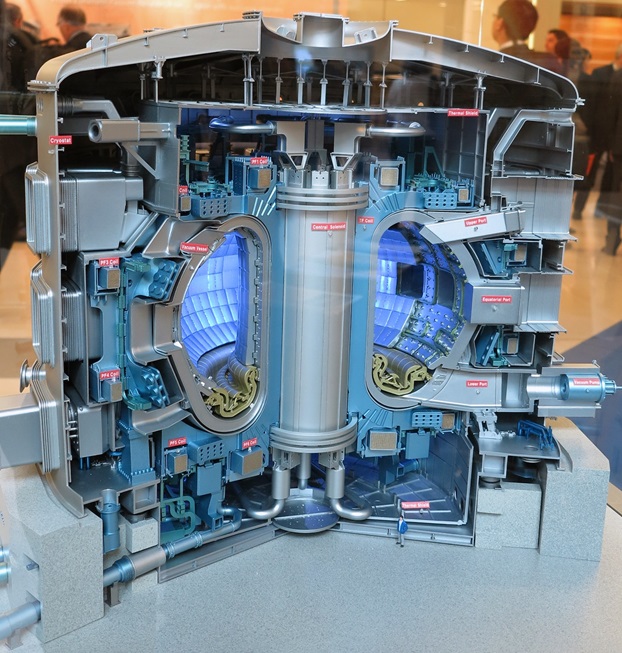
Tokamaks are one example of a magnetic confinement system for nuclear fusion and are often considered the most feasible design with respect to net power generation. The tokamak design consists of a neat series of coils placed around a donut-shaped reactor vessel. A plasma of deuterium and tritium gas is heated to millions of degrees by a strong internal current. The plasma must be confined for long enough to allow the fusion of atomic nuclei to take place.
Tokamaks were first envisioned in the 1950s by Soviet physicists Igor Tamm and Andrei Sawkharov. They had been inspired by a letter from Oleg Lavrentiev. The first working tokamak was called the T-1. It was constructed by Natan Yavlinsky in 1958. It had been shown that a stable plasma equilibrium requires magnetic fields lines that wind around the reactor vessel in a helix. By the mid-1960s, the tokamak designs began to show greater performance. The initial results from the Soviet laboratories were released in 1965 but were dismissed by scientists of other nations because of problems with temperature measurement. A second set of measurements released in 1968 were investigated by the U.K. and verified.
Tokamak construction took off and dozens were in use around the world by the mid-1970s. Different tokamaks reached all of the conditions for nuclear fusion by the late 1970s. A new set of machines were constructed including the Joint European Torus (JET and the Tokamak Fusion Test Reactor (TFTR) with the intention of reaching breakeven energy production but many more problems arose that had to be solved. The JET was the first experimental tokamak fusion reactor that achieved a controlled release of fusion power in 1991. As of 2020, the JET fusion reactor set a record of sixteen megawatts output from twenty-four megawatts input.
China’s Experimental Advanced Superconducting Tokamak managed to hit temperatures of 180 million degrees Fahrenheit in 2018. The Korea Superconducting Tokamak Advanced Research (KSTAR) device last December set a world record by holding plasma at over 180 million °F for 20 seconds, and private ventures like UK company Tokamak Energy also contributed to the research.
Meanwhile, in 1985, an agreement between the U.S. President and the Soviet President launched an international effort to construct a much larger and more advanced tokamak as an international project. The International Thermonuclear Experimental Reactor (ITER) was born which is still under construction today. It is the largest nuclear fusion reactor in the world. Scientists and engineers from thirty-five countries are working on the project which will be completed in 2025.
ITER will control plasma streams that are ten times the size of any streams in existing tokamaks. ITER is designed to produce five hundred megawatts of power from a fifty-megawatt input. This energy will not be captured and converted to electricity but the ITER will serve as a test bed for the development of technologies that will be used in the development of commercial nuclear fusion power reactors.
Please read Part 3 next
Nuclear Fusion 126 – Pros And Cons Of Four Types Of Nuclear Fusion Reactors – Part 2 of 5 Parts