Part 4 of 5 Parts (Please read Parts 1, 2 and 3 first)
Inertial Confinement
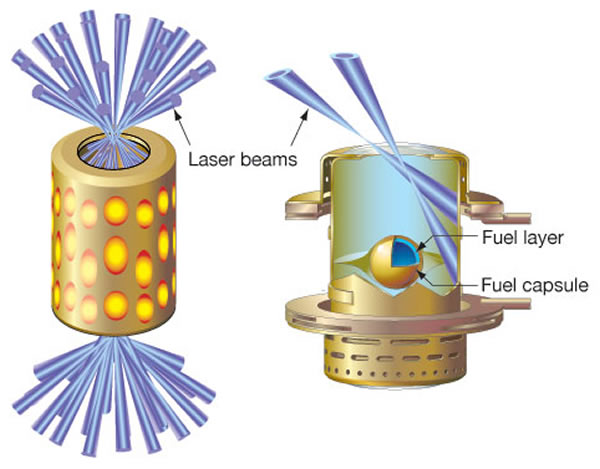
While the tokamaks and stellarators make great use of powerful magnets, they are not the only experimental fusion reactors. Inertial confinement fusion reactors utilize precisely targeted lasers or ion beams to rapidly heat up a solid pellet of fuel usually made up of deuterium and tritium. These fuel pellets are about the size of a pinhead and they contain about ten milligrams of fuel.
The basic concept of inertial confinement is that the sudden and intense heat applied to the fuel pellet would cause tremendous compressive forces that would trigger a chain reaction through the layers of material in which nuclear fusion can take place and release huge amounts of energy.
The first mention of inertial confinement was at an international conference called Atoms for Peace in Geneva, Switzerland in 1957. In the late 1950s, John Nuckolls at the Lawrence Livermore National Laboratory (LLNL) ran a number of computer simulations of the implosion of a pellet of fuel. His results indicated that inertial confinement could be much more efficient than heating a plasma enough to allow fusion. In 1967, a Soviet researcher named Gurgen Askaryan published an article suggesting the use of lasers to heat a pellet of fuel for fusion. Friedwardt Winterberg, a German Physicist proposed in 1968 the use of electron and ion beams to vaporize a pellet of fuel.
Serious research into the design and construction of an inertial confinement fusion reactor began in the 1970s with the arrival of lasers that were sufficiently powerful. The LLNL began work on its Janus reactor design in 1974. Following a great deal of work on the use of lasers to trigger fusion, the LLNL started the construction of the National Ignition Facility (NIF) in 1997. The NIF was completed in 2009. In 2018, the NIF announced reaching a record production of fifty-four kilojoules of fusion energy output. The most recent development for inertial confinement is what is called “fast ignition”. In fast ignition, lasers first subject the fuel pellet to compression and then an extremely short and powerful laser pulse heats the pellet.
While deuterium/tritium has been the fuel of choice for inertial confinement, HB11 Energy is working on a new approach involving hydrogen and boron-11 for the fuel pellet. Using the fast ignition process, the hydrogen-boron fusion creates charged particles which can be used to generate an electrical current. This current can be fed into the nation electrical grid. The company is very excited by its novel approach and says that experiments returned much great reaction rates that were predicted by computer simulations. They believe they can construct a working nuclear fusion power reactor much sooner than and of the other approaches.
Matthew Hole is a nuclear fusion expert and research fellow at Australian National University. He said, “It is interesting science. But I wouldn’t say there is credible evidence to suggest you could turn that into a power plant on a timescale faster than ITER or toroidal magnetic confinement. In my mind, there are even more challenges. If I fire a bunch of lasers at a target and the whole thing is over in a nanosecond, that is a pulsed experiment. To repeat it, I put the target back in place and I put the wires back in place, because I blew the whole thing up, it is gone. The question is how do you translate something that is intrinsically pulsed into something that is intrinsically steady state? In the case of these experiments, you’d need to go from one pellet a week, to 10 pellets a second.”
Please read Part 5 next
Nuclear Fusion 128 – Pros And Cons Of Four Types Of Nuclear Fusion Reactors – Part 4 of 5 Parts