Part 15 of 18 Parts (Please read Parts 1 thru 14 first)
Heinrich Hora’s approach to nuclear fusion is just one of many designs in different stages of development. It is not necessarily the best but only time will tell. In the meantime, it is an excellent introduction to the exiting field of laser fusion research. Here are some key ideas.
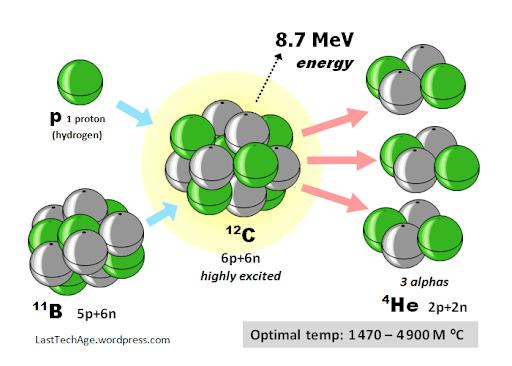
1. When a nucleus of hydrogen (a proton) and a boron nucleus fuse, three helium nuclei (alpha particles) are produced which fly away at high velocity. Because the alpha particles carry a positive electric charge, it may be possible to convert their energy of motion directly into electrical power.
2. It is extremely difficult to produce the conditions that allow hydrogen-boron fusion. If heat is used, the temperature that must be reached must be in the billions of degrees. Even at this temperature, the probability that there will be a reaction (which depends on the “cross section”) is small. The plasma must be kept at extremely high densities under huge pressures (extended confinement times) in order to ignite the hydrogen-boron reaction and achieve a significant degree of “burn-up” or consumption of fuel.
3. Lasers can be used to trigger “microexplosions” of tiny pellets of hydrogen-boron fuel. A laser based hydrogen-boron fusion reactor would have to work on the basis of ultra-short laser pulses which would be use to generate one microexplosion per second in a special chamber constructed to extract electric energy from the bursts of alpha particles generated by the fusion reaction.
4. Research into laser-based fusion in microexplosions have been carried out since the idea originated when the first hydrogen bomb was being developed. The early ideas for laser fusion were based on hitting a spherical pellet of fuel from all sides simultaneously with ultra-powerful laser pulses. This both heated and compressed the fuel pellet. However, instabilities tend to develop in plasma when rapidly heated and this interferes with the compression and ignition process.
5. One approach to laser fusion that avoids the problems of these early approached involved using laser pulses that were much shorter than the original pulses.
6. Theoretical predictions and experimental results support the idea of “ponderomotive” forces triggered in target fuel materials under the actions of intense pulses of laser light which operate differently than effects caused by heating alone. This manages to ignite fusion without time for instabilities to develop. The shorter and “cleaner” laser pulses for this approach rely on ponderomotive force rather than thermal effects to trigger fusion. Calculations predict that under the proper conditions, ultra-short, ultra-powerful laser pulse should accelerate macroscopic portions of a plasma to extreme velocities.
7. In 1985, laser chirped pulse amplification or (CPA) allowed laser pulses to be amplified to huge energy levels. Lasers were developed with power in the petawatt (or a million billion watts) range with pulse lengths of a picosecond (a trillionth of a second) or greater.
8. In 1996, experimental confirmation of plasma portion acceleration was obtained.
9. Calculations suggested that ignition of hydrogen-boron fusion could be reached more easily with a cylindrical shape container that used a single laser pulse focused on the end of a cylindrical fuel pellet. This should be far better than the results of hitting a spherical pellet from all sides simultaneously. The portion of the plasma that is accelerated slams into the rest of the plasma and acts like a “piston” to compress the rest of the fuel. Densities of current millions of time greater than any particle accelerator can be achieved.
10. Huge numbers of hydrogen-boron reactions have been recorded following the irradiation of a fuel pellet with a single high-power laser pulse.
Please read Part 16 next
Nuclear Fusion 98 – Powerful Lasers And A Mixture of Hydrogen and Boron Are Being Researched As The Basis For Nuclear Fusion Power Generation – Part 15 of 18 Parts