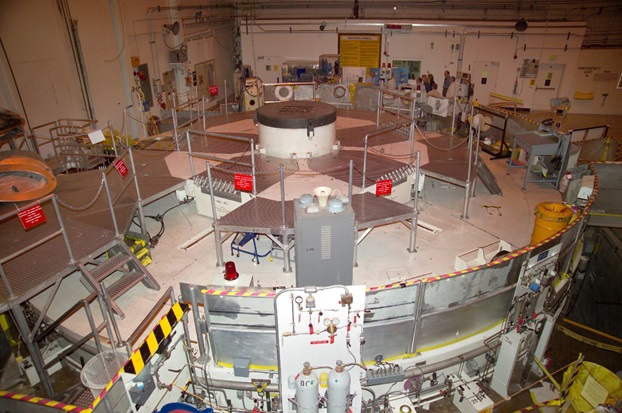
Part 2 of 2 Parts (Please read Part 1 first)
The ATR has been used to develop the reactors and fuels that can last the thirty-year lifespan of nuclear power U.S. warships. Because they don’t need to be refueled, the ships are able to spend more time on their mission and reduce the number of ships needed by the Navy. The USS Idaho is a Virginia-class nuclear powered attack submarine. It has definitely benefitted from the work done at the ATR. The submarine is scheduled to be launched in 2023 and it will spend about three decades in service.
“Experiments at the ATR include:
• Advanced Graphite Capsule: This experiment will test the effects of radiation on several types of graphite under consideration for the Next Generation Nuclear Plant program that currently have no high-flux temperature data available.
• Advanced Fuel Cycle Initiative / Light Water Reactor: The goal of the AFCI is to transmute longer-life fuels into shorter-life ones which would be able to be used in commercial light water reactors, to reduce the amount of waste that must be stored while increasing the fuel available for commercial reactors.
• Cobalt-60 Production: The least complex of current uses of the Advanced Test Reactor is the production of the 60Co radioisotope for medical uses. Disks of cobalt-59 1 mm -diameter by 1 mm thick are inserted into the reactor (Static Capsule Experiment), which bombards the sample with neutrons, producing cobalt-60. Approximately 200 kilocuries (7,400 TBq) are produced per year, entirely for medical uses.” Wikipedia
Neutrons cause the internal parts of the ATR to wear out over time. The reactor must by refurbished in order to be able to continue to carry out experiments. The original designers of the ATR foresaw the need for the ATR to be refurbished. They created a reactor with internal components that can be replaced when needed.
This summer, the ATR will be refurbished and improved with new components and experimental capacity. The ATR will undergo its sixth refurbishment since it was constructed in 1967 and the first refurbishment in 17 years. Hans Vogel is the director of the ATR Strategic Irradiation Capabilities Division. He and O’Kelly said that the most difficult challenge of the refurbishment will happen this summer when workers remove the sixty-two thousand pound stainless steel lid. Vogel also said, “Removing the reactor top head itself, that’s a 30-ton lift that we do, and that is a very infrequent evolution.” He mentioned that once the lid is removed, three months will be spent changing internal hardware. O’Kelly and Vogel said that the U.S. has considered spending billions of dollars to build a new test reactor but so far it has been decided to stick with the ATR.
The refurbishment will take nine months and cost one hundred and seventy-two million dollars. It is being referred to as a core internals replacement. The work began last months and is scheduled to be completed by the end of 2021. An additional one hundred million dollars has been spent over the last three years on replacing external equipment to keep the test reactor in operation.
Nuclear Reactors 902 – The Idaho National Laboratory Is Refurbishing The Advanced Test Reactor – Part 2 of 2 Parts