U.K. Labour Party’s deputy leader has backed its Copeland by-election candidate’s “100 per cent commitment to the nuclear industry”. newsandstar.co.uk
The UK intends to leave the European Atomic Energy Community (Euratom), according to explanatory notes to a bill the government published yesterday authorizing Brexit. The notes state the bill empowers the prime minister to leave both the European Union and Euratom. world-nuclear-news.org
The UK’s plan to leave Euratom has thrown into doubt the future of the Joint European Torus (JET), a nuclear-fusion facility in Culham, UK. nature.com
Small modular reactors (SMR) are in the news a lot these days. SMRs are designed to produce three hundred megawatts or less of electricity from nuclear fission. They will be built in modules in factories and shipped to the site where they will be assembled and operated. NuScale Power of Portland, Oregon just submitted a twelve thousand page application to the U.S. Nuclear Regulatory Commission to license the manufacture of the first commercial SMRs in the U.S.
The NuScale SMR design is a sixty-five foot self-contained reactor that uses enriched uranium for fuel. The NuScale SMRs will be built in a factory and shipped via truck, train or barge to their operational sites. Idaho National Laboratory would be the first customer for the NuScale SMRs. The plan is to build twelve fifty megawatt SMRs and immerse them in a cooling pool with eight million gallons of water.
The facility at the INL would be owned by Utah Associated Municipal Power Systems (UAMPS) which is an association of forty-five small utility companies in seven Western states focused on obtaining carbon-free energy sources. It will take years to plan and build the INL facility. The U.S. government is providing funding for planning and site development at INL. The U.S. government is supporting and encouraging the development of SMRs. New legislation has been passed by the U.S. House of Representative to make it easier to license SMRs.
Los Alamos County (LAC) in New Mexico is considering the purchase of a low power NuScale SMR. The model being considered would deliver sixteen megawatts of electricity. Eight megawatts would be used by residents and businesses of the county and eight megawatts would be used by the Los Alamos National Laboratory. LAC is a member of the UAMPS which is involved in the Idaho National Laboratory project. LAC has allocated fifty thousand dollars for a preliminary study of SMRs. County officials say that this is a very preliminary look at one of many possible future sources of low-carbon energy for the county.
LAC currently gets most of its power from hydroelectric projects on Abiquiu Lake and El Vado. It also gets a small amount from solar energy. The county wants to be carbon-neutral by 2040 and sees SMRs as one way of achieving that. The U.S. Department of Energy is expected to pay fifteen million dollars towards the research and planning phase of an SMR for LAC. Another seven and a half million dollars would come from NuScale with a final seven and a half million dollars from UAMPS for a total of thirty million dollars. The Department of Energy wants to have a low power SMR built and is willing to help with the upfront cost of the LAC SMR towards that end. There are “off-ramps” along the road to having an operational SMR in LAC if the county eventually decides that it does not want to have an SMR.
Supporters of SMRs for LAC point out that they are safer than conventional reactors because they shut down automatically if cooling systems fail. They are also cheaper to dispose of when their operational life is over. Critics in LAC point out that there are still security concerns and issues with disposing of spent fuel with SMRs. The critics would rather see the money invested in solar energy.
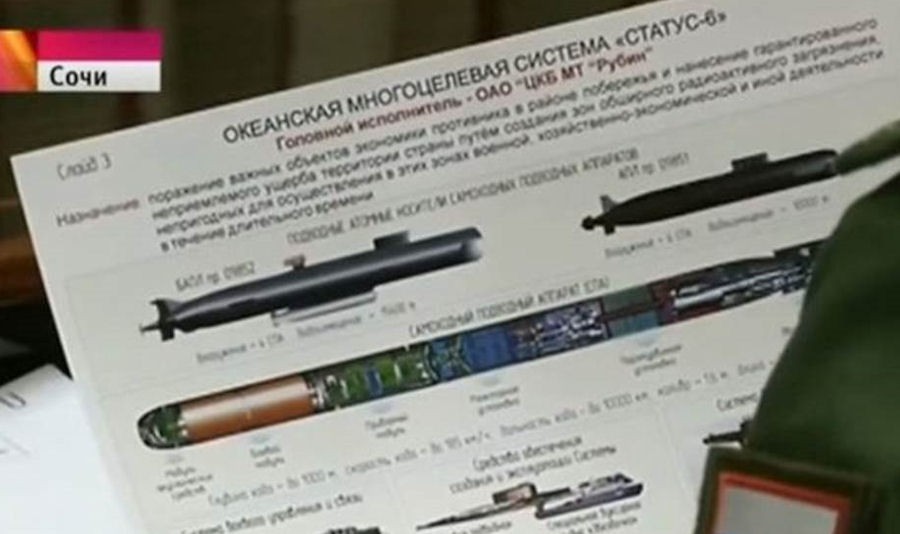
Back in 2015, I blogged about a supposed new Russian underwater drone with a nuclear warhead called “Ocean Multipurpose System: Status-6”. The plans for the drone were glimpsed in a Russian government video, suggesting that it was a deliberate “leak.” The basic idea was that the drone was fast and fitted with stealth technology that would make it impossible to detect. It would be brought near the coast of an enemy such as the U.S. and released. The drone would proceed undetected to close to the coast and release a torpedo with a nuclear warhead. The torpedo could run right into a busy port at sixty-five miles an hour and explode, contaminating hundreds of square miles and millions of people. Recently, it has been reported that the “new” drone system may not be so new after all.
Nuclear submarines have been around for many decades. The U.S. Nautilus was launched in 1955. The Soviet Union launched the K-3 Leninskiy Komsomol in 1958. The Russians have forty-five operation nuclear submarines. So the idea of using a nuclear submarine as a delivery system for a nuclear weapon in not new.
The U.S. developed remote-controlled underwater drones in the 1960s. They were used to find shipwrecks, check underwater cables, and for a variety of other uses. Britain worked on underwater drones in the 1970s and 1980s. Today, Germany, Sweden, China, the U.S. and Russia and other countries are all developing and deploying underwater drones for a variety of purposes. Many of the drones are used for civilian application but military drones are also being developed. Once again, underwater drones are hardly new developments.
Stealth technology for use in water has been under development since the 1980s. A variety of techniques has been created that can make an underwater vessel difficult to detect by sonar. However, the new techniques are certainly not capable of rendering a drone “impossible to detect.” The use of underwater stealth technologies while in constant evolution cannot be classified as a “new” technology.
Torpedoes have existed since the mid-1800s. The Russians developed a super-cavitating torpedo in the 1960s and it is still in service today. It has a special nose assembly that creates a bubble around the torpedo. This allows the rocket engine to propel the torpedo to speeds of two hundred miles per hour because the torpedo never actually touches the water. So the idea of a torpedo that travels at sixty five miles per hour being particularly fast is just absurd.
There is not a lot of information about the warhead on the drone. It could be a conventional nuclear warhead. Some say that it might be a neutron bomb that could kill millions of people. Neutron bombs have been around since the 1980s. Other reports say that a conventional explosive could be wrapped in Cobalt-60 to spread radioactive contamination over a wide area. The idea of such a “dirty bomb” has been around since the discovery of radioactive materials in the late 1800s and the understanding of the adverse effects of radiation on human health first realized in 1927. Not one of these warheads is a new concept.
While the Pentagon has stated that the Ocean Multipurpose System: Status-6 is a real Russian weapon, none of the technologies involved are new. The Russians may have combined old technologies into a new weapon that they are adding to their arsenal but any other major Western nation could easily duplicate such a weapon from well known technologies. And while underwater stealth technologies exist, they are not as perfect as implied by news stories on the Russian Ocean Multipurpose System: Status-6. Ultimately, there does not appear to be much reason for all the excited publicity about the system (including my original blog post). It is likely that the Russians allowed images of the system to “leak” specifically to alarm potential enemies.
Russian Ocean Multipurpose System: Status-6 “leaked” plans: