Category: Uncategorized

  • Geiger Readings for Sep 01, 2025

    Latitude 47.704656 Longitude -122.318745

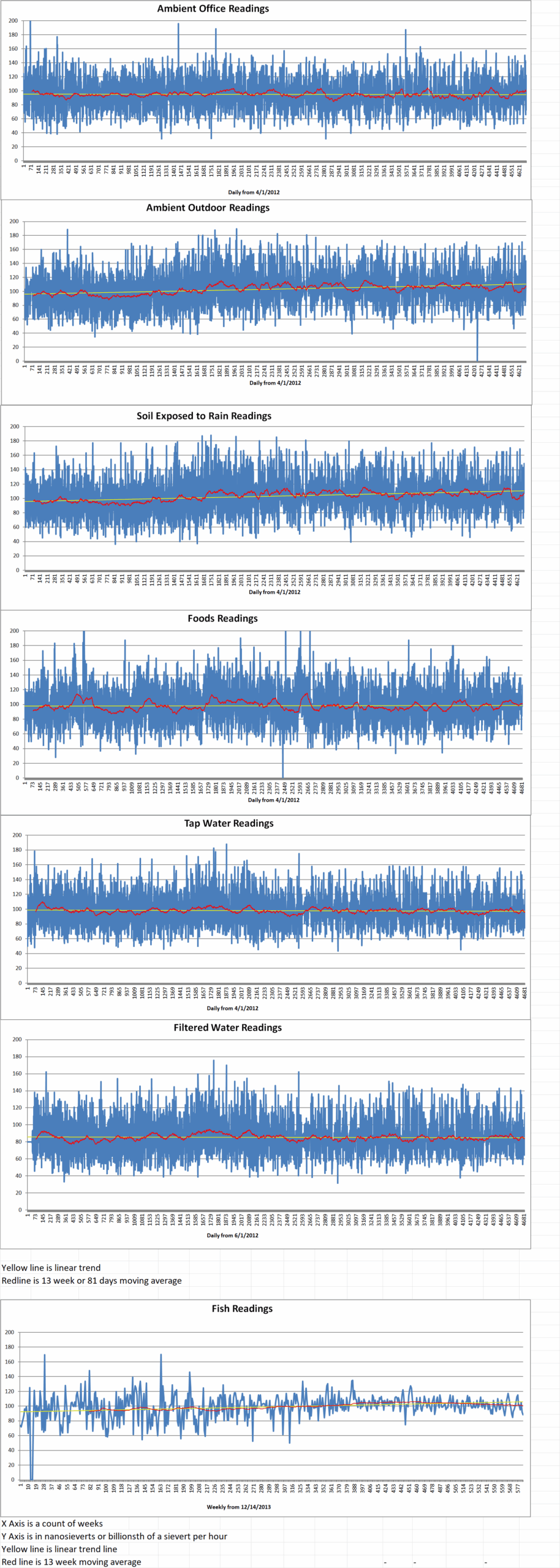
    Ambient office = 80 nanosieverts per hour

    Ambient outside = 115 nanosieverts per hour

    Soil exposed to rain water = 118 nanosieverts per hour

    Shitake mushroom from Central Market = 103 nanosieverts per hour

    Tap water = 115 nanosieverts per hour

    Filter water = 105 nanosieverts per hour

  • Geiger Readings for Aug 31, 2025

    Latitude 47.704656 Longitude -122.318745

    Ambient office = 73 nanosieverts per hour

    Ambient outside = 143 nanosieverts per hour

    Soil exposed to rain water = 148 nanosieverts per hour

    Heirloom tomato from Central Market = 113 nanosieverts per hour

    Tap water = 126 nanosieverts per hour

    Filter water = 114 nanosieverts per hour

  • Geiger Readings for Aug 30, 2025

    Latitude 47.704656 Longitude -122.318745

    Ambient office = 80 nanosieverts per hour

    Ambient outside = 134 nanosieverts per hour

    Soil exposed to rain water = 130 nanosieverts per hour

    Green onion from Central Market = 126 nanosieverts per hour

    Tap water = 101 nanosieverts per hour

    Filter water = 89 nanosieverts per hour

    Dover Sole from Central = 88 nanosieverts per hour

  • Nuclear Reactors 1580 – MIT Researchers Have Developed a System Which Utilizes X-Rays to Simulate Neutron Damage to Reactor Materials – Part 2 of 2 Parts

    A blue and white logo

AI-generated content may be incorrect.

    Part 3 of 3 Parts (Please read Parts 1 and 2 first)

    Dale Klein is a mechanical engineering professor at the University of Texas and former chair of the Nuclear Regulatory Commission. He said, “The market signals are even weaker for HALEU. He also noted that the U.S. doesn’t yet have any commercial reactors operating that would use HALEU. That’s a problem for the dozen-plus private and public planning to build Generation IV reactors.

    Klein said, “It is a chicken and egg situation. The fuel enrichers are not going to make the fuel unless they know they’ve got a market. You have to put in a lot more centrifuges, and you’re not sure what that market is going to be because none of these advanced reactors are running. It is an unsolved problem.”

    Centrus has its own competitors. Orano is a French government-owned company. In 2024, it announced plans to build a multibillion-dollar enrichment facility in Oak Ridge. But Orano has some limitations that Centrus doesn’t.

    Orano’s U.S. branch has publicized the proposed facility, but its chief executive in Paris said that they will not make a financial investment decision until 2027. In contrast, Centrus claims that it’s ready to scale up its Ohio facility which is already enriching small amounts of uranium as soon as it secures federal backing.

    Dan Leistikow is Centrus’ vice president of corporate communications. He wrote in an email that “Our facility is already licensed. We’ve secured $2 billion in customer contracts. As soon as federal funding is awarded, we’ll pair it with private dollars and get to work,” wrote in an email. “Centrus offers a fully American solution: proven U.S. technology, built by American workers.”

    Fleischmann believes that last point could be key to the company’s success. He explained, “Centrus’ strength is that they’re American, which means ultimately, if they get their act together, they’ll be able to produce weapons-grade uranium in addition to HALEU,” he said.

    The other major U.S. nuclear operator is Urenco. In 2010 they opened an enrichment plant in Eunice, New Mexico which is designed to produce one-third of U.S. utility requirements for enriched uranium.

    Data compiled from Urenco’s annual reports shows the plant’s annual capacity has dropped roughly twelve percent since 2018. No commercial enrichment facility in the U.S. or Europe lost that much capacity over the same time period.

    Nuclear experts say that the reason isn’t demand for fuel. If anything, demand for nuclear fuel is rising.

    Urenco uses “TC-21” centrifuge machines that are bigger and far more powerful than earlier commercial centrifuge technology known as the TC-12. Urenco has also deployed the bigger centrifuges in Germany and a few at Almelo in the Netherlands. Those two Urenco plants saw a respective ten percent and four percent decline in enrichment capacity since 2018.

    Publicly available information is limited on failure rates of the larger centrifuges. However, technical experts in academia and the industry say the large TC-21s enrich a lot of uranium but tend to fail more quickly than the earlier model. “The TC-12, were running for decades uninterrupted. That is an incredible feat,” said Terrani of Standard Nuclear.

    A Urenco-Orano joint venture keeps details about the technology closely guarded and have not responded to POLITICO’s E&E News’ request for failure rates of the two centrifuge models.

    Jeremy Derryberry is Urenco USA’s Director of Communications. He said that declining demand was the main reason for Eunice’s enrichment decline in capacity.

    Uranium prices sank after the Fukushima disaster in 2011, only months after the New Mexico facility opened. In the last three years, prices have risen due to restrictions on trade with Russia.

    Derryberry said, “At any enrichment facility, machine failures are to be expected, and ours are within our forecasts and expectations. We are actively deploying the TC-21 at Urenco sites in campaigns to expand new capacity and to refurbish existing capacity, and we believe it is a superior technology to what is being deployed at other facilities around the world.”

    Urenco is currently expanding its operations in New Mexico.

    Urenco

  • Geiger Readings for Aug 29, 2025

    Latitude 47.704656 Longitude -122.318745

    Ambient office = 93 nanosieverts per hour

    Ambient outside = 1 nanosieverts per hour

    Soil exposed to rain water = 66 nanosieverts per hour

    Corn from Central Market = 115 nanosieverts per hour

    Tap water = 75 nanosieverts per hour

    Filter water = 65 nanosieverts per hour

  • Nuclear Reactors 1579 – MIT Researchers Have Developed a System Which Utilizes X-Rays to Simulate Neutron Damage to Reactor Materials – Part 1 of 2 Parts

    A blue text on a black background

AI-generated content may be incorrect.

    Part 1 of 2 Parts

    MIT researchers have developed a technique that permits real-time, 3D monitoring of corrosion, cracking, and other material failure processes inside a nuclear reactor environment.

    This development could allow engineers and scientists to design safer nuclear reactors that also deliver higher performance for applications like electricity generation and naval vessel propulsion.

    During their experiments, the MIT researchers utilized extremely powerful X-rays to replicate the behavior of neutrons interacting with a material inside a nuclear reactor.

    They discovered that adding a buffer layer of silicon dioxide between the material and its substrate, and keeping the material under the X-ray beam for a longer period of time, improved the stability of the sample. This permits real-time monitoring of material failure processes.

    By reconstructing 3D image data on the structure of a material as it fails, researchers will be able to design more resilient materials that can better withstand the stress caused by irradiation inside a nuclear reactor.

    Ericmoore Jossou has shared appointments in the Department of Nuclear Science and Engineering (NSE), where he is the John Clark Hardwick Professor, and the Department of Electrical Engineering and Computer Science (EECS), and the MIT Schwarzman College of Computing. He said, “If we can improve materials for a nuclear reactor, it means we can extend the life of that reactor. It also means the materials will take longer to fail, so we can get more use out of a nuclear reactor than we do now. The technique we’ve demonstrated here allows researchers to push the boundary in understanding how materials fail in real-time.”

    Jossou is a senior author of a study on this technique. He is joined on the paper by lead author David Simonne, an NSE postdoc; Riley Hultquist, a graduate student in NSE; Jiangtao Zhao, of the European Synchrotron; and Andrea Resta, of Synchrotron SOLEIL. The research has been published in the journal Scripta Materiala.

    Simonne added, “Only with this technique can we measure strain with a nanoscale resolution during corrosion processes. Our goal is to bring such novel ideas to the nuclear science community while using synchrotrons both as an X-ray probe and radiation source.

    Studying real-time failure of materials used in advanced nuclear reactors has been a long-time goal of Jossou’s research group.

    Currently, researchers can only learn about such material failures after the fact, by removing the material from its environment and imaging it with a high-resolution instrument.

    Simonne continued, “We are interested in watching the process as it happens. If we can do that, we can follow the material from beginning to end and see when and how it fails. That helps us understand a material much better.”

    They simulate the process by firing a tightly focused X-ray beam at a sample to mimic the environment inside a nuclear reactor. The researchers must employ a special type of high-intensity X-ray, which is only available in a handful of experimental facilities worldwide.

    For their experiments they studied nickel, an element incorporated into alloys that are commonly used in advanced nuclear reactors. But prior to the start of the experiment, they had to prepare a sample.

    To do this, the researchers utilized a process called solid state dewetting. This process involves putting a thin film of a material onto a substrate and heating it to an extremely high temperature in a furnace until it transforms into single crystals.

    Jossou said, “We thought making the samples was going to be a walk in the park, but it wasn’t.”

    MIT Nuclear Research Laboratory

    Please read Part 2 next