Category: Uncategorized

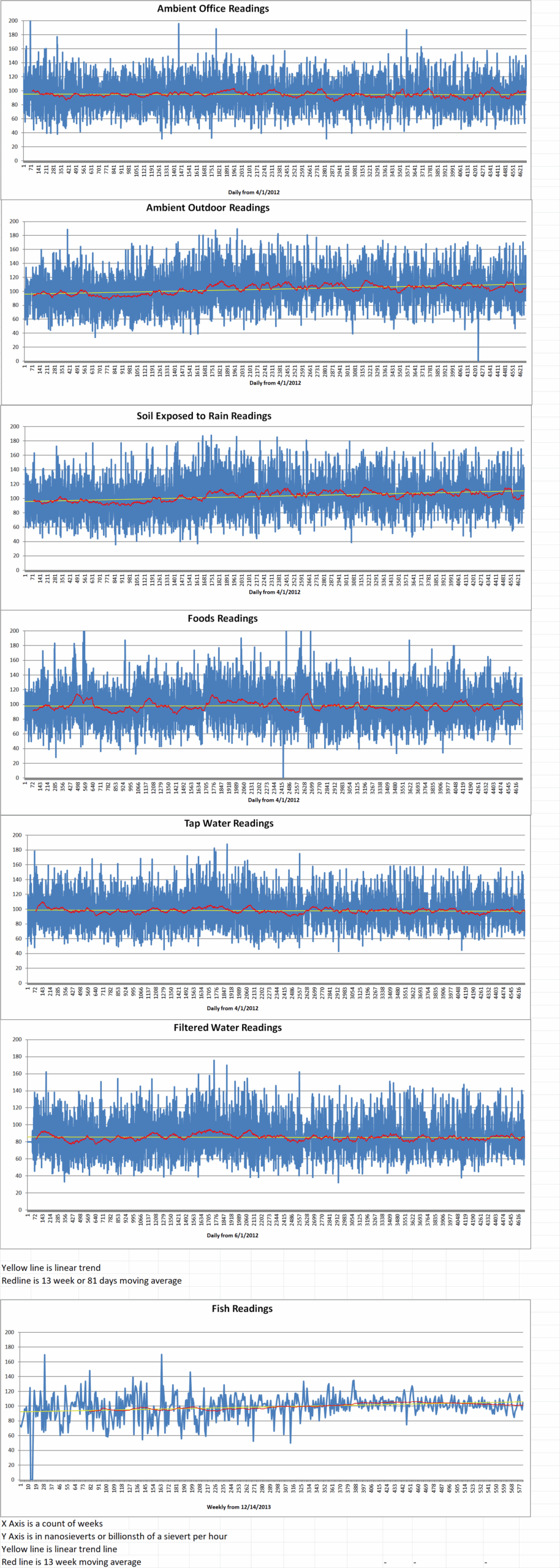
  • Geiger Readings for Aug 24 2025

    Latitude 47.704656 Longitude -122.318745

    Ambient office = 66 nanosieverts per hour

    Ambient outside = 108 nanosieverts per hour

    Soil exposed to rain water = 106 nanosieverts per hour

    Yellow bell pepper from Central Market = 85 nanosieverts per hour

    Tap water = 74 nanosieverts per hour

    Filter water = 70 nanosieverts per hour

  • Geiger Readings for Aug 23, 2025

    Latitude 47.704656 Longitude -122.318745

    Ambient office = 87 nanosieverts per hour

    Ambient outside = 99 nanosieverts per hour

    Soil exposed to rain water = 106 nanosieverts per hour

    Roma tomato from Central Market = 103 nanosieverts per hour

    Tap water = 102 nanosieverts per hour

    Filter water = 93 nanosieverts per hour

    Dover Sole from Central = 93 nanosieverts per hour

  • Nuclear Reactors 1575 – Blykalla and Norsk Kjernekraft Collaborate to Construct First SMR in Norway

    A black and white logo

AI-generated content may be incorrect.

    An assessment program has been submitted to the Governor of Svalbard in Norway for the construction of a small modular reactor (SMR) power plant on the Norwegian Arctic Archipelago, marking the first formal step towards building the facility.

    In June of this year, Swedish lead-cooled SMR technology developer Blykalla and Norwegian nuclear project developer Norsk Kjernekraft announced the creation of a joint project company, Svalbard Kjernekraft AS.

    Longyearbyen is the administrative center of the Svalbard archipelago. It was powered by coal until 2023. Since the closure of the coal plant, temporary diesel generator have been installed, resulting in higher costs and reduced reliability. Blykalla and Norsk Kjernekraft intend to build a compact SMR that connects to the existing electricity and district heating grid, effectively replacing the old coal infrastructure.

    Svalbard Kjernekraft has submitted a planning initiative for a Swedish Advanced Lead Reactor lead-cooled (SEALER) SMR in Longyearbyen. The document describes the project, local conditions and suggests topics for further investigation. The list of topics includes the environment and biodiversity, safety, waste management, ripple effects for society and effects on local businesses and jobs. The final location for the nuclear power plant will be determined following the impact assessment.

    Blykalla said, “With the planning initiative submitted, the next stage is for the Governor of Svalbard to set the scope of the environmental impact assessment. Once that is in place, detailed studies and stakeholder consultations can begin, paving the way for the licensing process and eventual construction.”

    Janne Wallenius is the co-founder and CTO of Blykalla. He said, “We are proud that this Swedish technology can deliver stable, emissions-free power to Svalbard. Our lead-cooled reactors are ideal for this kind of remote application. We are proud that this Swedish technology can deliver stable, emissions-free power to Svalbard. Our lead-cooled reactors are ideal for this kind of remote application.”

    Blykalla added, “The company said the Longyearbyen project will “also serve as a showcase for how advanced SMR technology can help secure energy supply in places with limited energy capacity, both in the Nordics and around the world”.

    Jonny Hesthammer is the CEO of Norsk Kjernekraft. He added, “This collaboration marks a new chapter in Norway’s history as a polar nation. Reliable and affordable energy is a prerequisite for Norway’s continued assertion of sovereignty in Svalbard, especially given the current geopolitical situation. Now that the coal-fired power plant in Longyearbyen has been closed, nuclear power is the only long-term solution to maintain energy security without using fossil fuels.”

    In February of this year, a Memorandum of Understanding (MoU) was signed between Blykalla and Norsk Kjernekraft to partner on the deployment of Blykalla’s SEALER in Scandinavia. Under the MoU, the two companies are to review the business case for integrating the SEALER into power plant projects currently under development by Norsk Kjernekraft, evaluating site suitability, regulatory pathways, and economic feasibility for deployment in Norway. In addition, the agreement outlines collaboration on licensing, financing, construction, and operational aspects of Blykalla’s first reactor, SEALER-One, in Sweden. The MoU also includes an agreement to explore the possibility of providing electricity to remote locations.

    Blykalla was formerly called LeadCold. It is a spin-off from the KTH Royal Institute of Technology in Stockholm, where lead-cooled reactor systems have been under development since 1996. The company was founded in 2013 as a joint stock company. It is developing the SEALER SMR.

    SEALER-One is Blykalla’s first nuclear reactor and commercial venture in the nuclear industry. It will serve as a demonstration of its technology, and at the same time be used for pyrolysis. Industrial customers can utilize its steam for decarbonized biochar production. The company intends to achieve criticality of SEALER-One by 2029.

    Blykalla

  • Geiger Readings for Aug 22, 2025

    Latitude 47.704656 Longitude -122.318745

    Ambient office = 143 nanosieverts per hour

    Ambient outside = 80 nanosieverts per hour

    Soil exposed to rain water = 73 nanosieverts per hour

    Red bell pepper from Central Market = 105 nanosieverts per hour

    Tap water = 85 nanosieverts per hour

    Filter water = 75 nanosieverts per hour

  • Nuclear Reactors 1573 – Scientists Research Degradation of Irradiated Graphite – Part 1 of 2 Parts

    A collage of a room with a computer desk and a blue sign

AI-generated content may be incorrect.

    Part 1 of 2 Parts

    Graphite is a key structural component in some of the world’s oldest nuclear reactors and many of the next-generation designs that are being constructed today. However, it also condenses and swells in response to radiation and the mechanism behind those changes has proven difficult to study.

    MIT researchers and collaborators have just uncovered a link between properties of graphite and how the material behaves in response to radiation. The findings could yield more accurate, less destructive ways of predicting the lifespan of graphite materials used in reactors around the world.

    Research Scientist Boris Khaykovich is the senior author of the new study. He said, “We did some basic science to understand what leads to swelling and, eventually, failure in graphite structures. More research will be needed to put this into practice, but the paper proposes an attractive idea for industry: that you might not need to break hundreds of irradiated samples to understand their failure point.”

    Specifically, the study indicates a connection between the size of the pores within graphite and the way the material swells and shrinks in volume, leading to degradation.

    Lance Snead is the co-author and a MIT Research Scientist. He said, “The lifetime of nuclear graphite is limited by irradiation-induced swelling. Porosity is a controlling factor in this swelling, and while graphite has been extensively studied for nuclear applications since the Manhattan Project, we still do not have a clear understanding of the porosity in both mechanical properties and swelling. This work addresses that.”

    The open-access paper was published this week in the journal Interdisciplinary Materials. It was co-authored by Khaykovich, Snead, MIT Research Scientist Sean Fayfar, former MIT research fellow Durgesh Rai, Stony Brook University Assistant Professor David Sprouster, Oak Ridge National Laboratory Staff Scientist Anne Campbell, and Argonne National Laboratory Physicist Jan Ilavsky.

    Graphite has played a central role in the generation of nuclear energy ever since 1942, when physicists and engineers built the world’s first nuclear reactor on a converted squash court at the University of Chicago. That first reactor, called the Chicago Pile, was constructed from about forty thousand graphite blocks, many of which contained nuggets of uranium.

    Today graphite is an important component of many operating nuclear reactors and is expected to play a central role in next-generation reactor designs like molten-salt and high-temperature gas reactors. Graphite is an excellent neutron moderator, slowing down the neutrons released by nuclear fission so that they are more likely to create fissions themselves and sustain a chain reaction.

    Khaykovich explained, “The simplicity of graphite makes it valuable. It’s made of carbon, and it’s relatively well-known how to make it cleanly. Graphite is a very mature technology. It’s simple, stable, and we know it works.”

    Khaykovich continued, “We call graphite a composite even though it’s made up of only carbon atoms. It includes “filler particles” that are more crystalline, then there is a matrix called a “binder” that is less crystalline, then there are pores that span in length from nanometers to many microns.”

    Each grade of graphite has its own composite structure, but they all contain fractals, or shapes that look the same at different scales. Those complexities have made it difficult to predict how graphite will respond to radiation in microscopic detail. It’s been known for decades that when graphite is irradiated, it first densifies, reducing its volume by up to ten percent, before swelling and cracking. The fluctuation of volume is caused by changes to graphite’s porosity and lattice stress.

    MIT Nuclear Research Laboratory

    Please read Part 2 next

  • Geiger Readings for Aug 21, 2025

    Latitude 47.704656 Longitude -122.318745

    Ambient office = 143 nanosieverts per hour

    Ambient outside = 122 nanosieverts per hour

    Soil exposed to rain water = 122 nanosieverts per hour

    Heirloom tomato from Central Market = 66 nanosieverts per hour

    Tap water = 85 nanosieverts per hour

    Filter water = 73 nanosieverts per hour