Category: Uncategorized

  • Geiger Readings for Apr 13, 2020

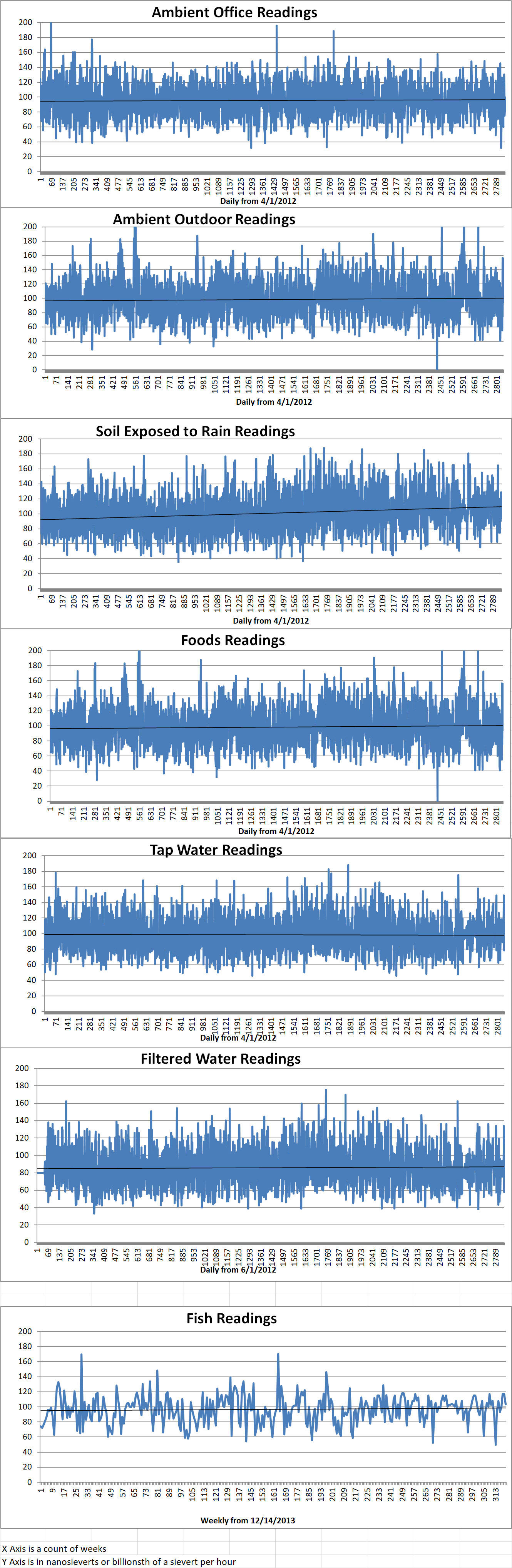
    Ambient office  = 69 nanosieverts per hour

    Ambient outside = 163 nanosieverts per hour

    Soil exposed to rain water = 158 nanosieverts per hour

    English cucumber from Central Market = 98 nanosieverts per hour

    Tap water = 123 nanosieverts per hour

    Filtered water = 107 nanosieverts per hour

  • Geiger Readings for Apr 12, 2020

    Geiger Readings for Apr 12, 2020

    Ambient office  = 80 nanosieverts per hour

    Ambient outside = 102 nanosieverts per hour

    Soil exposed to rain water = 102 nanosieverts per hour

    Broccoli from Central Market = 98 nanosieverts per hour

    Tap water = 108 nanosieverts per hour

    Filtered water = 95 nanosieverts per hour

  • Geiger Readings for Apr 11, 2020

    Geiger Readings for Apr 11, 2020

    Ambient office  = 82 nanosieverts per hour

    Ambient outside = 97 nanosieverts per hour

    Soil exposed to rain water = 96 nanosieverts per hour

    Beefsteak tomato from Central Market = 98 nanosieverts per hour

    Tap water = 113 nanosieverts per hour

    Filtered water = 99 nanosieverts per hour

    Dover sole – Caught in USA = 103 nanosieverts per hour

  • Nucear Reactors 771 – Increasing Interest In Nuclear Power Among African Nations – Part 2 of 2 Parts

    Nucear Reactors 771 – Increasing Interest In Nuclear Power Among African Nations – Part 2 of 2 Parts

    Part 2 of 2 Parts (Please read Part 1 first)
         Chipala has admitted that nuclear power plants are not cheap. However, he said that both Russia and China have indicated that they are interested in helping to fiancé any nuclear power projects in Zambia which hopes to have an operating nuclear power plant in the next ten to fifteen years.
         Egypt intends to begin the construction of its first nuclear power plant in July with the assistance of Russian financing.
        Gillane Allam is an ambassador from the Egyptian Council for Foreign Affairs. He recently said at a conference that adopting nuclear power in Africa would help end power cuts that were crippling economies across the continent.
        Akachukwu Okafor is a principal partner for Change Partners International, an energy and sustainability consultancy in Nigeria. He said that while nuclear power might not be the only answer to Africa’s problems, he did believe that it could be part of the answer along with renewable energy sources such as solar and wind. What will work to solve problems varies from country to country.
        Some African countries are considering nuclear power as part of a broader effort along with wind and solar to expand their power grids in a low-carbon way. Kenya and Ethiopia are members of this group.
         Benson with Power for All said that off-grid renewables projects are a smart choice for cash strapped African nations because they do not require expensive connections to the national grids. This will be critical in expanding energy access to the one third of African who do not have such access. He also said, “Given that close to 80 percent of Africans reside in rural areas, decentralized renewable energy makes sense.” Solar energy is also safer than nuclear energy because there is no environmentally hazardous spent nuclear fuel and no huge up-front expenditure to fund construction.
        Lassina Zerbo is the executive secretary of the Comprehensive Nuclear-Test-Ban Treaty Organization. He pointed out that any investment in nuclear technology in Africa will need strong cooperation with neighboring countries, a culture of transparency and accountability and a willingness to work together to deal with technological and security issues. He added that a lack of cooperation among African nations is one of the major challenges that is hold back efforts to establish commercial nuclear power generation on the continent.
          Colin Namalambo with the African Commission on Nuclear Energy said that there is a great need to establish legal frameworks in Africa before African nations should venture into nuclear energy production. This would include nuclear non-proliferation, safety and security.
         The scandal in South Africa over secret dealings with Russia to sign a contract for the construction of a nuclear power plant caused turmoil last year and almost brought down the government. There are serious questions with the respect to the need to construct huge centralized nuclear power plants in view of the fact that many of African nations do not have a widely distributed reliable national grid that would carry electricity to those who need it.
         There are also critical questions about the political leverage that goes along with financing nuclear power projects. Russia and China would gain an enormous amount of power over the domestic and foreign policy policies of any nation where they financed nuclear power.

  • Geiger Readings for Apr 10, 2020

    Geiger Readings for Apr 10, 2020

    Ambient office  = 100 nanosieverts per hour

    Ambient outside = 90 nanosieverts per hour

    Soil exposed to rain water = 95 nanosieverts per hour

    Tomato from Central Market = 81 nanosieverts per hour

    Tap water = 79 nanosieverts per hour

    Filtered water = 58 nanosieverts per hour

  • Nucear Reactors 770 – Increasing Interest In Nuclear Power Among African Nations – Part 1 of 2 Parts

    Nucear Reactors 770 – Increasing Interest In Nuclear Power Among African Nations – Part 1 of 2 Parts

    Part 1 of 2 Part
           Africa is experiencing shortfalls of electrical power, demands for more use of greener energy and threats of droughts to seriously reduce hydropower generation. Many African nations are now considering a move to nuclear power.
        The only commercial nuclear power plant in Africa is located in South Africa. However, the International Atomic Energy Agency (IAEA) has reported that ten out of the thirty countries in the world that are considering nuclear power are located in Africa.
        Ghana, Kenya, Egypt, Morocco, Niger, Nigeria and Sudan are currently meeting with the IAEA in order to assess their readiness to conduct their own nuclear power programs.  Algeria, Tunisia, Uganda and Zambia are also considering the possibility of requesting IAEA assistance.
         According to public announcements and the World Nuclear Association, Russia has signed agreements with seven sub-Saharan nations to assist them in the deployment nuclear power. Colin Namalambo is a commissioner of the African Commission on Nuclear Energy. He says that “Africa is embracing nuclear science in general.”
          Even though solar and wind power may be a cheaper and greener way to expand the production of electrical power in Africa, nuclear power is still being considered on a continent where one of three people does not have access to electricity.
        Benson Kibiti is director of communications for Power for All which intends to provide access to electricity to the over one billion people in Africa with no electricity in the next ten years. He says that off-grid solar is the best choice economically for Africa.
         He wrote in an email recently that “While I agree that the continent is in dire need of energy, with 600 million people still living without access to electricity, it takes 10 years and billions of dollars to commission a nuclear power station.”  He argued that this fact makes nuclear power a far too expensive choice. He added that off-grid solar is and should be Africa’s energy future.
         African nations from Egypt to Ghana are moving ahead with nuclear power programs. They argue that nuclear power is low-carbon and can provided reliable baseline energy in combination with renewable energy sources such as wind and solar. Prince Akor Larbi is a technician with the Ghana Atomic Energy Commission. He says that nuclear power will be clean and sustainable.
         In southern Africa climate change has been drying up the lakes behind hydroelectric dams. This has been a major cause of the serious consideration now being given to nuclear power in the affected regions. Those dams provide a majority of electricity for many south African nations from Zimbabwe to Zambia.
        The Zimbabwe Electricity Supply Authority was forced to reduce energy production for eighteen hours at Lake Kariba because of low water levels. They are still plagued by power shortages. Zambia is now discussing adding nuclear power to reinforce its energy mix and provide a stable reliable source of power. Mwape Chipala is an energy ministry spokesman. He said, “This is in order to have security of supply from all sources of energy and to prevent what is happening in Lake Kariba as a result of hydropower dependence.”
    Please read Part 2 next