Category: Uncategorized

  • Geiger Readings for Apr 17, 2020

    Geiger Readings for Apr 17, 2020

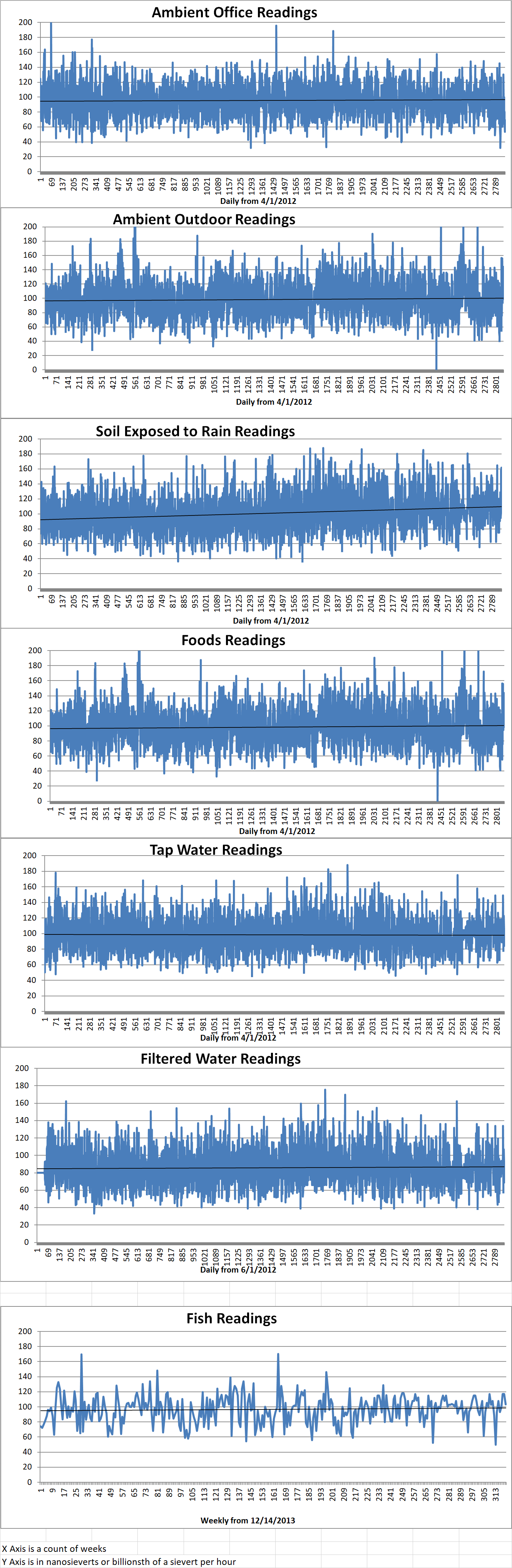
    Ambient office  = 86 nanosieverts per hour

    Ambient outside = 157 nanosieverts per hour

    Soil exposed to rain water = 155 nanosieverts per hour

    Tomato from Central Market = 93 nanosieverts per hour

    Tap water = 97 nanosieverts per hour

    Filtered water = 70 nanosieverts per hour

  • Pacific Northwest National Laboratory Developing Laser Ablation For Analysis Of Uranium Debris From Nuclear Explosions – Part 1 of 2 Parts

    Pacific Northwest National Laboratory Developing Laser Ablation For Analysis Of Uranium Debris From Nuclear Explosions – Part 1 of 2 Parts

    Part 1 of 2 Parts
      Many sophisticated laboratory tests have been developed for determining the composition of a material of interest. However, there are times when it is just not possible to bring a sample into the laboratory for testing. One example would be testing contents of shipping containers on the dock. Another would be analyzing a rock on the surface of Mars.
       Radioactive materials such as uranium are especially difficult to analyze with respect to nuclear explosions and the debris left behind. Detection systems that can be done quickly onsite reduce human exposure that could occur during hazardous collection or laboratory analysis.
           Nuclear chemistry in general and the way that uranium interacts chemically with oxygen during a nuclear explosion in particular are poorly understood. This makes it difficult to accurately identify materials involved in nuclear explosions.
         The Pacific Northwest National Laboratory (PNNL) is one of the United States Department of Energy national laboratories. “It draws on signature capabilities in chemistry, earth sciences, and data analytics to advance scientific discovery and create solutions to the nation’s toughest challenges in energy resiliency and national security.” Now a team of researchers at Pacific Northwest National Laboratory is working to expand our knowledge of uranium chemistry by using lasers. The leader of the PNNL team is physicist Sivanandan S. Harilal.
        The work of the PNNL team is detailed in a recent report published in the Journal of Analytical Atomic Spectrometry. The PNNL team shows how the analysis of the light emitted from plasmas created by a laser can be utilized to comprehend uranium oxidation in nuclear fireballs. This method yields new insights into the uranium gas-phase oxidation during nuclear explosions. The work of the PNNL team should accelerate progress toward the creation of a reliable, non-contact method for the remote detection of uranium and isotopes. The creation of such analytical methods has serious implications for the creation of nonproliferation safeguards, nuclear explosion monitoring and verification of adherence to international treaties.
          The PNNL method involves using a pulse of an extremely fast laser to blast a solid material. The laser beam excites the atoms and causes some of them to vaporize generating a tiny, brightly colored plasma plume. When the atoms jump into the superhot plasma plume, the light that is emitted is captured and studied by optical spectroscopy.
        Plasmas generated from different elements at different temperatures emit different wavelengths of light. Each plasma produces a distinct color related to the element(s) and temperatures. The color of the plasma from a candle is different than the color of a plasma made in a neon sign. And both are different than the color of a uranium plasma.
        The distinctive colors of light emitted by a plasma are exactly the same without regard to the size of the sample that is vaporized into a plasma. Although some material is vaporized to make a plasma in the PNNL research, the amount is so small that their method is considered to be non-destructive. The light emitted by the tiny plasma at the PNNL is similar to the chemical and nuclear transactions that are unleashed in a nuclear explosion.
    Please read Part 2 next

  • Geiger Readings for Apr 16, 2020

    Geiger Readings for Apr 16, 2020

    Ambient office  = 69 nanosieverts per hour

    Ambient outside = 158 nanosieverts per hour

    Soil exposed to rain water = 160 nanosieverts per hour

    Avocado from Central Market = 109 nanosieverts per hour

    Tap water = 84 nanosieverts per hour

    Filtered water = 69 nanosieverts per hour

  • Geiger Readings for Apr 15, 2020

    Geiger Readings for Apr 15, 2020

    Ambient office  = 61 nanosieverts per hour

    Ambient outside = 165 nanosieverts per hour

    Soil exposed to rain water = 162 nanosieverts per hour

    Red bell pepper from Central Market = 144 nanosieverts per hour

    Tap water = 93 nanosieverts per hour

    Filtered water = 77 nanosieverts per hour

  • Geiger Readings for Apr 14, 2020

    Geiger Readings for Apr 14, 2020

    Ambient office  = 53 nanosieverts per hour

    Ambient outside = 158 nanosieverts per hour

    Soil exposed to rain water = 161 nanosieverts per hour

    Blueberry from Central Market = 101 nanosieverts per hour

    Tap water = 100 nanosieverts per hour

    Filtered water = 88 nanosieverts per hour

    Dover sole – Caught in USA = 116 nanosieverts per hour

  • Nuclear Weapons 725 – Iran Has Not Admitted The Existence Of An Old Nuclear Weapons Facility

    Nuclear Weapons 725 – Iran Has Not Admitted The Existence Of An Old Nuclear Weapons Facility

        An international team of nuclear experts has just identified a new previously undisclosed Iranian nuclear weapons site. They are calling on Tehran to admit the existence of the newly identified site to international inspectors.
        The (ISIS) reveal Wednesday that it has uncovered evidence that Iran operated a nuclear weapons construction facility in norther Iran until at least 2011. The experts believe that the facility was destroyed as Western nations began a detailed investigation of Iran’s nuclear weapons program. Information about the nuclear weapons facility was discovered in a batch of records that were recently smuggled out of Iran by the Israelis.
         Iran is required by international law to declare all of its former nuclear weapons sites to international inspectors. However, Iran has never declared the new site identified by the international team of nuclear experts at ISIS. According to the ISIS team, “The facility was intended as a pilot plant, aimed at developing and making uranium components for nuclear weapons, in particular components from weapon-grade uranium, the key nuclear explosive material in Iranian nuclear weapon cores. The key building of the site, the uranium metals workshop, was apparently gutted and abandoned between late 2010 and early 2011.”
         It is believed that Iran destroyed the newly identified site after the international community discovered the existence of the Fordow nuclear enrichment plant in 2009. Fordow was a military bunker tunneled into the side of a mountain. It contained a great deal of Iran’s nuclear weapons program infrastructure.
         David Albright is the president and founder of ISIS. He has called on Iran to explain the existence of this nuclear weapons facility site to the International Atomic Energy Agency. He said, “Iran should declare this site to the International Atomic Energy Agency and allow its inspection, since the facility was designed and built to handle nuclear material subject to safeguards under Iran’s comprehensive safeguards agreement. The IAEA, more generally, should verify sites, locations, facilities, documentation, equipment, and materials involved in the Amad Plan activities, and urge Iran to cooperate fully in these investigations, despite their age, as part of ensuring that Iran has not continued nuclear weapons work up to today.”
        Albright said in an interview that the existence of the site had not been made public before Wednesday and that it is unlikely that Western nations knew about it prior to the theft of the nuclear documents by Israel. He added, “This site may have been close to being able to make weapon-grade uranium cores for nuclear weapons, albeit no evidence Iran had any weapon-grade uranium yet. But the site highlights concretely that Iran was putting in place a nuclear weapons production industry, not just a development program, and there is no evidence of its destruction.” This revelation and other evidence reviewed by the experts strongly suggests that Iran has not fully ended its pursuit of nuclear weapons. It may just be biding its time while it is under intense surveillance by Western nations.
        Andrea Stricker is a non-proliferation expert and research fellow at the Foundation for Defense of Democracies. She said that the discovery of this new Iranian site “shows the extent to which Tehran lied to international inspectors about its past and possibly ongoing nuclear weapons program. It is possible that the site provided information that Iran could be using for nuclear weapons research today.”
        “It could have been used to make actual nuclear weapon cores until a larger, planned facility called Shahid Boroujerdi was brought online. What’s more, there is no guarantee that these uranium metallurgy activities stopped, since the archive information shows intentions to move and hide military nuclear activities after 2003. Today, Tehran is closer to a nuclear weapon than previously thought. The IAEA needs to undertake a full investigation in Iran to ensure that its nuclear program is strictly peaceful.”