Part 2 of 4 Parts (Please read Part 1 first)
The irony of the current situation is rich. While Goldman Sachs, Microsoft, and Amazon promote SMRs as the solution to everything from AI’s growing energy hunger to coal’s continuing decline, the nuclear vendors themselves won’t promise nuclear power will be any cheaper than renewable power. Maybe they recall the Westinghouse executives who were imprisoned for defrauding the public on nuclear project costs. It is pure fantasy to believe that smaller, less powerful SMRs will magically generate cheap electricity. Power generation just doesn’t work that way.
For decades, the public was told that electricity generated by nuclear power was going to be “too cheap to meter.” Instead, nuclear power continues to be too expensive to afford and too complex to run reliably.
For the last seventy-five years, the American public has been the “buyer of last resort” for hundreds of loss-making nuclear power plants first developed during the administration of President Dwight Eisenhower under the Atoms for Peace initiative. Not one single nuclear power reactor has ever been built in the U.S. on time or on budget. Another one hundred and thirty nuclear power rectors were canceled before they ever produced a single watt of electricity. No commercial power reactors were financially viable without massive taxpayer subsidies.
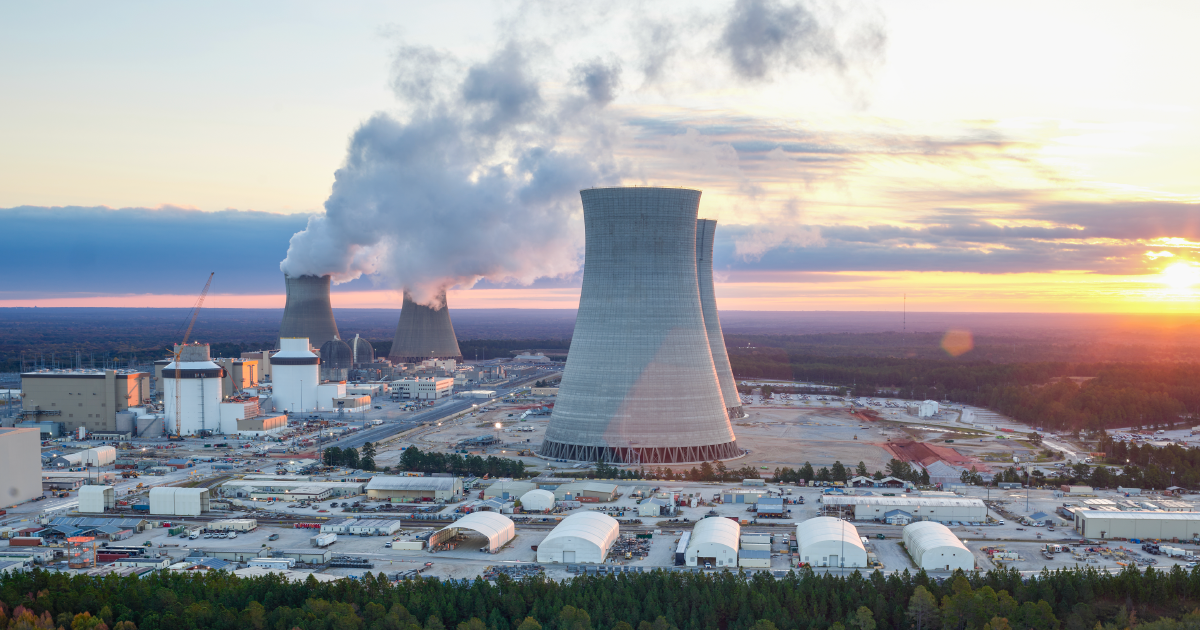
In the early 2000s, the industry tried to stage a comeback, promising a “Nuclear Renaissance.” Two dozen new reactors were announced, but as time went by, all but two were canceled. The only surviving nuclear power reactors from that push, Vogtle Units 3 and 4 in Georgia, deliver the most expensive electricity in the country, at twice the projected cost and years behind schedule.
Now, it’s a new century, and the nuclear industry has turned to SMRs. The new pitch is that assembly-line production of SMRs will ensure quality and lower costs. However, assembly lines can replicate flaws just as efficiently as they can replicate working parts. In the 1970s, an inspection of the output of a Chattanooga factory that supplied reactor vessels to the nuclear industry found that every reactor vessel checked had contaminated welds. In addition, six reactors arrived at their sites with factory-induced damage, which limited their lifespans and reduced their efficiency.
Every steam generator ever built for U.S. reactors has failed prematurely. Replacement generators also failed, sometimes within a year. SMRs will use the same technology as the current power reactors, but somehow nuclear enthusiasts would have us believe that the outcome will be different this time.
Early prototypes of small reactors about the size of today’s SMRs failed regularly, sometimes catastrophically. The SL-1 reactor in Idaho exploded, killing all three operators. The Wall Street Journal called these plants “Atomic Lemons” which were costlier and less efficient than anyone expected.
At the Millstone Nuclear Power Plant, the plant was shut down for months at a time due to repeated mechanical failures in Reactor 1. After fixing one problem, the same issue might crop up a year later.
Plant Vogtle: Alvin W. Vogtle Nuclear Power Plant in Georgia
Please read Part 3 next
Part 3 of 4 Parts (Please read Parts 1 and 2 first)
Novelty is often accompanied by uncertainty. While SMRs and conventional nuclear power reactors both fall under the umbrella of nuclear fission reactors, the similarities largely end there. The mechanical and electrical differences between these two concepts are significant. SMRs introduce a host of new engineering challenges that have not been thoroughly analyzed or experienced in traditional nuclear power plants. This potentially offsets any anticipated benefits and prolongs the path to reliable deployment.
Each of these changes introduces new opportunities for failure. None of them are well understood and all of them are expensive to fix. SMRs introduce a host of untested problems, including using close to weapons-grade higher-enriched uranium, raising proliferation and safety concerns.
If anything, their smaller size actually exacerbates some problems. The compact cores of SMRs can leak more neutrons than conventional reactor cores. This leads to more complex damage to the nuclear reactor itself and different radioactive waste streams. This radioactive waste is harder and more expensive to manage and dispose of.
Despite the “modular” promise, each SMR is still a massive piece of radioactive infrastructure, requiring the same level of security, emergency planning, and long-term waste management as any other commercial nuclear reactor.
SMRs present all the risk and complexity of a conventional power reactor, but at even higher costs per unit of energy, due to the loss of economies of scale. This is why nuclear power has never been financially viable. Every plant built in the U.S. required public subsidies. Every single attempt to reduce unit costs by increasing reactor size, designing the plant in factory modules, or eliminating safety features has ended in disaster or disappointment.
The industry’s new claim that mass-producing SMRs will lower costs ignores the harsh lessons of economies of scale. In the development of nuclear power, bigger was always supposed to be better. Now, suddenly, people are supposed to believe that smaller is the answer.
There is no better example of failed SMR promises than the much-publicized NuScale SMR project in Utah that was set to be the first SMR built in the U.S.? However, last November, citing soaring costs, the Utah Associated Municipal Power Systems (UAMPS) canceled the project. Since it was announced in 2015, the UAMPS project planned on building twelve reactors by 2023 for a cost of $3 billion. By the time it was canceled in November of last year, cost estimates had tripled.
Agencies like the U.S. Nuclear Regulatory Commission (NRC) are supposed to be looking out for the public interest. However, the NRC has repeatedly weakened safety and staffing requirements at the behest of SMR vendors. This is called “regulatory capture”.
Dr. Edwin Lyman is with the Union of Concerned Scientists. He said, “The NRC is truly a captured agency… NEI complained that the agency’s proposed language for a new rule to weaken security for new nuclear reactors was too stringent. So, the NRC complied and completely eviscerated the draft. Pathetic.”
NuScale
Please read Part 4 next
Part 4 of 4 Parts (Please read Parts 1, 2, and 3 first)
But none of this has stopped nuclear vendors from touting their SMR hopefuls:
-
Holtec has never built a reactor. Its design has been revised three times in three years, each version larger, and more complex and expensive than the last. At one point, Holtec even claimed its reactor would be as safe as a chocolate factory.
-
Natrium is backed by Bill Gates. It uses liquid sodium coolant and a thermal storage gimmick. The design is so complex that the only thing it is likely to generate is more press releases and perhaps a few more government grants. The only fuel available for Natrium’s first core load was supposed to come from Russia. When Russia invaded Ukraine, the Natrium project was immediately delayed by at least two years. This exposed the folly of building a new generation of reactors dependent on a single, geopolitically fraught source of fuel.
-
NuScale was the first to get NRC approval for an SMR design, but it has no customers and just canceled its flagship project due to cost overruns. Its original fifty-megawatt design was quickly upsized to seventy-seven megawatts after the economics failed to add up. After revisiting the drawing board, the new version was just approved in May of this year, but there are no unsubsidized potential buyers.
-
Westinghouse’s conventional AP1000 reactors in Georgia nearly bankrupted the company. Now it has returned to the market-place with an even smaller AP300. Apparently, it’s philosophy is “if at first you don’t succeed, shrink the reactor and try again”.
The world’s financial and tech giants are lining up behind SMRs, as long as they are subsidized by someone else. Goldman Sachs estimates that SMRs could provide “round-the-clock power” for the data centers of tomorrow. It even suggested that the cost of SMRs could undercut large-scale renewables. Microsoft is actively hiring veterans of the nuclear industry to accelerate its own SMR strategy, apparently convinced that mini-nukes will help keep its cloud and AI ambitions carbon-free.
The U.K. government is betting billions of pounds on Rolls-Royce and a new generation of “mini nukes” to fill the country’s looming energy gap, promising jobs, security, and a low-carbon future.
The dream that led to first nuclear power plants was that mining uranium was a lot cheaper than coal mining. However, while nuclear costs continue to rise, wind, solar, and battery storage are becoming increasingly cheaper and more reliable every year. And the sun and wind provide energy for free. Renewable energy sources are now the lowest-cost source of new electricity in most markets. Nuclear power, by contrast, has never achieved cost reductions through learning or mass production. Every new reactor design is a new experiment, with new risks and new costs.
Every single dollar spent on SMRs is a dollar not spent on proven, less expensive, rapidly deployable renewable energy sources. The delays and overruns that have plagued nuclear power projects mean that SMRs cannot be built in time to meet urgent climate goals. In the meantime, wind, solar, and storage are already delivering reliable, affordable, and clean power to the grid.
The latest SMR campaign is not a revolution but a rerun of earlier nuclear renaissances. It’s an expensive distraction from the real work of reducing the release of carbon dioxide from our energy system. The climate crisis demands solutions that are proven, scalable, and affordable. These are qualities that nuclear power, in any form, has never delivered.
Despite all the headlines and billions in taxpayer subsidies, an SMR will never be built in time to matter, and not at a price that makes sense. But that certainly won’t stop the industry from burning through billions more in public money, chasing a fantasy that distracts and diverts resources from real, proven solutions.
Rolls-Royce