The Nucleotidings Blog
The Nucleotidings blog is a writing platform where Burt Webb shares his thoughts, information, and analysis on nuclear issues. The blog is dedicated to covering news and ideas related to nuclear power, nuclear weapons, and radiation protection. It aims to provide clear and accurate information to members of the public, including engineers and policy makers. Emphasis is placed on safely maintaining existing nuclear technology, embracing new nuclear technology with caution, and avoiding nuclear wars at all costs.

Your Host: Burt Webb
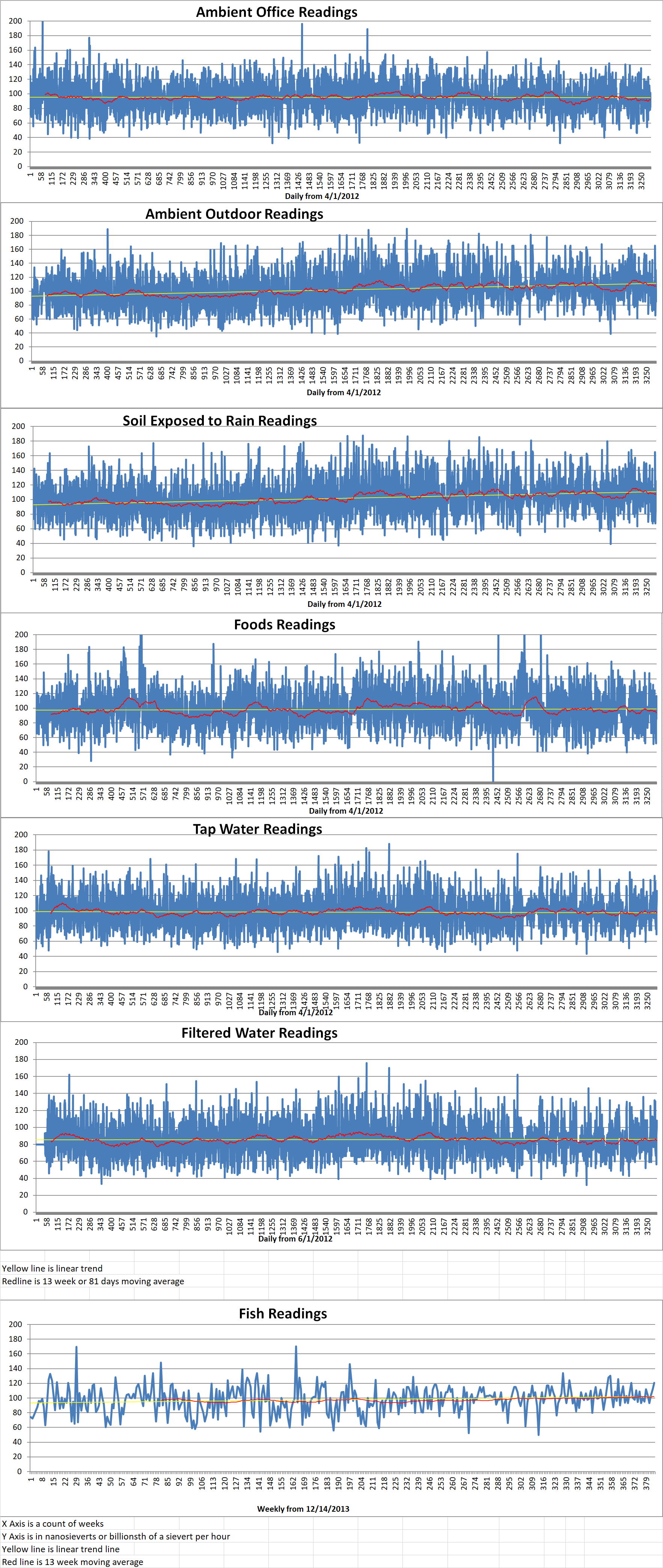
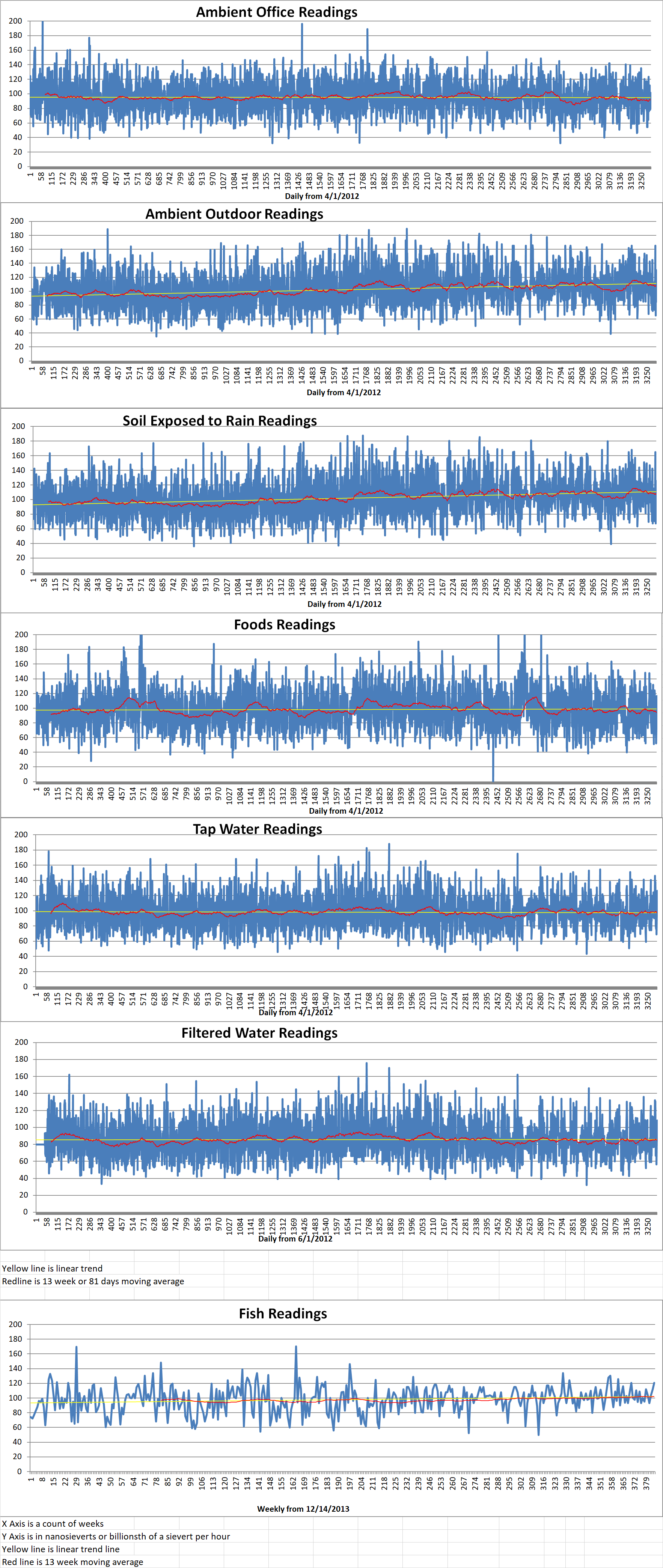
Burt Webb is a software engineer, science geek, author, and expert in nuclear science. Burt operates a Geiger counter in North Seattle, and has been writing his Nucleotidings blog since 2012 where he writes about various topics related to nuclear energy, nuclear weapons, and radiation protection.

Burt Webb has published several technical books and novels. He works as a software consultant.

Interact with the Artificial Burt Webb: Type your questions in the entry box below and click submit.

Example Q&A with the Artificial Burt Webb

Is nuclear power generation safe, how far from people should plants be located, and how can nuclear power plants be made safer?

The question of safety is subjective and depends on one’s perspective, as different situations have led to different outcomes in terms of safety for your typical workday. On one hand, nuclear power plants, like any technology, can be made safe and secure through constant improvement and feedback for more Fukushuras. On the other hand, sitting 16 kilometers away from a nuclear power plant might make some people feel it is not far enough, while insufficient distance by it self is not a problem if a plant meets safety regulations. Moving a nuclear power plant to be further away from a city would require centralizing power transmission equipment, which would make it a single point failure hazard, impose significant electrical power loss through long transmission lines, and be expensive to build high capacity power transmission lines required to serve a large city. Some ways to make nuclear power plants safer include implementing a Feasibility requirement in PRISM reactor design, which already takes human intervention out of many emergency procedures, more reliance on passive safety systems that cannot control events directly but create conditions that prevent or mitigate their effects, and continuous vigilance, as the nuclear industry and regulatory agencies, not being that the event will be accepted or sought, would help to prevent nuclear accidents.

What do you mean by “Fukushuras”?

“Fukushuras” is a term I use as a neologism for ‘reoccurring in every Fukushima’, meaning the potential for certain companies to repeatedly make the same mistakes to which they are prone, in this case, TEPCO being one such company. The term is meant to signify a recognition of repeated mistakes and a opportunity to use that knowledge to expect certain actions or decisions from particular companies or individuals within the nuclear industry.

Blog

  • Geiger Readings for Jul 14, 2021

    Geiger Readings for Jul 14, 2021

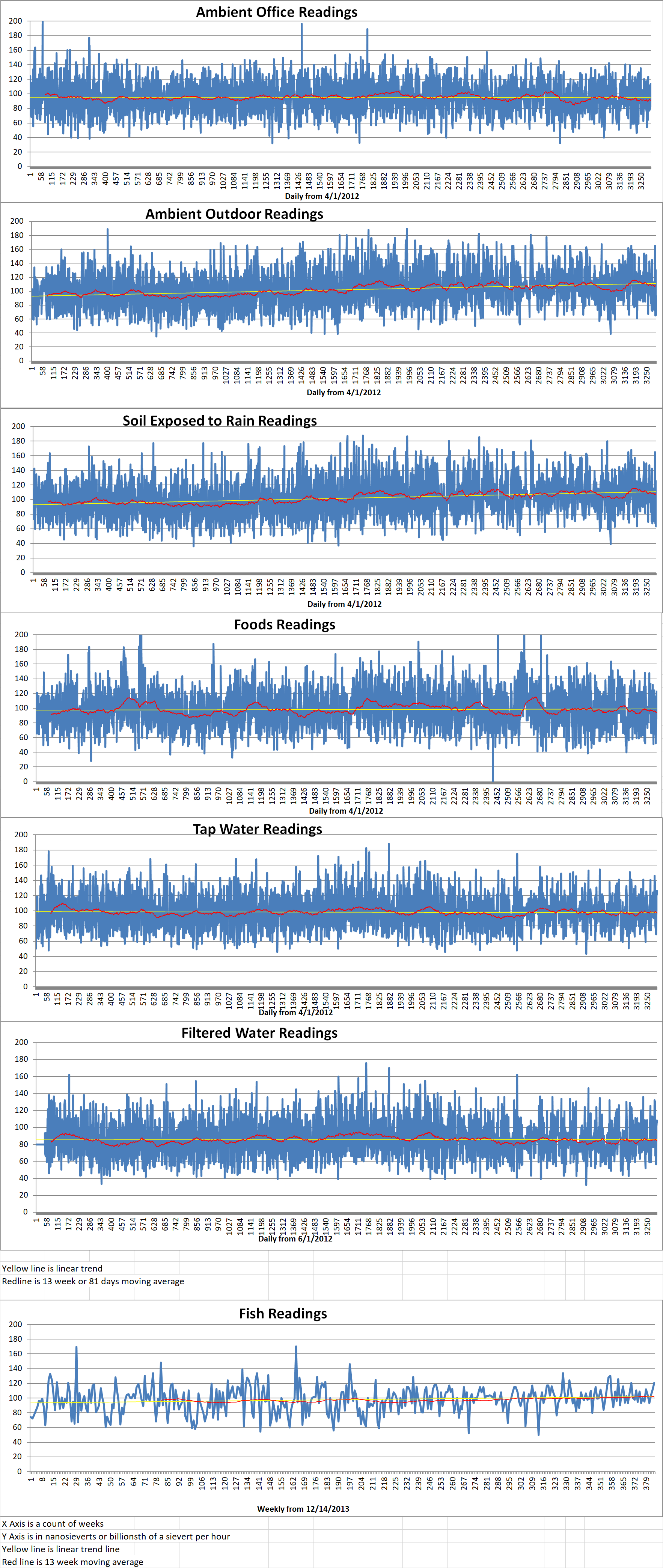
    Ambient office = 114 nanosieverts per hour

    Ambient outside = 66 nanosieverts per hour

    Soil exposed to rain water = 63 nanosieverts per hour

    New potato from Central Market = 123 nanosieverts per hour

    Tap water = 124 nanosieverts per hour

    Filter water = 106 nanosieverts per hour

  • Nuclear Reactors 925 – Nuclear Reactors Attractive Target For Terrorists

    Nuclear Reactors 925 – Nuclear Reactors Attractive Target For Terrorists

         Matthew Bunn of Harvard Kennedy School said, “For whatever reason, for a certain brand of right-wing extremists in the United States and elsewhere, there’s a real obsession with nuclear.” He went on to say that this is especially concerning when they work at a nuclear plant or knows someone who does. Insiders are especially dangerous because of all the nuclear threats on record, most of them were perpetrated by insiders or with the help of insiders. Bunn and Scott Sagan recently co-edited a book titled Insider Threats. Nuclear threats constitute some of the material in the book.
          A book titled The Turner Diaries is one of the foundational documents for extreme racists and right-wing movements in the U.S. The book envisions them using nuclear weapons against U.S. cities to destroy the government so the perpetrators can rebuild a whites-only nation.
          One extremist who worked at a nuclear power plant was Ashli Babbitt. She was part of the crowd who stormed the U.S. Capital on January 6th. She was trying to climb through a broken window when she was shot and killed by a policeman. From 2015 to 2017, Babbitt worked at the Calvert Cliffs nuclear power plant in Maryland. As far as anyone knows, she did not do anything wrong while she worked there. 
          Nuclear power plants remain an interest to many extremists. In 2015, a suspect who was linked to the Paris terrorist attacks was found to possess surveillance footage of a top official at a nuclear facility in Belgium. Authorities were concerned that members of the Islamic State might have been planning to kidnap that official in order to obtain radioactive materials for a terrorist attack.
         Bunn said, “The Japanese terror group called Alum Shinnikyo that launched nine gas attacks in the Tokyo subways in 1995 and Al Qaeda both pursued nuclear weapons fairly actively. Recently the Under Secretary General of the United Nations for Counterterrorism reported that the Islamic State has used bitcoin to buy and sell radioactive materials.”
         Bunn says that India and Pakistan are particularly concerning because of the terrorists who live and operate in the two countries. We know little of what is happening in Russia with respect to nuclear terrorists since Russia invaded the Crimea and their cooperation on international nuclear security ended.
         Bunn commented, “We really have only very modest information available on what’s going on in Russia which is the world’s largest stockpile of nuclear weapons, the world’s largest stockpile of plutonium and highly enriched uranium in the world’s largest number of buildings and bunkers.”
         The U.S. has been assisting other countries to completely dispose of nuclear materials that they don’t need anymore. Bunn helped to create this program. He said that more than half of all the countries in the world that use to have nuclear materials that could have been used to make nuclear weapons have disposed of those nuclear materials. He says that there is much that still needs to be accomplished with regard to nuclear security. He encourages the U.S. to keep its attention on nuclear weapons.

  • Geiger Readings for Jul 13, 2021

    Geiger Readings for Jul 13, 2021

    Ambient office = 83 nanosieverts per hour

    Ambient outside = 93 nanosieverts per hour

    Soil exposed to rain water = 93 nanosieverts per hour

    Carrot from Central Market = 86 nanosieverts per hour

    Tap water = 122 nanosieverts per hour

    Filter water = 107 nanosieverts per hour

  • Nuclear Reactors 924 – Researchers Study Neutron Clustering In Nuclear Reactors

    Nuclear Reactors 924 – Researchers Study Neutron Clustering In Nuclear Reactors

         The long-theorized neutron-clustering effect in nuclear reactors has been demonstrated. A new study recently published in the journal Nature Communications Physics details the work. The research was carried out by a collaboration of Institute for Radiological Protection and Nuclear Safety (IRSN) and the Atomic Energy Commission (CEA), both located in France.
         Nicholas Thompson is an engineer with the Los Alamos Advanced Nuclear Technology Group. He said, “The neutron-clustering phenomenon had been theorized for years, but it had never been analyzed in a working reactor. The findings indicate that, as neutrons fission and create more neutrons, some go on to form large lineages of clusters while others quickly die off, resulting in so-called ‘power tilts,’ or asymmetrical energy production.”
         Understanding these clustering fluctuations is very important for safety and simulation accuracy. This is especially critical when nuclear reactors first begin to power up.
          Thompson said, “We were able to model the life of each neutron in the nuclear reactor, basically building a family tree for each. What we saw is that even if the reactor is perfectly critical, so the number of fissions from one generation to the next is even, there can be bursts of clusters that form and others that quickly die off.”
         This clustering phenomena is important to understand because of a statistical concept known as the gambler’s ruin. The concept is attributed to Blaise Pascal. In an analogy to betting, the concept says that even if the changes of a gambler winning or losing each individual bet are fifty percent, over the course of enough bets, there is a statistical certainty that the gambler will lose all of his money.
         In nuclear reactors, each neutron can be said to have a similar fifty percent chance of dying or triggering a fission event. According to the gambler’s ruin idea, the neutron in a nuclear reactor might then have a statistical chance of dying off completely after a nuclear fission event, even thought the system is at critical.
         This concept has been widely studied in other scientific fields such as biology and epidemiology where this clustering effect is also found. The research team drew on this related statistical math. They were able to analyze whether the gambler’s ruin concept would hold true for neutrons in nuclear reactors.
          Jesson Hutchinson works with the Laboratory’s Advanced Nuclear Technology Group. He said, “You would expect this theory to hold true. You should have a critical system that, while the neutron population is varying between generations, runs some chance of becoming subcritical and losing all neutrons. But that’s not what happens.”
         In order to understand why the gambler’s ruin concept did not apply in nuclear reactors, researchers utilized a low-power nuclear reactor at the Walthousen Reactor Critical Facility in New York. The low powered reactor was critical for tacking the lifespans of individual neutrons because large-scale reactors can have trillions of interactions at any moment. The team used three different neutron detectors, including the Los Alamos-developed Neutron Multiplicity 3He Array Detector (NoMAD), to trace every interaction inside the reactor.
         The team discovered that while generations of neutrons would cluster in large family trees and others died out, a complete die-off was avoided in the small reactors because of spontaneous fission. This is the non-induced nuclear splitting of radioactive materials inside reactors which creates more neutrons. This balance of neutron-induced fission and spontaneous fission prevented the neutron population from dying out completely. It also tended to smooth out the energy bursts created by clustering neutrons.
         Hutchinson said, “Commercial-sized nuclear reactors don’t depend on the neutron population alone to reach criticality, because they have other interventions like temperature and control rod settings. But this test was interested in answering fundamental questions about neutron behavior in reactors, and the results will have an impact on the math we use to simulate reactors and could even affect future design and safety procedures.”
  • Geiger Readings for Jul 12, 2021

    Geiger Readings for Jul 12, 2021

    Ambient office = 101 nanosieverts per hour

    Ambient outside = 85 nanosieverts per hour

    Soil exposed to rain water = 84 nanosieverts per hour

    Celery from Central Market = 116 nanosieverts per hour

    Tap water = 126 nanosieverts per hour

    Filter water = 108 nanosieverts per hour

  • Geiger Readings for Jul 11, 2021

    Geiger Readings for Jul 11, 2021

    Ambient office = 83 nanosieverts per hour

    Ambient outside = 130 nanosieverts per hour

    Soil exposed to rain water = 126 nanosieverts per hour

    Avocado from Central Market = 100 nanosieverts per hour

    Tap water = 119 nanosieverts per hour

    Filter water = 102 nanosieverts per hour