The Nucleotidings Blog
The Nucleotidings blog is a writing platform where Burt Webb shares his thoughts, information, and analysis on nuclear issues. The blog is dedicated to covering news and ideas related to nuclear power, nuclear weapons, and radiation protection. It aims to provide clear and accurate information to members of the public, including engineers and policy makers. Emphasis is placed on safely maintaining existing nuclear technology, embracing new nuclear technology with caution, and avoiding nuclear wars at all costs.

Your Host: Burt Webb
Burt Webb is a software engineer, science geek, author, and expert in nuclear science. Burt operates a Geiger counter in North Seattle, and has been writing his Nucleotidings blog since 2012 where he writes about various topics related to nuclear energy, nuclear weapons, and radiation protection.

Burt Webb has published several technical books and novels. He works as a software consultant.

Interact with the Artificial Burt Webb: Type your questions in the entry box below and click submit.

Example Q&A with the Artificial Burt Webb

Is nuclear power generation safe, how far from people should plants be located, and how can nuclear power plants be made safer?

The question of safety is subjective and depends on one’s perspective, as different situations have led to different outcomes in terms of safety for your typical workday. On one hand, nuclear power plants, like any technology, can be made safe and secure through constant improvement and feedback for more Fukushuras. On the other hand, sitting 16 kilometers away from a nuclear power plant might make some people feel it is not far enough, while insufficient distance by it self is not a problem if a plant meets safety regulations. Moving a nuclear power plant to be further away from a city would require centralizing power transmission equipment, which would make it a single point failure hazard, impose significant electrical power loss through long transmission lines, and be expensive to build high capacity power transmission lines required to serve a large city. Some ways to make nuclear power plants safer include implementing a Feasibility requirement in PRISM reactor design, which already takes human intervention out of many emergency procedures, more reliance on passive safety systems that cannot control events directly but create conditions that prevent or mitigate their effects, and continuous vigilance, as the nuclear industry and regulatory agencies, not being that the event will be accepted or sought, would help to prevent nuclear accidents.

What do you mean by “Fukushuras”?

“Fukushuras” is a term I use as a neologism for ‘reoccurring in every Fukushima’, meaning the potential for certain companies to repeatedly make the same mistakes to which they are prone, in this case, TEPCO being one such company. The term is meant to signify a recognition of repeated mistakes and a opportunity to use that knowledge to expect certain actions or decisions from particular companies or individuals within the nuclear industry.

Blog

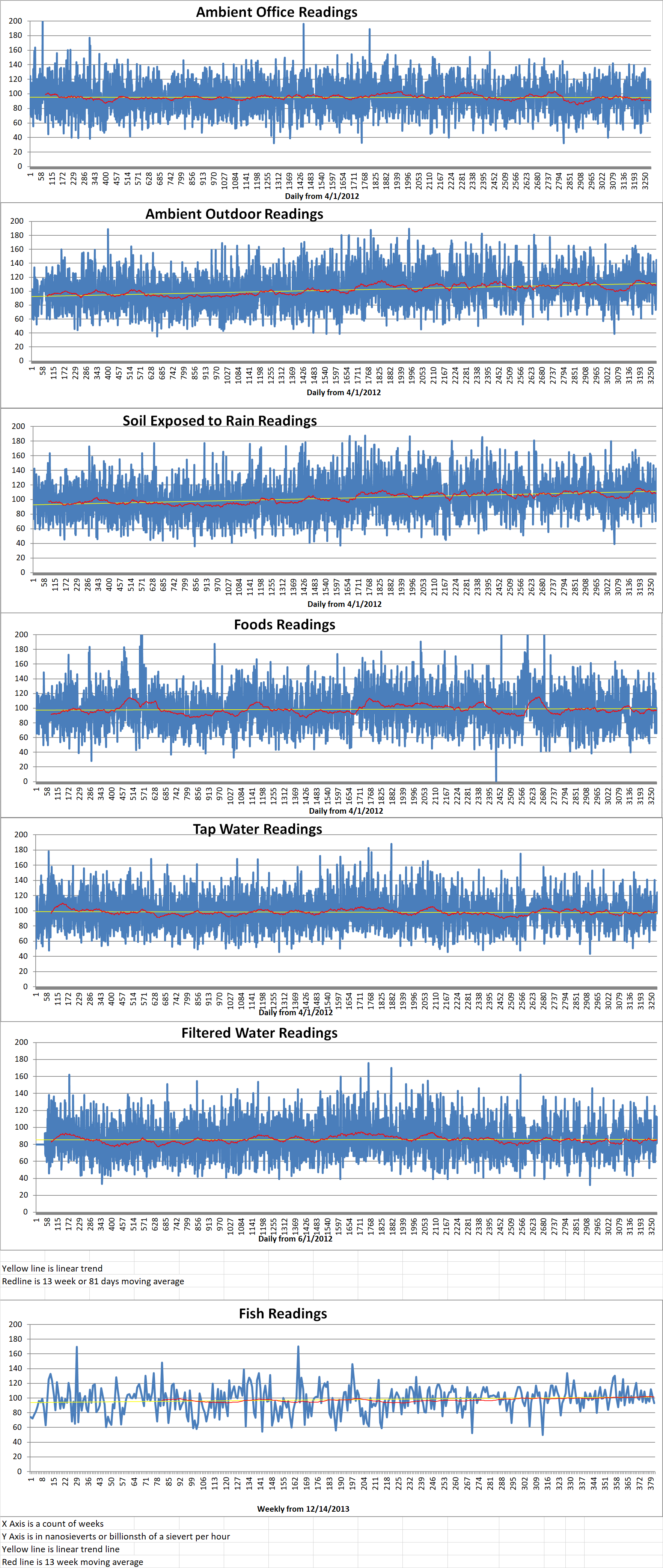
  • Geiger Readings for Jun 22, 2021

    Geiger Readings for Jun 22, 2021

    Ambient office = 75 nanosieverts per hour

    Ambient outside = 145 nanosieverts per hour

    Soil exposed to rain water = 143 nanosieverts per hour

    Tomato from Central Market = 80 nanosieverts per hour

    Tap water = 124 nanosieverts per hour

    Filter water = 112 nanosieverts per hour

  • Radioactive Waste 806 – The Problem Of Spent Nuclear Fuel – Part 1 of 2 Part

    Radioactive Waste 806 – The Problem Of Spent Nuclear Fuel – Part 1 of 2 Part

    Part 1 of 2 Parts
          One of the biggests problems with the use of nuclear fusion to generate electricity is the generation of radioactive spent nuclear fuel waste. Nuclear power plants in the U.S. generate about two thousand metric tons of spent fuel every year. Because it is highly radioactive, the waste is stored at various sites around the country. The federal government has the authority to decide what to do with the spent nuclear fuel.
          A special fund was established by the government in 1989. It was called the Nuclear Waste Fund (NWF) and all nuclear power plant owners in the U.S. were required to pay into the NWF to provide money for a national spent nuclear fuel waste disposal repository to be opened in 1999. A total of forty billion dollars has been deposited in that fund.
         Originally, a  “deep geological repository” under Yucca Mountain in Nevada was going to be constructed to hold the spent nuclear fuel waste generated by U.S. power reactors but this proved to be polically impossible with serious resistance from Nevada state officials as well some members of the Obama administration. Fifteen billiion dollars were spent on Yucca Mountrain before the effort was abandoned in 2009.
         Due to the inability of the U.S. Department of Energy (DoE) to successfully dispose of this spent nuclear fuel as promised, it has just been steadily accumulating. The latest figures released by the DoE say that about eighty thousand tons of spent nuclear fuel is waiting for a final disposal site to be constructed in the U.S.
          Some of the nuclear power plant operators sued the U.S. government in 2013 for failure to fulfill the obligation to dispose of the spent nuclear fuel. Every year, several hundred million dollars is now paid out to them each year by the U.S. Treasury as part of the series of settlements and judgements. To date, about eight billion dollars has been paid to nuclear plant owners.
          All of the aggregated nuclear waste in the U.S. takes up a relatively small volume and temporary storage sites exist in addition to storage onsite at the nuclear power plants. There is no pressing need to do anything immediately and, therefore, policity makers feel no need to expedite the creation of a permanent geological storage facility for spent nuclear fuel. Work on a repository continues but 2050 is the ealiest projected date for such a repository to be completed and put into operation.
         There are some nuclear experts who believe that some of this radioactive waste could be recycled into usabable fuel for nuclear reactors. This is an old concept, stimulated by the fact that only a small proportion of radioactrive materials are burned in a nuclear reactor before the fuel must be replaced. (Some estimates place the percentage of burned fuel as low as ten percent.) Proponents of fuel recycling iare working on nuclear reactors that are specially designed to use “reprocessed nuclear fuel”. Even critics of this idea will admit that the chemistry, physics, engineering of nuclear fuel recycling appear to be technically feasible. The critics focus on the disputable economics and perceived security risks.
    Please read Part 2 next

  • Geiger Readings for Jun 21, 2021

    Geiger Readings for Jun 21, 2021

    Ambient office = 78 nanosieverts per hour

    Ambient outside = 116 nanosieverts per hour

    Soil exposed to rain water = 117 nanosieverts per hour

    English cucumber from Central Market = 100 nanosieverts per hour

    Tap water = 97 nanosieverts per hour

    Filter water = 81 nanosieverts per hour

  • Geiger Readings for Jun 20, 2021

    Geiger Readings for Jun 20, 2021

    Ambient office = 117 nanosieverts per hour

    Ambient outside = 73 nanosieverts per hour

    Soil exposed to rain water = 70 nanosieverts per hour

    Garlic bulb from Central Market =66 nanosieverts per hour

    Tap water = 98 nanosieverts per hour

    Filter water = 82 nanosieverts per hour

  • Geiger Readings for Jun 19, 2021

    Geiger Readings for Jun 19, 2021

    Ambient office = 118 nanosieverts per hour

    Ambient outside = 111 nanosieverts per hour

    Soil exposed to rain water = 116 nanosieverts per hour

    Yellow onion from Central Market = 101 nanosieverts per hour

    Tap water = 98 nanosieverts per hour

    Filter water = 85 nanosieverts per hour

    Dover sole – Caught in USA = 93 nanosieverts per hour

  • Radioactive Waste 805 – Radioactive Materials Escaped Portsmouth Gaseous Diffusion Plant In Ohio

    Radioactive Waste 805 – Radioactive Materials Escaped Portsmouth Gaseous Diffusion Plant In Ohio

         On Saturday, June 19th there will be a roundtable discussion with Democratic Congressman Tim Ryan and former Congressman Zack Space considering the open-air demolition and other activities at the site of the Portsmouth Gaseous Diffusion Plant in Piketon, Ohio. Ryan said that the community is searching for a solution to the closure of the Zahns Corner Middle School. This is related to the discovery of radioactive isotopes in the soil outside of the closed plant.
         Ryan said, “Pike County was selected by the U.S. government to construct a gaseous diffusion plant in the 1950s, to produce enriched uranium for our nuclear arsenal. For decades, the people of Southern Ohio worked tirelessly, keeping our country safe during the Cold War. When the Cold War ended, the Portsmouth Gaseous Diffusion Plant in Pike County was then used for commercial nuclear reactors. However, operations ceased in 2001. Since then, previous administrations decided to construct a landfill on the current site and bury much of the contaminated waste in this community’s backyard.”
         Ryan added, “I have already engaged Secretary of Energy (Jennifer) Granholm in this issue, and we need to make it right for those families who served the country for so many decades. There’s been a disconnect for a little while between the community in Pike County and the Department of Energy and I am going to make sure that there is a connection there, and that their interests are being heard and we are going to make sure these families are safe.”
         Ryan continued, “You don’t have to be a rocket scientist to draw some level of connection. Again, we don’t know, but there is an enrichment uranium plant, they are doing an open-air demolition, there, and we know Pike County has the highest cancer rates in the state of Ohio. That needs to be looked into. My job is to make sure the smaller communities and the people who have served the country don’t get forgotten. To think that there are school children who may be dying because of what’s happening makes your stomach sick. I know this administration will want to do something about that. We just need to make sure that the interests in small-town southern Ohio make it all the way to Washington DC so we can protect these families.”
         Zahns Corner remains closed after radioactive material was detected in a near the school in 2019.
         Wes Hairston is the Superintendent of Scioto Valley School District. He will be attending the discussion on the 19th. He said “We have lost quite a few young people in this area. People that attended Zahns Corner Middle School so obviously we have concerns with that.”
          Hairston said that they have three goals. “We want to replace our school. We want to have better communications with the DOE and environmental management offices. And we hope to at some point have the property re-industrialized, so it is something useful to the community. For us obviously this is not a republican-democrat issue. We have a bunch of little, tiny Ohioans that we are trying to protect.”
         Ryan said that he wants work on the demolition at the site paused until area residents are assured that it is safe to continue.