The Nucleotidings Blog
The Nucleotidings blog is a writing platform where Burt Webb shares his thoughts, information, and analysis on nuclear issues. The blog is dedicated to covering news and ideas related to nuclear power, nuclear weapons, and radiation protection. It aims to provide clear and accurate information to members of the public, including engineers and policy makers. Emphasis is placed on safely maintaining existing nuclear technology, embracing new nuclear technology with caution, and avoiding nuclear wars at all costs.

Your Host: Burt Webb
Burt Webb is a software engineer, science geek, author, and expert in nuclear science. Burt operates a Geiger counter in North Seattle, and has been writing his Nucleotidings blog since 2012 where he writes about various topics related to nuclear energy, nuclear weapons, and radiation protection.

Burt Webb has published several technical books and novels. He works as a software consultant.

Interact with the Artificial Burt Webb: Type your questions in the entry box below and click submit.

Example Q&A with the Artificial Burt Webb

Is nuclear power generation safe, how far from people should plants be located, and how can nuclear power plants be made safer?

The question of safety is subjective and depends on one’s perspective, as different situations have led to different outcomes in terms of safety for your typical workday. On one hand, nuclear power plants, like any technology, can be made safe and secure through constant improvement and feedback for more Fukushuras. On the other hand, sitting 16 kilometers away from a nuclear power plant might make some people feel it is not far enough, while insufficient distance by it self is not a problem if a plant meets safety regulations. Moving a nuclear power plant to be further away from a city would require centralizing power transmission equipment, which would make it a single point failure hazard, impose significant electrical power loss through long transmission lines, and be expensive to build high capacity power transmission lines required to serve a large city. Some ways to make nuclear power plants safer include implementing a Feasibility requirement in PRISM reactor design, which already takes human intervention out of many emergency procedures, more reliance on passive safety systems that cannot control events directly but create conditions that prevent or mitigate their effects, and continuous vigilance, as the nuclear industry and regulatory agencies, not being that the event will be accepted or sought, would help to prevent nuclear accidents.

What do you mean by “Fukushuras”?

“Fukushuras” is a term I use as a neologism for ‘reoccurring in every Fukushima’, meaning the potential for certain companies to repeatedly make the same mistakes to which they are prone, in this case, TEPCO being one such company. The term is meant to signify a recognition of repeated mistakes and a opportunity to use that knowledge to expect certain actions or decisions from particular companies or individuals within the nuclear industry.

Blog

  • Geiger Readings for Jun 15, 2021

    Geiger Readings for Jun 15, 2021

    Ambient office = 80 nanosieverts per hour

    Ambient outside = 82 nanosieverts per hour

    Soil exposed to rain water = 83 nanosieverts per hour

    Red bell pepper from Central Market = 124 nanosieverts per hour

    Tap water = 99 nanosieverts per hour

    Filter water = 88 nanosieverts per hour

  • Nuclear Reactors 911 – University Of Manchester Published A Plan For Analysis Of Prospects For Nuclear Power in the U.K.  – Part 1 of 2 Parts

    Nuclear Reactors 911 – University Of Manchester Published A Plan For Analysis Of Prospects For Nuclear Power in the U.K. – Part 1 of 2 Parts

    Part 1 of 2 Parts
         The U.K. has been pondering the proper role of nuclear power for several years. They have old nuclear power reactors that will have to be retired in the not-too-distant future. This energy will have to be replaced. They are currently constructing the Hinkley C nuclear power reactor, but other such projects have been foundering, primarily because of questions of financing. While there is some public support for nuclear power, there is also a great deal of public resistance to accepting the nearby construction of nuclear power plants.
          Nuclear power has been touted as one of the solutions to the problem of carbon emissions. Industrialized nations are trying to cooperate in the reduction of carbon emissions to zero by 2050. While nuclear power may be “carbon-free” during operation, a great deal of carbon dioxide is emitted during the mining and refining of uranium for fuel as well as the curing of concrete used in construction. With the steadily dropping cost of alternative energy such as solar and wind systems and the steadily rising cost of constructing and maintaining nuclear power plants, there are public calls for the end of nuclear power in the U.K. For those who support the development of both alternative energy and nuclear power to fight climate change, it is an unfortunate truth that in selecting support for a strong nuclear power program, supporting alternative energy becomes more difficult.
         Nuclear experts at the University of Manchester have been working on the issue of nuclear power for the U.K. and they have identified eight actions that will be required to objectively assess the role of nuclear power in net-zero carbon emission for the future of U.K. power generation. They have published a position paper with the title Nuclear energy for net zero: a strategy for action. The position paper determines what policymakers and industry need to explore in order to make informed decisions based on a “best economics” basis. These tasks include the development of advisory bodies, non-partisan modeling of the economic path and the optimization of research and development programs.
          The position paper was authored by the senior leadership team at the university’s Dalton Nuclear Institute (DNI). The DNI is host to the biggest and most advanced nuclear research capability in the U.K. The authors are Francis Livens, director; Gregg Butler, head of strategic assessment; William Bodel, research associate in nuclear systems choice; and Juan Matthews, visiting professor in nuclear energy technology.
         Livens said, “Net zero by 2050 is such a massive challenge for this country that it is really all hands to the pumps. The reality is we need to explore all these options and evaluate them on a level playing field and come to an objective decision about, ‘Does nuclear have a part to play in our energy future or not?’. Either way, the UK needs to move fast to resolve this question and take any opportunity that is there. If it continues to prevaricate, any opportunity will certainly be lost.” 
         Bodel said, with respect to the new position paper, “We have developed this paper because we felt a responsibility as an impartial academic community to support our colleagues in government and industry. The UK has set a world-leading net-zero target, but simply setting the target is not enough – we need to achieve it. Now is the time to take key actions which will determine the roles nuclear can play, recognizing that they should only be adopted if they contribute to an optimized economic and environmental solution. We might know a lot about nuclear energy – but it’s got to be viewed as a candidate for helping to reach net zero – not as an end in itself.”
    Please read Part 2 next
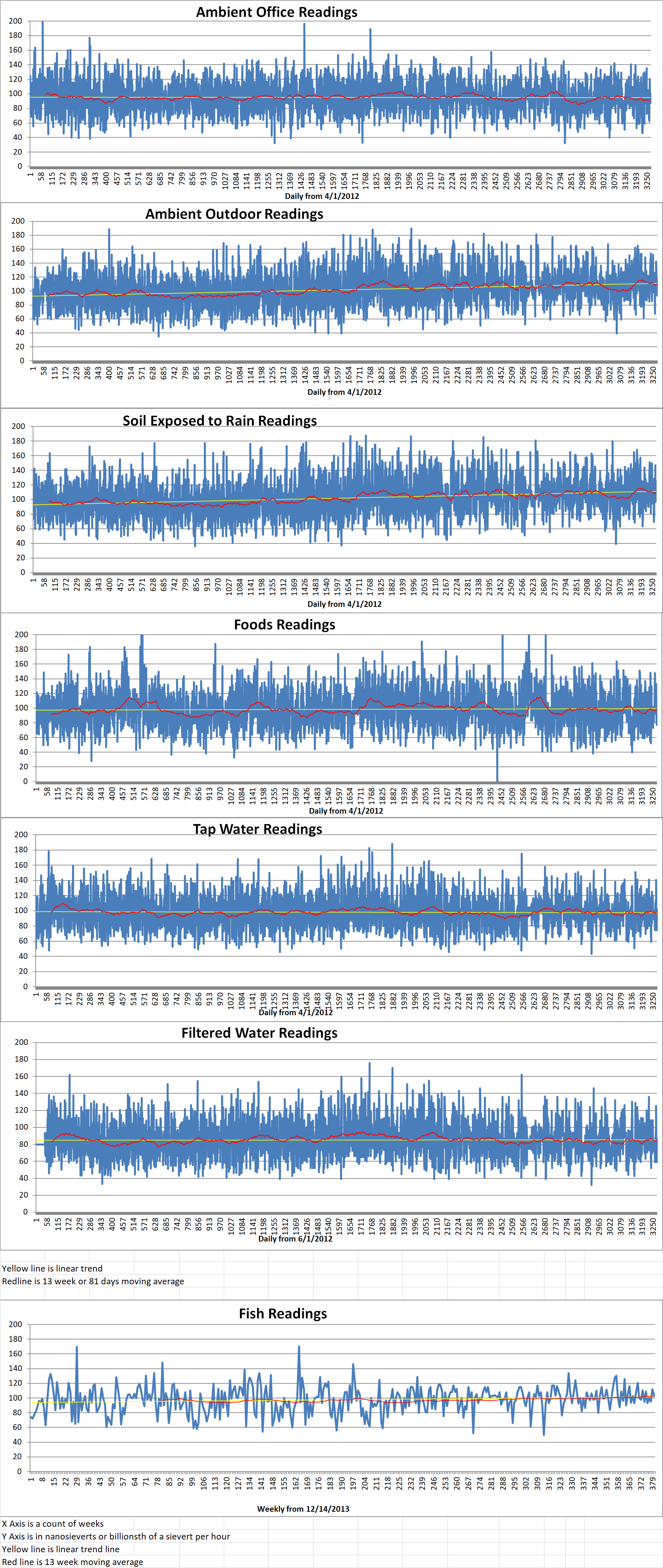
  • Geiger Readings for Jun 14, 2021

    Geiger Readings for Jun 14, 2021

    Ambient office = 105 nanosieverts per hour

    Ambient outside = 125 nanosieverts per hour

    Soil exposed to rain water = 123 nanosieverts per hour

    Heirloom tomato from Central Market = 66 nanosieverts per hour

    Tap water = 115 nanosieverts per hour

    Filter water = 107 nanosieverts per hour

  • Geiger Readings for Jun 13, 2021

    Geiger Readings for Jun 13, 2021

    Ambient office = 99 nanosieverts per hour

    Ambient outside = 93 nanosieverts per hour

    Soil exposed to rain water = 98 nanosieverts per hour

    Tomato from Central Market = 77 nanosieverts per hour

    Tap water = 87 nanosieverts per hour

    Filter water = 67 nanosieverts per hour

  • Geiger Readings for Jun 12, 2021

    Geiger Readings for Jun 12, 2021

    Ambient office = 100 nanosieverts per hour

    Ambient outside = 119 nanosieverts per hour

    Soil exposed to rain water = 125 nanosieverts per hour

    English cucumber from Central Market = 98 nanosieverts per hour

    Tap water = 102 nanosieverts per hour

    Filter water = 87 nanosieverts per hour

    Dover sole – Caught in USA = 103 nanosieverts per hour

  • Nuclear Reactors 910 – Problems With Buildup Of Noble Gases At The Taishan Nuclear Power Plant in China

    Nuclear Reactors 910 – Problems With Buildup Of Noble Gases At The Taishan Nuclear Power Plant in China

         The Taishan nuclear power plant in China’s Guangdong province is owned and operated by a joint venture between EDF, the French owned nuclear company and China General Power Group (CGN), the Chinese owned nuclear power company. The U.S. news network reported that Framatome, the EDF subsidiary which designed the Taishan reactors, warned that there was an immediate radiological threat at the Taishan plant. EDF has begun investigating a buildup of inert gases at the plant, but said that the plant was operating safely. They said that the buildup of krypton and xenon which affected the primary circuit of the Unit 1 reactor at Taishan was a “known phenomenon, studied and provided for in the reactor operating procedures”.
         A spokesperson said that the build up of gases could be because of an issue with fuel rods and seals. EDF measurements of inert gases were below the maximum levels authorized in China. The spokesman added that that it was too early to say whether or not the reactor would have to be shut down. Krypton and xenon do not tend to react with other substances which is why they are called “noble gases.” They do have radioactive properties and are subject to constant monitoring.
          CGN said that the operations at the Taishan plant met applicable safety rules and that the surrounding environment was safe. CGN put out a statement on their website that “Regular monitoring data shows the Taishan station and its surrounding environment meet normal parameters.” Framatome issued a statement that they were supporting efforts to resolve the situation. EDF has requested a meeting with CGN to review the findings to date but no date has yet been set for the meeting.
        The International Atomic Energy Agency (IAEA), the U.N. nuclear watchdog, said, “At this stage, the agency has no indication that a radiological incident occurred.” The IAEA also said that they were in contact with officials in China about the issue.
         The French Nuclear Safety Authority (ASN) had no immediate comment when asked about the issue. The U.S. State Department and the U.S. Nuclear Regulatory Commission referred inquiries to the Department of Energy. The White House has not responded to questions.
         The Taishan reactor is the first French-designed European Power Reactor (EPR) to become operational. The same technology is being deployed in France, Finland and Britain. Power from the plant provides electricity for Guangzhou and Shenzhen areas which contain Guangdong provinces major manufacturing hubs. These facilities have faced serious power shortages in recent weeks because of hot weather and lower than usual hydropower supplies from neighboring Yunnan province.
         CNN reported that the warning that Framatome issued contained an accusation that the Chinese safety authority was raising the acceptable limits for radiation levels outside the Taishan plant in order to avoid having to shut the plant down. The Chinese National Nuclear Safety Administration has not yet made a public statement or answered questions about the Taishan situation. They have said that the Taishan nuclear power plant meets all the relevant safety regulations.

  • Geiger Readings for Jun 11, 2021

    Geiger Readings for Jun 11, 2021

    Ambient office = 88 nanosieverts per hour

    Ambient outside = 97 nanosieverts per hour

    Soil exposed to rain water = 98 nanosieverts per hour

    Blueberry from Central Market = 80 nanosieverts per hour

    Tap water = 74 nanosieverts per hour

    Filter water = 59 nanosieverts per hour