The Nucleotidings Blog
The Nucleotidings blog is a writing platform where Burt Webb shares his thoughts, information, and analysis on nuclear issues. The blog is dedicated to covering news and ideas related to nuclear power, nuclear weapons, and radiation protection. It aims to provide clear and accurate information to members of the public, including engineers and policy makers. Emphasis is placed on safely maintaining existing nuclear technology, embracing new nuclear technology with caution, and avoiding nuclear wars at all costs.

Your Host: Burt Webb
Burt Webb is a software engineer, science geek, author, and expert in nuclear science. Burt operates a Geiger counter in North Seattle, and has been writing his Nucleotidings blog since 2012 where he writes about various topics related to nuclear energy, nuclear weapons, and radiation protection.

Burt Webb has published several technical books and novels. He works as a software consultant.

Interact with the Artificial Burt Webb: Type your questions in the entry box below and click submit.

Example Q&A with the Artificial Burt Webb

Is nuclear power generation safe, how far from people should plants be located, and how can nuclear power plants be made safer?

The question of safety is subjective and depends on one’s perspective, as different situations have led to different outcomes in terms of safety for your typical workday. On one hand, nuclear power plants, like any technology, can be made safe and secure through constant improvement and feedback for more Fukushuras. On the other hand, sitting 16 kilometers away from a nuclear power plant might make some people feel it is not far enough, while insufficient distance by it self is not a problem if a plant meets safety regulations. Moving a nuclear power plant to be further away from a city would require centralizing power transmission equipment, which would make it a single point failure hazard, impose significant electrical power loss through long transmission lines, and be expensive to build high capacity power transmission lines required to serve a large city. Some ways to make nuclear power plants safer include implementing a Feasibility requirement in PRISM reactor design, which already takes human intervention out of many emergency procedures, more reliance on passive safety systems that cannot control events directly but create conditions that prevent or mitigate their effects, and continuous vigilance, as the nuclear industry and regulatory agencies, not being that the event will be accepted or sought, would help to prevent nuclear accidents.

What do you mean by “Fukushuras”?

“Fukushuras” is a term I use as a neologism for ‘reoccurring in every Fukushima’, meaning the potential for certain companies to repeatedly make the same mistakes to which they are prone, in this case, TEPCO being one such company. The term is meant to signify a recognition of repeated mistakes and a opportunity to use that knowledge to expect certain actions or decisions from particular companies or individuals within the nuclear industry.

Blog

  • Geiger Readings for May 27, 2021

    Geiger Readings for May 27, 2021

    Ambient office = 87 nanosieverts per hour

    Ambient outside = 124 nanosieverts per hour

    Soil exposed to rain water = 121 nanosieverts per hour

    Jalepeno pepper from Central Market = 97 nanosieverts per hour

    Tap water = 93 nanosieverts per hour

    Filter water = 81 nanosieverts per hour

  • Nuclear Reactors 902 – The Idaho National Laboratory Is Refurbishing The Advanced Test Reactor – Part 2 of 2 Parts

    Nuclear Reactors 902 – The Idaho National Laboratory Is Refurbishing The Advanced Test Reactor – Part 2 of 2 Parts

    Part 2 of 2 Parts (Please read Part 1 first)
          The ATR has been used to develop the reactors and fuels that can last the thirty-year lifespan of nuclear power U.S. warships. Because they don’t need to be refueled, the ships are able to spend more time on their mission and reduce the number of ships needed by the Navy. The USS Idaho is a Virginia-class nuclear powered attack submarine. It has definitely benefitted from the work done at the ATR. The submarine is scheduled to be launched in 2023 and it will spend about three decades in service.
    “Experiments at the ATR include:
    • Advanced Graphite Capsule: This experiment will test the effects of radiation on several types of graphite under consideration for the Next Generation Nuclear Plant program that currently have no high-flux temperature data available.
    • Advanced Fuel Cycle Initiative / Light Water Reactor: The goal of the AFCI is to transmute longer-life fuels into shorter-life ones which would be able to be used in commercial light water reactors, to reduce the amount of waste that must be stored while increasing the fuel available for commercial reactors.
    • Cobalt-60 Production: The least complex of current uses of the Advanced Test Reactor is the production of the 60Co radioisotope for medical uses. Disks of cobalt-59 1 mm -diameter by 1 mm thick are inserted into the reactor (Static Capsule Experiment), which bombards the sample with neutrons, producing cobalt-60. Approximately 200 kilocuries (7,400 TBq) are produced per year, entirely for medical uses.” Wikipedia
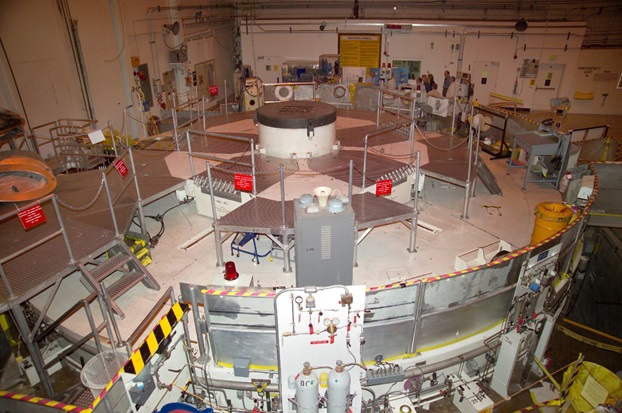
          Neutrons cause the internal parts of the ATR to wear out over time. The reactor must by refurbished in order to be able to continue to carry out experiments. The original designers of the ATR foresaw the need for the ATR to be refurbished. They created a reactor with internal components that can be replaced when needed.
          This summer, the ATR will be refurbished and improved with new components and experimental capacity. The ATR will undergo its sixth refurbishment since it was constructed in 1967 and the first refurbishment in 17 years. Hans Vogel is the director of the ATR Strategic Irradiation Capabilities Division. He and O’Kelly said that the most difficult challenge of the refurbishment will happen this summer when workers remove the sixty-two thousand pound stainless steel lid. Vogel also said, “Removing the reactor top head itself, that’s a 30-ton lift that we do, and that is a very infrequent evolution.” He mentioned that once the lid is removed, three months will be spent changing internal hardware. O’Kelly and Vogel said that the U.S. has considered spending billions of dollars to build a new test reactor but so far it has been decided to stick with the ATR.
        The refurbishment will take nine months and cost one hundred and seventy-two million dollars. It is being referred to as a core internals replacement. The work began last months and is scheduled to be completed by the end of 2021. An additional one hundred million dollars has been spent over the last three years on replacing external equipment to keep the test reactor in operation.

  • Geiger Readings for May 26, 2021

    Geiger Readings for May 26, 2021

    Ambient office = 87 nanosieverts per hour

    Ambient outside = 111 nanosieverts per hour

    Soil exposed to rain water =110 nanosieverts per hour

    Crimini mushroom from Central Market = 73 nanosieverts per hour

    Tap water = 98 nanosieverts per hour

    Filter water = 73 nanosieverts per hour

  • Nuclear Reactors 901 – The Idaho National Laboratory Is Refurbishing The Advanced Test Reactor – Part 1 of 2 Parts

    Nuclear Reactors 901 – The Idaho National Laboratory Is Refurbishing The Advanced Test Reactor – Part 1 of 2 Parts

    Part 1 of 2 Parts
         “The Advanced Test Reactor (ATR) is a research reactor at the Idaho National Laboratory, located east of Arco, Idaho. This reactor was designed and is used to test nuclear fuels and materials to be used in power plants, naval propulsion, research and advanced reactors. It can operate at a maximum thermal power of 250 MW and has a “Four Leaf Clover” core design (similar to the Camunian rose) that allows for a variety of testing locations. The unique design allows for different neutron flux (number of neutrons impacting one square centimeter every second) conditions in various locations. Six of the test locations allow an experiment to be isolated from the primary cooling system, providing its own environment for temperature, pressure, flow and chemistry, replicating the physical environment while accelerating the nuclear conditions.”
         The ATR also plays an important role in keeping commercial nuclear power plants running longer and in developing new and safer reactors to mitigate climate change. Sean O’Kelly is associate lab director in charge of ATR. He said, “ATR is an absolutely beautiful reactor. There has never been one like it on the planet.”
          The ATR is the most powerful test reactor of its kind, producing two hundred and fifty megawatts of power at full output. China has a similar test reactor that produces one hundred and twenty-five megawatts. Belgium’s test reactor can produce one hundred megawatts and the Oak Ridge National Laboratory in Tennessee has a test reactor that can produce eighty-five megawatts.
         “The neutron flux provided by the reactor can be either constant or variable, and each lobe of the four-leaf-clover design can be controlled independently to produce up to 1015 thermal neutrons per second per square centimeter or 5·1014 fast neutrons s−1 cm−2. There are 77 different testing locations inside the reflector and another 34 low-intensity locations outside the core, allowing many experiments to run simultaneously in different test environments. Test volumes up to 5.0 inches (130 mm) in diameter and 4 feet (1.2 m) long can be accommodated. Experiments are changed on average every seven weeks, and the reactor is in nominal operation (110 MW) 75% of the year.” Wikipedia
         O’Kelly said that the more power your test reactor has, the more that fuels and materials can be tested to their limits. He added that, “You don’t want fuel that is designed for 100 megawatts, and the first time you go to 103 megawatts, it fails. You build a safety margin in, and we have to test to that safety margin.” The ATR has what O’Kelly describes as the ability to maintain “a constant gradient of neutron flux throughout the core. ATR has this constant curvature of flux, so the experimenters have a fixed power and they know exactly what the power is in that region.” He said that other test reactors can be more difficult for experiments because the environment is changing during the experiment.
          The ATR is configured in order to run multiple tests simultaneously. Some of the prime testing slots face a decade-long waiting for the opportunity to run experiments. Other testing slots are booked in advance. The ATR is unique because instead of turning heat into energy like commercial nuclear power reactors, the ATR produces neutrons so new materials and fuels can be tested to see how they are affected by a high-radiation environment. The ATR has a unique cloverleaf design which includes a core that is surrounded by beryllium metal to reflect the neutrons.
    Please read Part 2

  • Geiger Readings for May 25, 2021

    Geiger Readings for May 25, 2021

    Ambient office = 79 nanosieverts per hour

    Ambient outside = 127 nanosieverts per hour

    Soil exposed to rain water = 122 nanosieverts per hour

    Avocado from Central Market = 93 nanosieverts per hour

    Tap water = 101 nanosieverts per hour

    Filter water = 83 nanosieverts per hour

  • Nuclear Reactors 900 – Idaho National Laboratory Is Working On New Thorium-Uranium Reactor Fuel Called ANEEL

    Nuclear Reactors 900 – Idaho National Laboratory Is Working On New Thorium-Uranium Reactor Fuel Called ANEEL

         There are a variety of nuclear fuels currently being used in commercial nuclear power reactors. The most common is enriched uranium but unenriched uranium and mixtures of plutonium and uranium are also used for fuel. Now scientists at the Department of Energy’s Idaho National Laboratory have developed a new fuel called Advanced Nuclear Energy for Enriched Life, or ANEEL.   ANEEL is a proprietary mixture of thorium and low-enriched uranium. James Conca at Forbes believes that it could be very useful if society decides that nuclear power is the only answer to climate change mitigation.
         Thorium has been researched as a possible nuclear fuel for decades and thorium test reactors have been built. Thorium melts at a higher temperature and generates energy at a lower temperature when compared to uranium fuel. It is also more resistant to core meltdowns. Conca said, “The ANEEL fuel has a very high fuel burn-up rate[, which] means the fuel stays in the reactor longer and gets more energy out of the same amount of fuel. [It’s] prohibitively difficult to make into a weapon. [And] ANEEL fuel will reduce the waste by over 80% and end up with much less plutonium. Less spent fuel means less refueling, less cost, less fuel handling and less volume to dispose.”
         Any thorium fuel must contain at least a small amount of fissile material because pure thorium is not fissile by itself. On the other hand, thorium is much more plentiful than uranium. It is found in high quantities in the kinds of developing energy markets where nuclear may really be needed in the future. India has a great deal of thorium and a great need for more electricity.
          Conca said, “India itself has more Th than U, particularly as monazite sands, a reason they have been pursuing Th in nuclear reactors for decades.” He suggested that this could lead to a beneficial arrangement where India could export thorium to the U.S. to make ANEEL and then the ANEEL could be sent to India. Conca mentioned that there is an old nuclear reactor in India which is already able to burn ANEEL fuel. Conversion to ANEEL could lead to improved diplomacy in the global nuclear industry. Conca said, “Whenever the United States is involved in another country’s nuclear program, that country signs various agreements related to security, weapons nonproliferation and nuclear materials, including nuclear fuel.”
         Idaho National Laboratory is working with Texas A&M University and a private startup named Clear Core Thorium Energy (CCTE) on the ANEEL project. CCTE has been working on plans to retrofit existing nuclear power reactors to burn ANEEL fuel. They hope to enter commercial production by 2024. Reactors do not have to shut down in order to be fueled with ANEEL. Conca said, “[I]n developing nations, the need is urgent. Most do not have the infrastructure to install natural gas, wind or solar. Additionally, many do not have sufficient topography and river flow for hydro. So it’s either coal or nuclear. If you care at all about the environment, then it better be nuclear.”