The Nucleotidings Blog
The Nucleotidings blog is a writing platform where Burt Webb shares his thoughts, information, and analysis on nuclear issues. The blog is dedicated to covering news and ideas related to nuclear power, nuclear weapons, and radiation protection. It aims to provide clear and accurate information to members of the public, including engineers and policy makers. Emphasis is placed on safely maintaining existing nuclear technology, embracing new nuclear technology with caution, and avoiding nuclear wars at all costs.

Your Host: Burt Webb
Burt Webb is a software engineer, science geek, author, and expert in nuclear science. Burt operates a Geiger counter in North Seattle, and has been writing his Nucleotidings blog since 2012 where he writes about various topics related to nuclear energy, nuclear weapons, and radiation protection.

Burt Webb has published several technical books and novels. He works as a software consultant.

Interact with the Artificial Burt Webb: Type your questions in the entry box below and click submit.

Example Q&A with the Artificial Burt Webb

Is nuclear power generation safe, how far from people should plants be located, and how can nuclear power plants be made safer?

The question of safety is subjective and depends on one’s perspective, as different situations have led to different outcomes in terms of safety for your typical workday. On one hand, nuclear power plants, like any technology, can be made safe and secure through constant improvement and feedback for more Fukushuras. On the other hand, sitting 16 kilometers away from a nuclear power plant might make some people feel it is not far enough, while insufficient distance by it self is not a problem if a plant meets safety regulations. Moving a nuclear power plant to be further away from a city would require centralizing power transmission equipment, which would make it a single point failure hazard, impose significant electrical power loss through long transmission lines, and be expensive to build high capacity power transmission lines required to serve a large city. Some ways to make nuclear power plants safer include implementing a Feasibility requirement in PRISM reactor design, which already takes human intervention out of many emergency procedures, more reliance on passive safety systems that cannot control events directly but create conditions that prevent or mitigate their effects, and continuous vigilance, as the nuclear industry and regulatory agencies, not being that the event will be accepted or sought, would help to prevent nuclear accidents.

What do you mean by “Fukushuras”?

“Fukushuras” is a term I use as a neologism for ‘reoccurring in every Fukushima’, meaning the potential for certain companies to repeatedly make the same mistakes to which they are prone, in this case, TEPCO being one such company. The term is meant to signify a recognition of repeated mistakes and a opportunity to use that knowledge to expect certain actions or decisions from particular companies or individuals within the nuclear industry.

Blog

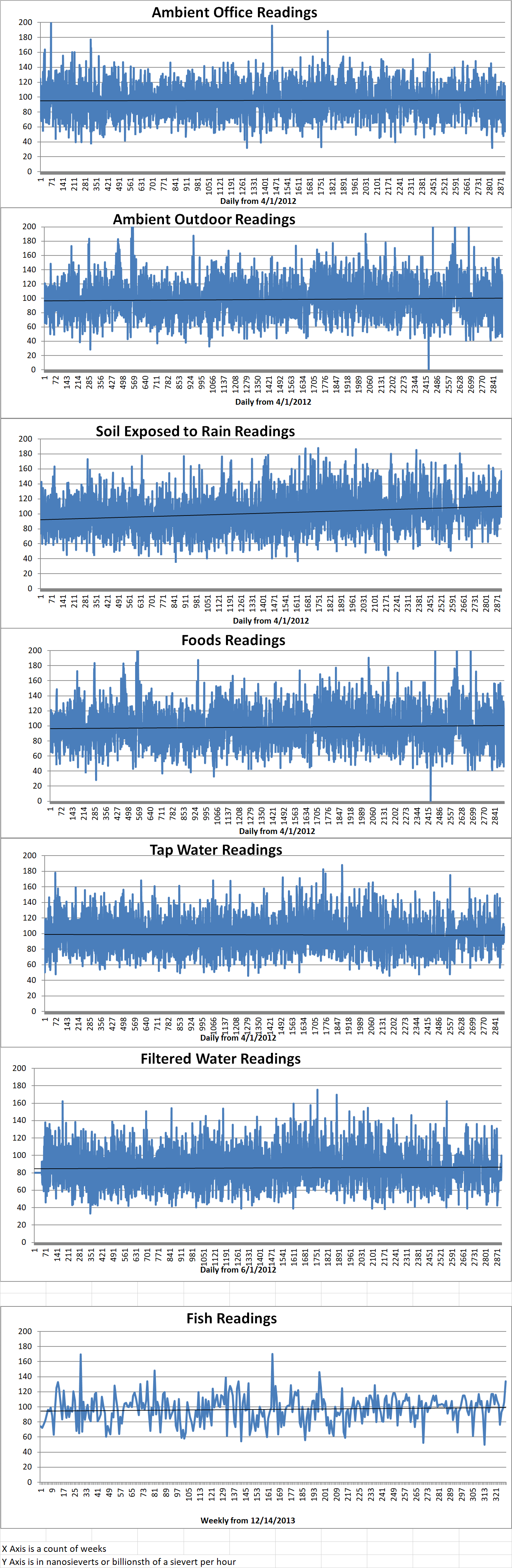
  • Geiger Readings for Jun 09, 2020

    Geiger Readings for Jun 09, 2020

    Ambient office  = 113 nanosieverts per hour

    Ambient outside = 115 nanosieverts per hour

    Soil exposed to rain water = 113 nanosieverts per hour

    Tomato from Central Market = 81 nanosieverts per hour

    Tap water = 95 nanosieverts per hour

    Filtered water = 73 nanosieverts per hour

  • Radioactive Waste 772 – GE-Hitachi Global Laser Enrichment Working With The Department Of Energy On Re-enrichment Of Depleted Uranium

    Radioactive Waste 772 – GE-Hitachi Global Laser Enrichment Working With The Department Of Energy On Re-enrichment Of Depleted Uranium

        GE-Hitachi Global Laser Enrichment (GLE) and the U.S. Department of Energy signed an agreement in 2016 for the sale of depleted Department of Energy (DoE) UF6 inventories also known as deplete uranium tails. These UF6 stockpiles are left over from previous enrichment operations. They contain a lower proportion of uranium-235 than is present in naturally occurring uranium ore. They can be re-enriched for use in nuclear fuels. The 2016 contract was signed at a time when a recovery in the uranium market was expected to begin soon.
        GLE and DoE have just signed an amendment to the 2016 contract. It was signed in order to bring the contract into alignment with current uranium market conditions. The amendment was a key condition for another agreement between an Australian company called Silex Systems, a Canadian company named Cameco Corporation and GE- Hitachi Nuclear Energy for the purpose of the restructuring of GLE. Final approval for the restructuring will result in Silex acquiring fifty one percent of GLE and Cameco increasing its share of GLE from the current twenty four percent to forty nine percent. The federal approval is expected to be granted before the end of this year.
         GLE is the exclusive licensee of the Separation of Isotopes by Laser EXcitation (SILEX) uranium enrichment process. GLE is working to make it commercially viable through the construction of the Paducah Laser Enrichment Facility (PLEF) which will re-enrich depleted UF6. The availability of the depleted UF6 inventories owned by the DoE is a major key to the contract going forward. The recently signed amendment to the deal between GLE and DoE ensures that the agreement will be in effect long enough for GLE to complete the pilolt plant for the PLEF which is scheduled to begin commercial operation late in the 2020s.
         The re-enrichment project is expected to continue for several decades. It will produce about two thousand tons each year of naturalized uranium as UF6. This is equivalent to a uranium mine with an annual output of about five million two hundred thousand pounds of U308 or 2000 tons. The output of the PLEF facility will have the added value of already being converted to UF6 as opposed to U308 from a mine which would still have to be converted.
         Silex said that “Preliminary economic analysis of the project indicates that it would rank as a large ‘Tier 1’ uranium mine by today’s standards with respect to the long life and low cost of production.”
         On June 5th, the DoE issued a Record of Decision (RoD) which formalizes its decision to dispose of depleted uranium oxide from gaseous diffusion plants including those in Portsmouth, Ohio and Paducah, Kentucky at one or more of three nominated locations which are EnergySolutions LLC’s site near Clive, Utah; Waste Control Specialists LLC’s site near Andrews, Texas; and the Nevada National Security Site in Nye County, Nevada. The facilities in Utah and Texas are commercial sites. The Nevada site is government-owned. The DoE says that there are eight hundred thousand tons of depleted UF6 at the Portsmouth and Paducah sites. Both sites are now converting UF6 to deplete uranium oxide.
         The RoD that was issued by the DoE only applies to material that has been declared to be nuclear waste. The DoE stated that it has near-term plans to focus on depleted uranium oxide at commercial waste disposal sites. It is planning to launch a pilot project next year to ship several railcars containing cylinders of depleted uranium oxide to a commercial disposal facility.

  • Geiger Readings for Jun 08, 2020

    Geiger Readings for Jun 08, 2020

    Ambient office  = 76 nanosieverts per hour

    Ambient outside = 109 nanosieverts per hour

    Soil exposed to rain water = 109 nanosieverts per hour

    Strawberry from Central Market = 84 nanosieverts per hour

    Tap water = 105 nanosieverts per hour

    Filtered water = 91 nanosieverts per hour

  • Geiger Readings for Jun 07, 2020

    Geiger Readings for Jun 07, 2020

    Ambient office  = 54 nanosieverts per hour

    Ambient outside = 157 nanosieverts per hour

    Soil exposed to rain water = 157 nanosieverts per hour

    Yam from Central Market = 122 nanosieverts per hour

    Tap water = 107 nanosieverts per hour

    Filtered water = 94 nanosieverts per hour

  • Geiger Readings for Jun 06, 2020

    Geiger Readings for Jun 06, 2020

    Ambient office  = 109 nanosieverts per hour

    Ambient outside = 93 nanosieverts per hour

    Soil exposed to rain water = 96 nanosieverts per hour

    Avocado from Central Market = 109 nanosieverts per hour

    Tap water = 108 nanosieverts per hour

    Filtered water = 100 nanosieverts per hour

    Dover sole – Caught in USA = 134 nanosieverts per hour

  • Nuclear Reactors 790 – Development Of TRISO Fuel Is Proceeding – Part 2 of 2 Parts

    Nuclear Reactors 790 – Development Of TRISO Fuel Is Proceeding – Part 2 of 2 Parts

    Part 2 of 2 Parts (Please read Part 1 first)
         The main concern about any nuclear power reactor is the possibility that the core could melt down in a disaster. The main advantage of TRISO fuel is that it is just not possible for it to melt down.
         Each TRISO particle has a core of uranium, carbon and oxygen. This core is about the size of a seed from a poppy. It is surround by three layers of carbon and ceramic-based materials. The structure that results from this encapsulation not only prevents any of the radioactive fission products from being released but it can also resist neutron irradiation, corrosion, oxidation and high temperatures which are the most common sources of risk in nuclear power reactors.
         TRISO fuel particles have been irradiated and subjected to more than three hundred hours of testing at temperatures up to eighteen hundred degrees Celsius or three thousand degrees Fahrenheit. These tests exceeded the worst-case projections for nuclear accident conditions. The TRISO particles showed minimal damage at most with full fission product retention. Paul Demkowicz is the technical lead for post-irradiation examination of TRISO fuel. He said, “The ability of the fuel to retain fission products at such high temperatures translates directly to enhanced safety of the reactor. This sort of test data is important input for reactor design and reactor licensing.”
         TRISO fuel particles were first developed in the United Kingdom in the 1960s as part of the Dragon Reactor project. This was an experimental high-temperature gas-cooled reactor. By 2002, the U.S. Department of Energy (DoE) had already invested significant effort into the improvement of TRISO fuel and significant progress was made. By 2009, a test of improved TRISO fuel established an international record by achieving a nineteen percent maximum burnup during a three-year test as the Idaho National Laboratory. This is three times the burnup rate of conventional light water reactors. The burnup rate for nuclear fuel is a measure of how much energy can be extracted from a primary nuclear reactor fuel. These tests established the efficiency and long-life capability of TRISO reactors. The DoE has expressed interest in producing and burning TRISO fuel in commercial nuclear power reactors and the private sector nuclear industry has shown interest. TRISO is not a far-off new technology. It is almost ready for the marketplace.
        There are already two experimental reactors that use TRISO fuel. These are the HTR-1 reactor in China and the High-temperature engineering test reactor in Japan. The DoE’s Advanced Reactor Technologies (ART) program is currently carrying out advanced TRISO fuel research. Some vendors including X-energy and Kairos Power have show solid interest in using TRISO fuel in their reactors. They are especially interested in TRISO fuel utilization in small modular reactors and microreactor designs. There are various projects around the globe that are developing high-temperatures and molten salt nuclear reactors which can use TRISO fuel. By 2019, three companies were selected by the U.S. Department of Defense (DoD) to develop TRISO nuclear reactor prototypes. These companies are X-energy, BWX Technologies and Westinghouse Government Services.
         These trends could indicate a shift in the planning for nuclear power plants. Up until now, the focus has been on building huge nuclear power plants that power entire cities. Now we have companies working on smaller and more robust nuclear power reactors that would be used to provide power for smaller areas without the risks of the full-sized reactors in use today. X-energy CEO Clay Sell said that TRISO reactors are also well suited for applications in the military and in the exploration and exploitation of space
    .