
The Laboratory for Laser Energetics (LLE) at the University of Rochester is the biggest university-based U.S. Department of Energy (DoE) program in the nation. The OMEGA laser is located at the LLE. It is the most powerful laser at any academic institution in the U.S. The LLE is one of leading research laboratory in the U.S. exploring the laser direct-drive approach to generating energy from nuclear fusion.
In this approach, spherical deuterium-tritium pellets of fuel are bombarded with sixty laser beams which hit the surface of the pellets from all directions at once. Under the intense heat of the laser beams, the pellets implode and turn into a plasma. If they can concentrate enough heat and pressure at the exact center of the implosion, a thermonuclear burn wave will travel outward in all directions in the plasma. This would produce energy from nuclear fusion far in excess of the energy used to drive the lasers. Much more powerful lasers than OMEGA would be needed to achieve this goal.
One of the biggest problems with advancing nuclear fusion research is the lack of models which could predict accurately which specifications for target shape and laser pulse shape would yield the best results. The LLE has been able to triple the yield of their fusion experiments by utilizing the latest data science techniques to make use of previously collected data and earlier computer simulations.
The Rochester team is made up of Varchas Gopalaswamy and Dhrumir Patel, PhD students and their supervisor Riccardo Betti, chief scientist and Robert L. McCrory Professor at LLE. The team applied sophisticated analytical techniques to data gathered from one hundred previous fusion experiments with the OMEGA laser.
Gopalaswamy said, “We were inspired from advances in machine learning and data science over the last decade.” Betti said “This approach bridges the gap between experiments and simulations to improve the predictive capability of the computer programs used in the design of experiments.” The results of their research allowed the team to optimize the specifications for the exact shape and size of the fuel pellets and the temporal shape of the laser pulse to best trigger fusion.
The National Ignition Facility (NIF) at Lawrence Livermore National Laboratory has lasers that are about seventy times as powerful as the OMEGA laser. If the models developed by the Rochester team can be extrapolated for these more powerful lasers, the result should be about one thousand times as many fusion reactions per test run. A modest improvement in target compression on the OMERA laser system should be enough to approach breakeven conditions at the level of power available to the NIF laser systems. This extrapolation of modeling is not a simple thing. Betti said, “Extrapolating the results from OMEGA to NIF is a tricky business. It is not just a size and energy issue. There are also qualitative differences that need to be assessed.”
Parallel to the work at Rochester, scientists at the NIF are working to see if the results from Rochester can be applied successfully at the NIF. Unlike the direct drive fusion approach at Rochester, at the NIF they use an indirect drive approach. The fuel pellet is enclosed in a metal can called a hohlraum. Lasers are fired into both ends of the can along the axis to heat the hohlraum and its contents. X-rays are generated in the hohlraum which causes the fuel pellet to explode and produce fusion reactions in the plasma. This approach has been making progress towards breakeven.
Blog
-

Nuclear Fusion 54 – Researchers At Rochester University Develop New And Better Computer Simulations Of Laser Ignited Fusion Systems
-

Geiger Readings for Feb 01, 2019
Ambient office = 97 nanosieverts per hour
Ambient outside = 164 nanosieverts per hour
Soil exposed to rain water = 166 nanosieverts per hour
Pinapple from Central Market = 45 nanosieverts per hour
Tap water = 116 nanosieverts per hour
Filter water = 97 nanosieverts per hour
-

Nuclear Weapons 372 – Department Of Energy Secretly Ships Weapons-Grade Plutonium From Georgia To Nevada
Recently I blogged about costs related to the handling of nuclear materials left over from the development and manufacture of nuclear weapons. If such radioactive materials are not going to be permanently stored where they are created, then they will have to be transported to a permanent storage location which may be thousands of miles away. Transportation of radioactive materials is dangerous for a number of reasons including possibility of accidents and deliberate attacks on transport vehicles.
There is a debate over whether the public should be informed of such dangerous shipments or whether such transportation should be secret. On the one hand, critics of secrecy say that people who live and work along the route deserve to know that dangerous shipments are passing. Supporters of secrecy say that keeping the shipments secret is necessary to prevent attacks and hijacking of shipments.
Nevada filed an injunction to stop shipments of nuclear materials to Nevada for storage before a thorough study was made of the possible environmental impact. Today, the U.S. Department of Energy National Nuclear Security Administration (NNSA) announced that the court proceedings were moot because the NNSA had already secretly shipped half a ton of highly radioactive weapons-grade plutonium from Georgia to Las Vegas.
The plutonium came from the Savannah River Site located twenty-five miles southeast of Augusta, Georgia. It was sent to the Nevada National Security Site which is about eighty miles northwest of Las Vegas. It is around two thousand miles between the origin and destination of the shipments.
Bruce Diamond is the general counsel for the DoE. He said in a court filing, “Because sufficient time has now elapsed after conclusion of this campaign, DOE may now publicly state that it has completed all shipment of plutonium (approximately ½ metric ton) to Nevada. Although the precise date that this occurred cannot be revealed for reasons of operational security, it can be stated that this was done before November 2018, prior to the initiation of the litigation.” He went on to say that concerns about the security of the shipment stopped the DoE from sharing any information about the shipment before or during the transport.
Steve Sisolak is the Governor of Nevada. He responded to the revelation of the shipment by saying, “I am beyond outraged by this completely unacceptable deception from the U.S. Department of Energy. The department (of Energy) led the State of Nevada to believe that they were engaging in good-faith negotiations with us regarding a potential shipment of weapons-grade plutonium, only to reveal that those negotiations were a sham all along. They lied to the State of Nevada, misled a federal court, and jeopardized the safety of Nevada’s families and environment.”
Nevada Senator Jacky Rosen said that the actions of the DoE were “deceitful and unethical” and that they were a danger to “the health and safety of thousands of Nevadans and Americans who live in close proximity to shipment routes.”
Concerns about the safety and the security of shipping highly radioactive materials across the U.S are both valid. However, the likelihood of accidents during transport is much greater than the likelihood of deliberate interference and/or hijacking of such shipments. Therefore, I believe that the right of the public to know about such shipments should outweigh the security concerns. If such shipments are kept secret and there is one major accident with a shipment that exposes people to radioactive materials, there will be enormous public outrage. It will be very difficult to maintain secrecy after such an event. -
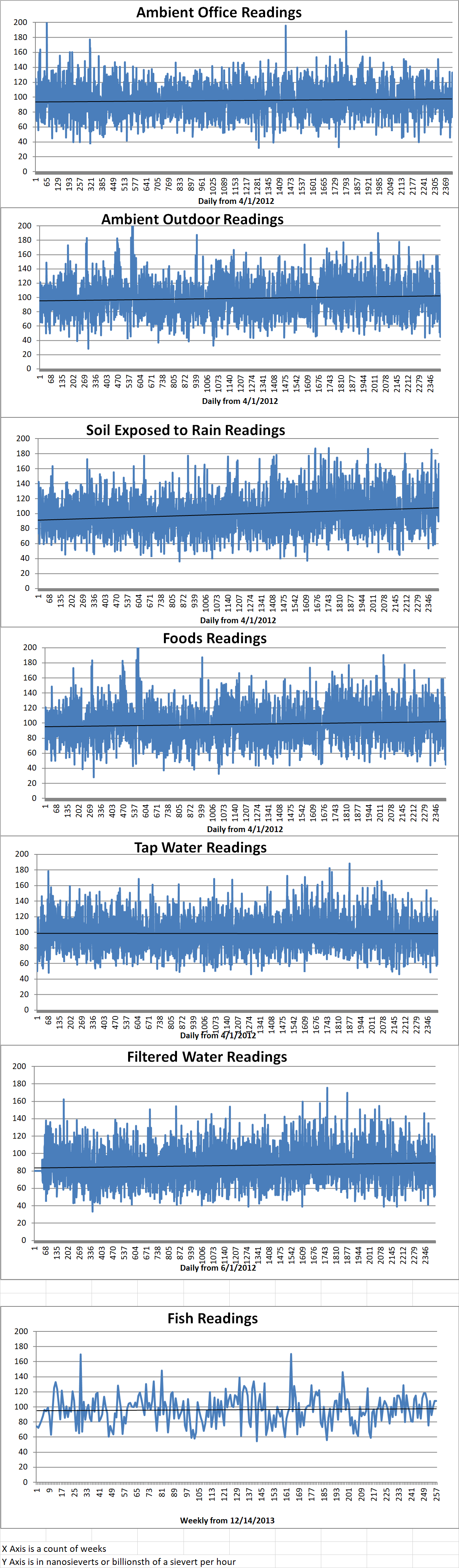
Geiger Readings for Jan 31, 2019
Ambient office = 97 nanosieverts per hour
Ambient outside = 164 nanosieverts per hour
Soil exposed to rain water = 166 nanosieverts per hour
Green beans from Central Market = 45 nanosieverts per hour
Tap water = 116 nanosieverts per hour
Filter water = 97 nanosieverts per hour
-

Radioactive Waste 377 – Greenpeace Reports On Global Spent Nuclear Fuel Problem
I often blog about nuclear waste. It is one of the major problems with the use of nuclear power to generate electricity and heat. Recently Greenpeace published a report on nuclear waste storage facility in seven countries including Belgium, Britain, Finland, France, Japan, Sweden, and the United States. Several of these countries have so much spent nuclear fuel that they are nearing the point of saturation for storage options. In addition to running out of room to store spent nuclear fuel, these countries are also confronting other problems including the risk of fire at storage facilities, the venting of radioactive gases from storage facilities, contamination of the environment, the failure of storage containers to safely store spent fuel, possible terrorist attacks on storage facilities and the increasing cost of storage.
Shaun Burnie is a nuclear expert at Greenpeace Germany and a coordinator of the team that put out the report. He said, “More than 65 years after the start of the civil use of nuclear power, not a single country can claim that it has the solution to manage the most dangerous radioactive wastes.” He also said that although storing nuclear waste deep underground is the most researched long-term storage option, it “has shown major flaws which exclude it for now as a credible option.”
At present, there are around two hundred and fifty thousand tons of highly radioactive spent nuclear fuel in fourteen countries around the globe. Most of this spent fuel remains in the cooling pools at reactor sites which lack secondary containment storage in dry casks and is susceptible to loss of cooling. In some cases, the nuclear power plants do not even have an alternative source of electricity to run the cooling system if the reactors go offline.
The Greenpeace 100-page report was compiled by a panel of experts. It details problems with the management of a huge amount of spent nuclear fuel in France which gets seventy five percent of its electricity from its fleet of fifty-eight nuclear power plants. The report states that “There is no credible solution for long-term safe disposal of nuclear waste in France.” Nuclear regulatory agencies in France have expressed concerns with respect to huge cooling pools at the La Hague nuclear power plant in Normandy. The French company, Orana, manages the Normandy plant. They say that the cooling pools will not be full until 2030 at the current rate.
There are about seventy thousand tons of spent nuclear fuel in the U.S. alone. The U.S. has spent billions of dollars over decades trying to site and construct a permanent geological repository under Yucca Mountain in Nevada that was supposed to be operational in 1999. The project was cancelled in 2010 by the Obama administration.
Currently, about seventy percent of the spent nuclear fuel in the U.S. sits in cooling pools. Often there are more than three times as many fuel assemblies in the pools beyond the designed capacities. When the pools can no longer accept any more fuel assemblies, the reactors may have to be shut down.
Millions of dollars are spent annually by proponents of nuclear power to promote its adoption and expansion. Unless the problem of spent nuclear fuel can be solved in the near future, it would be unwise to expand the use of nuclear power. -
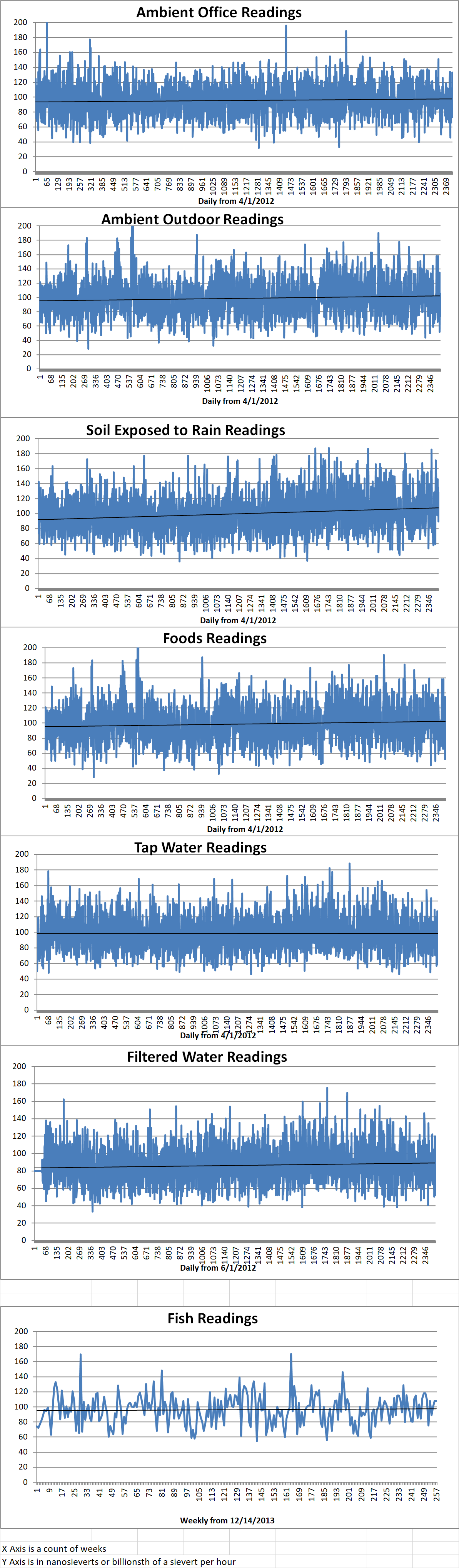
Geiger Readings for Jan 30, 2019
Ambient office = 133 nanosieverts per hour
Ambient outside = 128 nanosieverts per hour
Soil exposed to rain water = 128 nanosieverts per hour
Aloha pepper from Central Market = 74 nanosieverts per hour
Tap water = 90 nanosieverts per hour
Filter water = 83 nanosieverts per hour
-
Radioactive Waste 656 – Sharp Increase In Estimates Of DoE Nuclear Waste Cleanup Results From Increased Estimate For the Hanford Reservation
One of the biggest problems with nuclear power in the U.S. is the disposal of the seventy thousand tons of spent nuclear fuel from the 98 operating commercial nuclear power reactors. In addition to having to deal with this huge problem, there is also the need to clean up nuclear waste created by the U.S. government in the development of nuclear weapons and nuclear research projects. This cleanup is in the hands of the U.S. Department of Energy (DoE).
In 2017, the DoE estimated the cost of nuclear clean up at three hundred eighty-four billion dollars. The estimate for 2018 was four hundred and ninety-four billions dollars. The estimate increased in one year by roughly twenty five percent or one hundred billion dollars. These estimated were provided to the DoE under a contract with the accounting firm KPMG. David Trimble is the director of the Government Accountability Office’s Natural Resource and Environment division. He said, “We believe the number is growing and we believe the number is understated.”
Eighty percent of the increase in the annual estimation is a result of new estimates of the cost of cleaning up the radioactive wastes and hazardous chemicals at the five hundred and eighty six square mile Hanford Reservation in south central Washington State. The Hanford Reservation hosted nine production reactors and processing facilities which generated plutonium for the construction of the U.S. nuclear arsenal during the Cold War with the Soviet Union. The Reservation was developed and put into operation in the early 1940S and continued to operate until 1989
Cleaning up the radioactive mess at Hanford has already cost the U.S. government one hundred and seventy billion dollars in the last thirty years. Unfortunately, the most complicated and difficult part of the clean up has not been accomplished yet. There are over fifty-six million gallons of what are described as “hazardous and highly radioactive waste” by the DoE Inspector General.
The sharp rise in the estimated cost of DoE cleanup of radioactive wastes resulted from an update in the projected cost of activities at Hanford. They need to build and operate a waste treatment plant which will have to include “operating costs, tank farm retrieval and closure costs.” The report on estimated Hanford costs also mentioned that changes were needed in technical approach or scope and updated estimations of projected waste volumes.
A DoE spokesperson said that the office that oversees the Hanford cleanup is “committed to making progress on the ground at Hanford and mitigating the years of escalating liabilities at the site. The statement continued “(the DoE) is working with regulators and stakeholders on best options to treat and dispose of radioactive waste.” Trimble at the General Accounting Office says that he does not believe that the DoE has a coherent strategic plan on how to carry out its cleanup mission.
Secretary of Energy Rick Perry has proposed that the radioactive waste at Hanford be reclassified to make its ultimate disposal cheaper. This proposal is rigorously opposed by environmental groups in the Pacific Northwest.