Blog
-
Geiger Readings for July 25, 2016
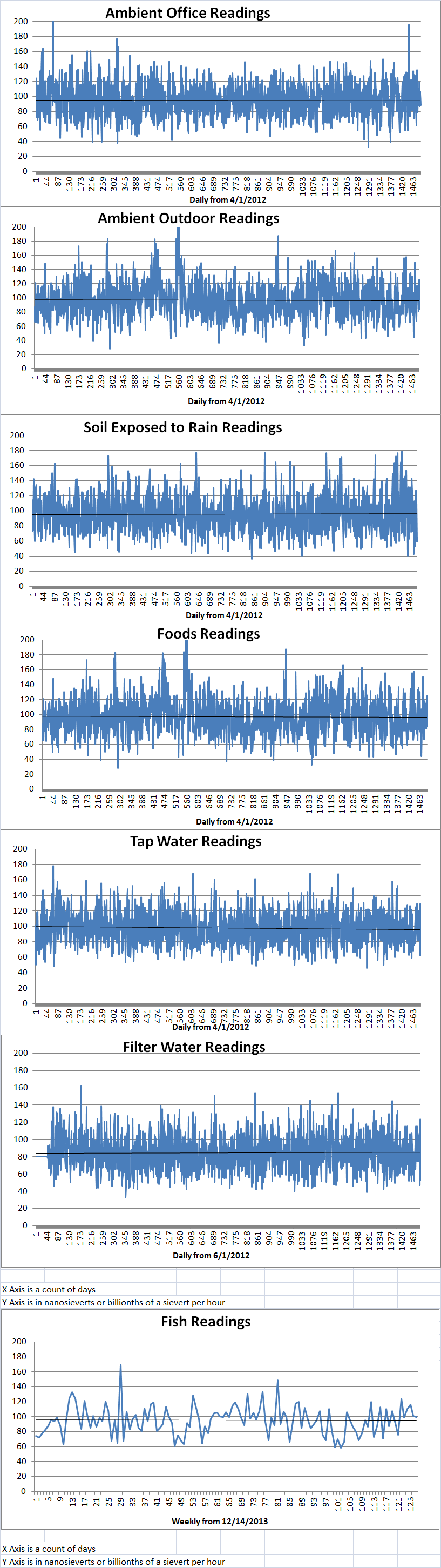
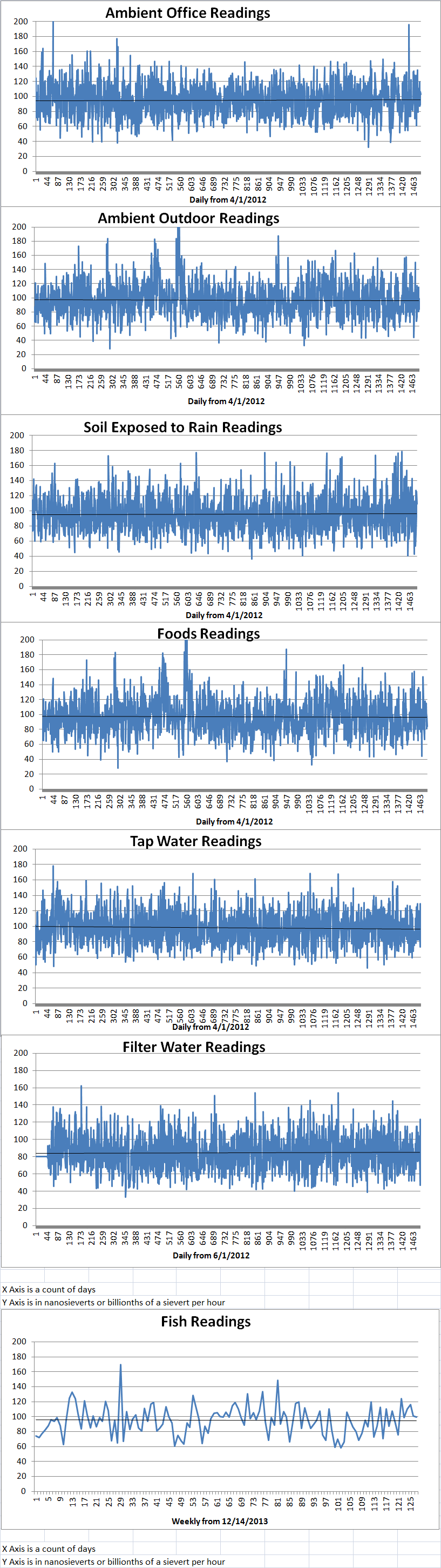
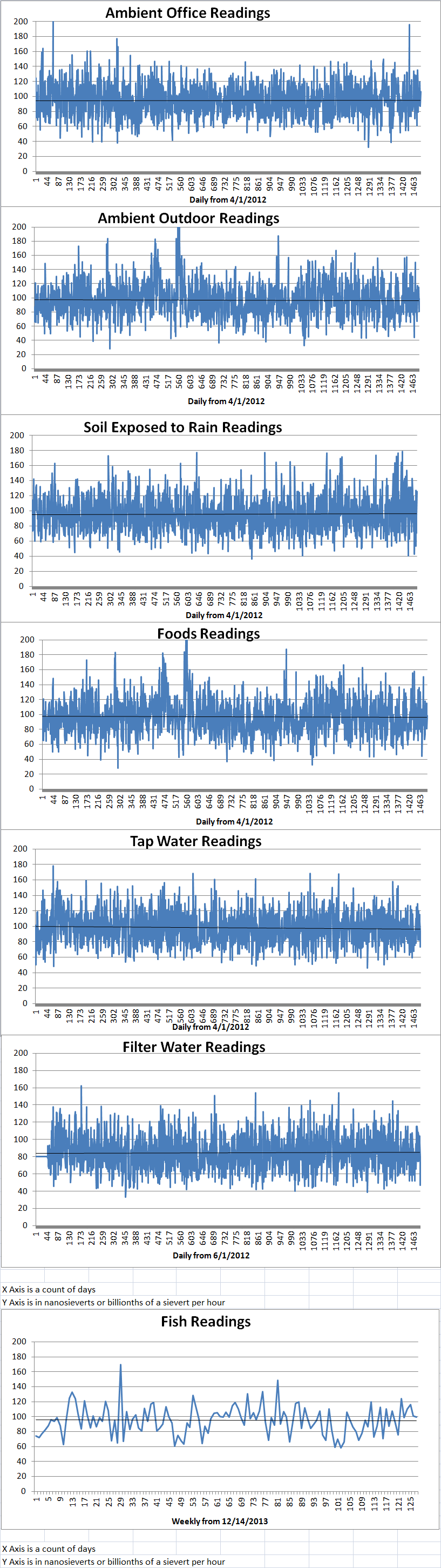
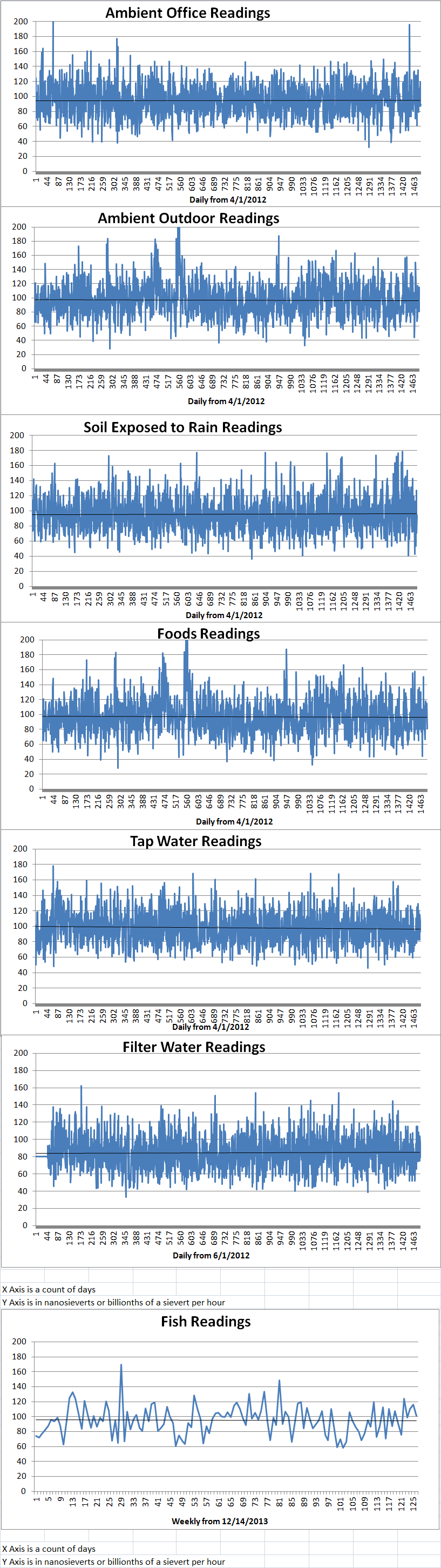
Ambient office = 88 nanosieverts per hourAmbient outside = 78 nanosieverts per hourSoil exposed to rain water = 59 nanosieverts per hourRoma tomato from Central Market = 126 nanosieverts per hourTap water = 62 nanosieverts per hourFiltered water = 52 nanosieverts per hour -
Geiger Readings for July 24, 2016
Ambient office = 103 nanosieverts per hourAmbient outside = 96 nanosieverts per hourSoil exposed to rain water = 110 nanosieverts per hourRusset potato from Central Market = 84 nanosieverts per hourTap water = 129 nanosieverts per hourFiltered water = 124 nanosieverts per hour -
Geiger Readings for July 23, 2016
Ambient office = 106 nanosieverts per hourAmbient outside = 135 nanosieverts per hourSoil exposed to rain water = 126 nanosieverts per hourWalla Walla Sweet Onion from Central Market = 899 nanosieverts per hourTap water = 69 nanosieverts per hourFiltered water = 47 nanosieverts per hourSockeye salmon – Caught in USA = 100 nanosieverts per hour -
Nuclear Reactors 388 – Japan May Make Major Switch From Nuclear Power to Renewable Power
Five years have passed since the Fukushima nuclear disaster in Japan when three nuclear power reactors melted down following a massive tsunami caused by an earthquake. All of the Japanese power reactors were shut down after the disaster. During the past five years, the Japanese have tried to clean up the contamination of the disaster and move on. Unfortunately, radioactive ground water is still leaking into the Pacific Ocean, there is still widespread radioactive fallout scattered around Japan, huge amounts of radioactive debris are still awaiting disposal, and the exact location of the melted reactor cores is unknown. It will take decades and many billions of dollars to finished cleaning up.
Studies of problems that contributed to the disaster were carried out and blame was assigned. Lawsuits were filed and are still going on. People were evacuated from their homes in the area near the reactors and now some have returned. There have been huge impacts on the economics, politics and society of Japan. The Japanese government has not been fully candid about the causes of and responsibilities for the disaster. Laws have been passed to censor independent reports trying to get to the truth of all that happened and is going on.
The current Prime Minister Abe and his administration remain committed to nuclear power as a critical part of Japanese energy sources as well as a major export market. They are beginning to turn some of the reactors back on but a recent reactor that is being reactivated is sitting close to an active volcano. About a third of the reactors will not be turned back on because they are too near active fault lines and at risk from earthquakes. So far only two reactors have actually been restarted and the governors of the provinces where they are located are saying that they will be shut down. There are many among the Japanese people who would rather that none of the reactors are ever restarted again.
The Japan Association of Corporate Executives (JACE) is a top business lobbying group in Japan. It has around fourteen hundred executives from nine hundred and fifty companies.
The JACE has come out against nuclear power as a major energy source which represents a major shift in corporate support for nuclear power in Japan. Prior to the Fukushima disaster, nuclear power generation accounted for about thirty percent of the electricity generated in Japan. The JACE is saying that P.M. Abe should give up his ambition of supply twenty percent of Japan’s power by 2030 and concentrate on renewables instead. JACE is saying that given the current circumstances, they doubt that Japan will ever get more than ten percent of its power from nuclear energy in the future.
Renewable energy sources supplied about fourteen percent of Japan’s electricity in 2016 and current plans call for raising that to as much as twenty four percent by 2030. However, recently, incentives for renewables were cut back.
Abe’s administration has publicly reaffirmed its commitment to nuclear power recently. JACE is pushing for a strong move into renewables. There are reports that the Japanese government will cut back nuclear ambitions and move forward with more support for renewables in a new national energy roadmap to be published early next year.
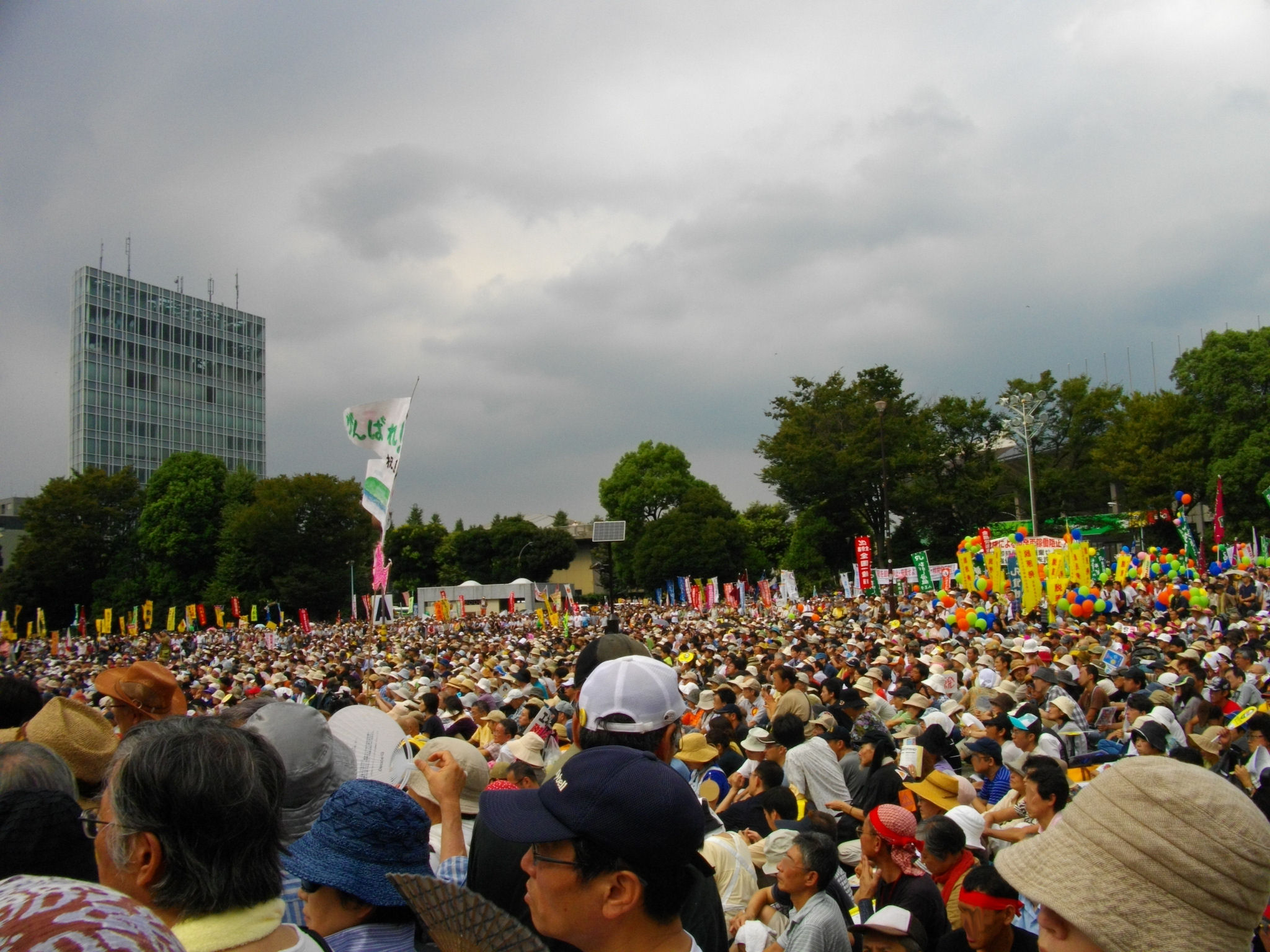
Japan anti-nuclear protest rally in Tokyo in 2011:
-
Geiger Readings for July 22, 2016
Ambient office = 89 nanosieverts per hourAmbient outside = 96 nanosieverts per hourSoil exposed to rain water = 94 nanosieverts per hourParsnip from Central Market = 81 nanosieverts per hourTap water = 93 nanosieverts per hourFiltered water = 79 nanosieverts per hour -
Nuclear Weapons 214 – World War III May Begin In The Baltic States
Yesterday, I spoke about the terrible danger of global nuclear war and new technology for identifying nuclear warheads in the reduction of nuclear arsenals. I mentioned the rising tensions between the U.S. and Russia. Following the coup and government change in Ukraine in 2014, the Russians annexed the Crimea and supported rebellion in eastern Ukraine.
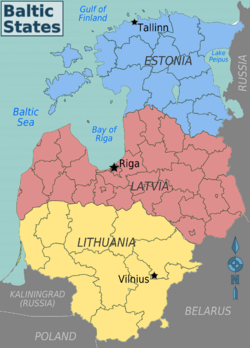
This Russian aggression generated great turbulence in eastern Europe as countries that shared borders with Russia feared that they might be next for Russian aggression. This includes the Baltic states of Lithuania, Estonia and Latvia as well as Poland. Recently Russia has been massing troops on its side of the borders of these countries and holding military exercises. The three Baltic states became members of NATO in 2004 which committed NATO including the U.S. to defend these countries in any conflict with Russia. This defense includes the possible use of nuclear weapons against Russia if a conflict escalates.
The U.S. currently maintains about two hundred tactical B-61 nuclear gravity bombs in Belgium, Germany, Italy and the Netherlands. Bombers which can deliver these weapons are stationed in other NATO members. Russia has a large arsenal of tactical nuclear weapons including cruise missiles and nuclear artillery. Russia has publically stated that it would consider the use of tactical nuclear weapons against NATO if it were losing a conventional ground war.
Recently, NATO committed to move a thousand troops into each of these at-risk countries to act as “trip wires” against possible Russian invasion. Russia is also considering moving mid range missiles into the Russian province of KIalingrad on the Baltic Sea as a counter move. As tensions in eastern Europe ratchet up, it is the Baltic states that might be the area where an all out nuclear war begins.
The Baltic states are close to important military and governmental centers in Russia. Moscow, the capital of Russia is only a few hundred miles away. An attack launched from the Baltic states could be devastating for Russia. The U.S. considers the protection of the Baltic states to be integral to maintaining the credibility of NATO. The U.S. has said that protecting the Baltic states was as important as defending Berlin, Paris and London.
From a military perspective, the defense of the Baltic states is virtually impossible. Russia has enormous military resources in the region and could overrun the Baltic states in a matter of days regardless of NATO resistance in a ground war. The U.S. has not made a commitment to send troops and weapons to the Baltic states that could turn back such a Russian invasion.
If a ground war broke out in the Baltic states, it is inevitable that the conflict would spill over the border into Russia. If that happened, the Russians would have to consider that their capital could be under threat and they would escalate with the possible use of tactical nuclear weapons as they have threatened. NATO also insists that an escalating conflict in eastern Europe could be justification for the use of tactical nuclear weapons. Both Russia and the U.S. have tactical nuclear weapons in the area that could be quickly deployed in an escalating conflict.
There are also new weapons being developed and deployed that could further destabilize the balance of forces in the Baltic states. The U.S. is replacing old fighters with the F-35 stealth fighter that is invisible to Russian radar. Russia is developing integrated air defenses in the area which would permit it to control the air space above a battlefield.
All in all, the situation in the Baltic states is ripe for conflict and escalation. Russian aggression countered by NATO could quickly escalate into the exchange of tactical nuclear weapons. This in turn could easily escalate into all out nuclear war between NATO and Russia which could spread to the U.S. mainland. This would be the end of human civilization. It is very important that the rising tensions in the Baltic states be dealt with diplomatically before World War III breaks out.
-
Radiation News Roundup July 21, 2016
A year after pact aimed at thwarting Tehran’s rogue nuclear program was signed, head of atomic agency and speaker of parliament discuss new enrichment plans. timesofisrael.com
Czech utility ČEZ has requested the Ministry of Environment carry out an environmental impact assessment (EIA) for the potential construction of two new reactors at the Dukovany nuclear power plant. world-nuclear-news.org