
Blog
-
Geiger Readings for Mar 10, 2015
Ambient office = 115 nanosieverts per hourAmbient outside = 64 nanosieverts per hourSoil exposed to rain water = 81 nanosieverts per hourAvocado from Central Market = 57 nanosieverts per hourTap water = 100 nanosieverts per hourFiltered water = 91 nanosieverts per hour -
Australia Hopes To Become The Major Global Supplier of Uranium In The Coming Decade
Uranium is the main fuel for nuclear power plants. It is found in many types of geological formations in combination with many minerals all over the world. In spite of its ubiquity, some forms and deposits are easier to mine than others. There are about four hundred nuclear power reactors in use in the world today. Japan shut down about fifty following the Fukushima disaster in March of 2011. On the other hand, China, India and Russia are investing heavily in building new reactors. There was a softening of demand after the Fukushima disaster for uranium fuel but now demand is picking up again. The current contract price of uranium is around forty seven dollars a pound.
The nuclear power industry has enjoyed years of low uranium prices. The U.S. has about a quarter of the power reactors in the world. U.S. power plants have enjoyed fifteen years of reactor fuel prices below the cost of uranium on the open market because they had a deal with the Russian to purchase reactor fuel made from decommissioned Russian nuclear warheads left over from the Cold War. This cozy arrangement has just ended. Prices for uranium have started to rise in the past year.
Australia has the largest reserves of uranium in the world at around thirty percent. This may increase as more mines come online and exploration continues. Recently, changes in state and government laws opened up much of the nation to uranium exploration. Canada has the next largest reserves at about twelve percent. Kazakhstan comes next at around ten percent. Kazakhstan, Canada and Australia produce about two thirds of the world’s uranium. Kazakhstan’s production has quadrupled in the past ten years and it now produces forty one percent of the world supply. Canada’s production has been flat for ten years and now accounts for about sixteen percent of world production. Australia’s production has dropped by about forty percent in the last ten years and is now about nine percent of world production.
Although Australia has the largest reserves by far, Australian production has declined because the cost of extraction makes the current price of forty seven dollars a pound too low for some of the producers. If the contract price of uranium rises to fifty dollars a pound, more Australian producers will be able to turn a profit. They would really like to see the price rise to sixty five dollars a pound which would bring more mines and producers online. With the sharp increase in construction of nuclear power reactors around the world and the planning for many more, the price of uranium should rise significantly in the next few years. If the desired price increase occur, then Australia with its massive reserves could become the major supplier of uranium to the world within a decade.
With many new reactors coming online and competition for uranium fuel supply rising, it is inevitable that the price of uranium will rise in the next few years. With competition from ever cheaper sustainable energy sources and cheap abundant oil and natural gas, higher uranium prices will make nuclear power less attractive. Time will tell if all the planned reactors get built and Australia becomes the dominating nuclear fuel source that it aspires to be.
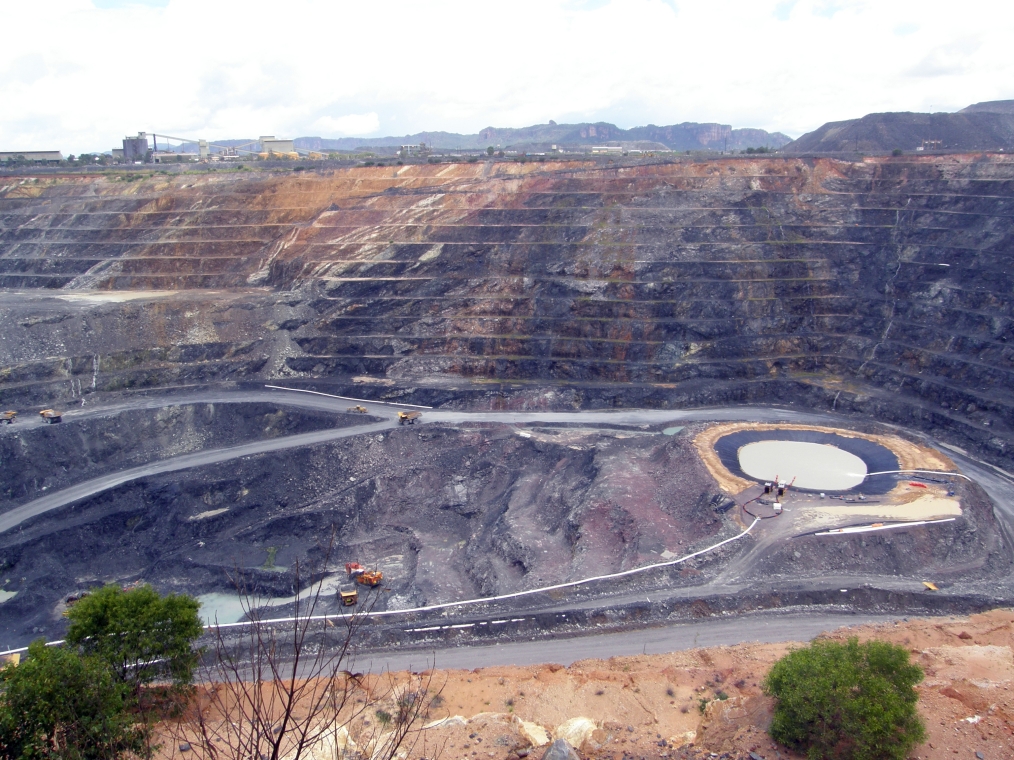
Australian Ranger 3 open pit uranium mine:
-
Geiger Readings for Mar 09, 2015
Ambient office = 114 nanosieverts per hourAmbient outside = 108 nanosieverts per hourSoil exposed to rain water = 104 nanosieverts per hourOrange bell pepper from Central Market = 128 nanosieverts per hourTap water = 64 nanosieverts per hourFiltered water = 53 nanosieverts per hour -
Russian Nuclear Powered Ion Space Propulsion System
This week, I am going to talk about using nuclear fission for space propulsion. I have mentioned nuclear fission propulsion engines in the past. The Soviet Union was very interested in nuclear engines for space travel and created a functional nuclear engine after a twenty year program that started in 1960 and ended in 1980. It was never used to propel any spacecraft. In the U.S., Project Orion was a design for a spacecraft that used nuclear propulsion that was never built. The Russians are currently working on a new nuclear fission propulsion system.
The most recent Russian nuclear propulsion project was launched in 2010 with a budget of about two hundred and seventy five million dollars. It was part of the Russian space program planning for the period up to 2020. The goal was to develop a nuclear fission-based propulsion system that would provide much greater economic efficiency by increasing the amount of electricity available on a spacecraft by ten times. It is hoped that this will allow deep space mission of greater duration and distance. The funding was split among a number of different organizations and facilities.
The new system is to include “high-conversion circuits , a high temperature compact fast reactor with a gas cooling system, nuclear and radiation safety features for in all phases of operation, high temperature turbine and compact heat exchangers with a decade of design life, high-speed electric generators with high power converters, high efficiency fuel cells, and a propulsion system based on high-performance powerful ionic electric propulsion.”
In the this new Russian system, a nuclear reactor generates up to four megawatts of electricity which heats a gas that then drives a turbine. The turbine generates electricity with high efficiency which is used to charge fuel cells. An ion propulsion system then uses the electricity available to send charged ions of xenon gas out the back of the space craft. There will be six main engines and eight smaller engines for roll control and course correction.
Ion propulsion is not as immediately powerful as chemical rockets but it operates continuously for long periods of time. This is much more efficient than chemical rockets and it requires much less fuel. Unlike current rocket engines which fire intensely for short periods and then shut off leaving the spacecraft to coast for long periods, the new propulsion system would be able to maneuver, accelerate and decelerate during the flight.
The head of the Russian Rosatom nuclear corporation just announced that Russia may test a prototype of their new nuclear propulsion engine for space exploration as soon as 2018. Conventional rockets would take more than six months to reach Mars and would not be able to carry enough fuel to make the return trip. The new Russian nuclear propulsion system should be able to reach Mars in about six weeks and return to Earth without refueling.
Traditional rocket engines and traditional fuels are reaching the end of their utility for deep space missions and the Russians are betting that nuclear propulsions systems will be the next “big thing” in space propulsion. The U.S. recently tested the first use of ion engines in orbit and they are being considered for U.S. deep space missions.
Artist’s concept of a Russian spacecraft with nuclear driven ion propulsion:
-
Geiger Readings for Mar 08, 2015
Ambient office = 96 nanosieverts per hourAmbient outside = 72 nanosieverts per hourSoil exposed to rain water = 80 nanosieverts per hourRomaine lettuce from Central Market = 75 nanosieverts per hourTap water = 98 nanosieverts per hourFiltered water = 88 nanosieverts per hour -
Nuclear Reactors 335 – Adding Carbon Nanotubes to Aluminum Can Prevent Embrittlement in Nuclear Reactors
One of the major considerations of creating nuclear reactors is the question of what materials to use for what purposes. A variety of elements in a variety of combinations have been found to be useful. The materials near the core of nuclear reactors are subjected to intense heat and bombardment with neutrons which causes some of them to become porous and brittle with age. This is a major reason that nuclear power plants are licensed for limited life spans. Forty years has been a common license period with twenty year renewals if the reactor is found to be sound enough to keep operating.
A team of researchers at MIT has found that adding small quantities of carbon nanotubes (CNT) to aluminum can slow down the process of embrittlement in a nuclear reactor. At this time, the new additive can only be used in lower temperature environments like research reactors. It is hoped that, in time, the same additive might be used in other metals and in the higher temperatures of nuclear power reactors. In addition to dealing with radiation damage, it has been found that addition of the carbon nanotubes can increase the strength of the composite material by up to fifty percent. It also increases the tensile ductility of the composite which means that it can withstand more deformation before it breaks.
Metals such as aluminum have microscopic grains or zones. When subjected to conditions in reactor cores, radiation transmutation can generate helium which forms tiny bubbles along the boundaries of the grains. This porosity makes the metal brittle. When about two percent of the volume of the metal is occupied by carbon nanotubes, the nanotubes form a one dimensional transport network along which the helium can percolate. The helium is able to leak out of the metal and does not remain to cause further damage. Although the carbon nanotubes are converted to carbides after being exposed to radiation, the carbides retain the long narrow shape which provides an avenue of escape for the helium. The tubular carbides have a huge combined surface area while allows point defects in the metal to recombine which also prevents embrittlement. The carbide nanotubes can withstand a lot of radiation. The reduction in embrittlement is between five and ten times that of untreated metal.
The current research is focused on aluminum but the researchers are going to move on to test the process on zirconium. Zirconium is used extensively in the nuclear industry for the coating layer or cladding on the outside of long thin cylinders or rods of nuclear fuel. They hope to find that the beneficial results of adding carbon nanotubes to aluminum will be replicated when they are added to other metals. If this proves to be true, the new process could be extremely useful in a number of applications in nuclear power reactors.
The amount of carbon nanotubes added to the metal constitute only about one percent by weight. Carbon nanotubes are inexpensive to produce. The composite resulting from the addition of carbon nanotubes to metal can be created inexpensively in standard industrial processes. Korea is already manufacturing tons of the new material for use in automobile manufacture.