Blog
-
Geiger Readings for Dec 20, 2015
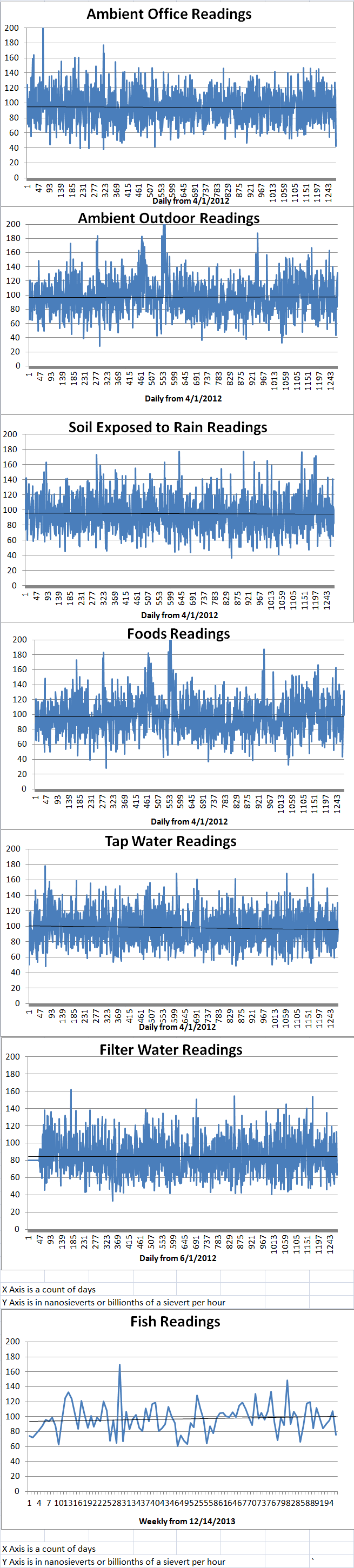
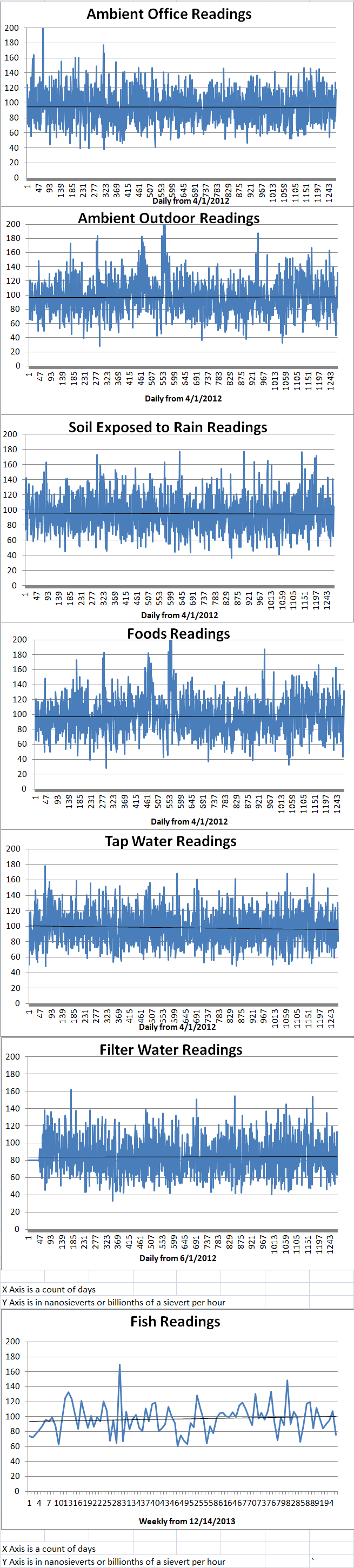
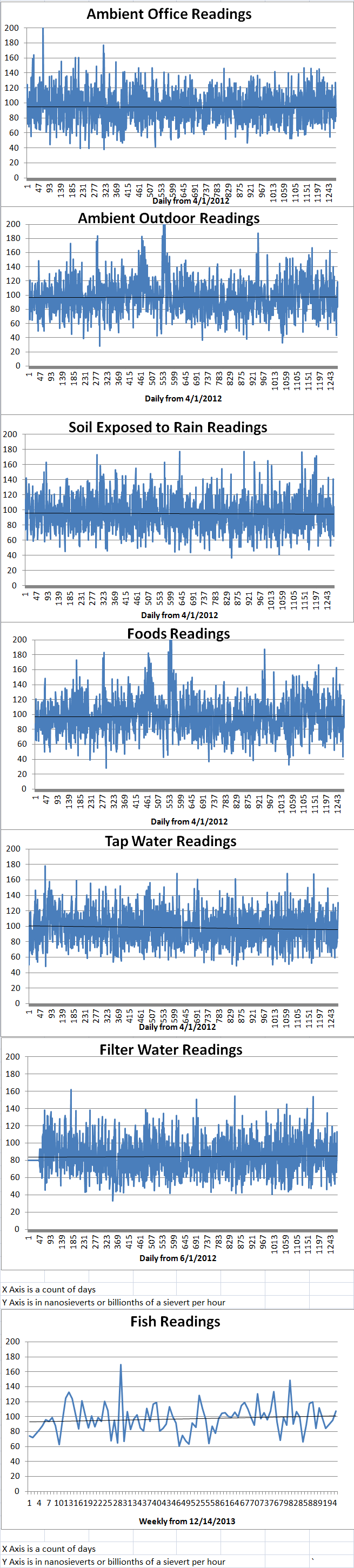
Ambient office = 43 nanosieverts per hourAmbient outside = 86 nanosieverts per hourSoil exposed to rain water = 82 nanosieverts per hourCarrot from Central Market = 99 nanosieverts per hourTap water = 96 nanosieverts per hourFiltered water = 77 nanosieverts per hour -
Geiger Readings for Dec 19, 2015
Ambient office = 118 nanosieverts per hourAmbient outside = 100 nanosieverts per hourSoil exposed to rain water = 100 nanosieverts per hourRed bell pepper from Central Market = 132 nanosieverts per hourTap water = 81 nanosieverts per hourFiltered water = 63 nanosieverts per hourRockfish – Caught in USA = 75 nanosieverts per hour -
Climate Scientists Are Mistaken In Supporting Nuclear Power For Climate Change Mitigation – Part One of Two Parts
Part One of Two Parts
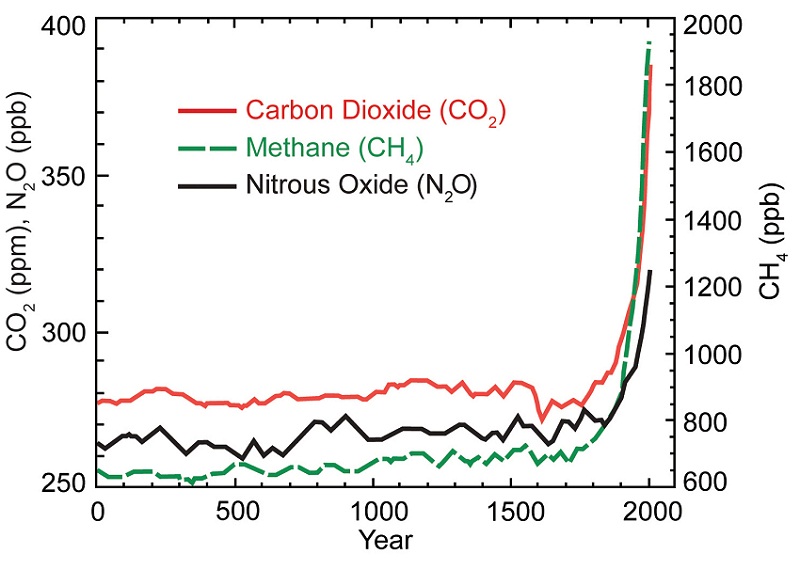
The big conference in Paris on Climate change where one hundred and ninety six nations agreed on measures to confront climate caused by carbon dioxide emissions stirred up a lot of commentary on various aspects of the climate change problem. One issue that is relevant to this blog is the call by some prominent climate scientists for the use of nuclear power to reduce carbon dioxide emission from the generation of electricity. This has been met by some critics as another form of climate change denial. This charge has, in turn, inspired some commentators to ridicule the accusation of “denier” against these climate scientists who call for more nuclear power. The supporters of the climate scientists say that they merely “disagree” about the best way to reduce carbon emissions and that to call them deniers is underserved slander because, in the supporters view, “denier” implies willful ignorance.
I don’t know if “denier” is the correct term for climate scientists who say that nuclear power is a good way to reduce carbon emissions but I do have to support the idea that there is willful ignorance at work here. For the average person not to know all the problems with nuclear power generation is understandable and forgivable. But for climate scientists concerned about carbon emissions, it is not understandable and forgivable. They are academics with professional reputations who can influence decision makers with their expertise and statements about serious problems. If they are going to make pronouncements about the benefits of a particular power source with respect to carbon emissions, they cannot, in good faith and honoring their profession, ignore problems and only focus on the fact that nuclear power plants emit less carbon than fossil fuel sources. They are duty-bound to also consider many problems that come with nuclear power before they start advising that it be expanded.
1. Nuclear power is not carbon free. It requires fossil fuels to mine, refine and transport uranium fuel. The massive amount of concrete required for plant construction and cooling towers gives off carbon dioxide as it dries. And this carbon debt is incurred during start up. It requires years to pay off.
2. The cost of nuclear power keeps rising and the cost of renewables keeps falling. They are reaching parity now and then the cost of nuclear power will keep climbing. Investors are not particularly excited about the prospects of nuclear power’s ability to compete in today’s power marketplace.
3. The spent nuclear fuel pools are filling up and there is no permanent repository for spent fuel in the U.S. and most other nuclear nations. Spent fuel will have to be stored temporarily in dry casks which are made of concrete and steel. The manufacture of such casks will generate carbon emission. And this must happen soon.
4. The Nuclear Regulatory Commission has been less than rigorous in ensuring adherence to regulations on the part of the nuclear industry. In some cases, officials at the NRC have secretly colluded with owners of nuclear power plants to change regulations in favor of the owners.
5. The nuclear industry has often put profits above proper construction, safety, training and maintenance at nuclear power plants in the U.S. and other countries. The Fukushima disaster was largely the fault of the company that owned and operated the nuclear power plant. This type of negligence invites more major accidents.
Please see Part Two

-
Geiger Readings for Dec 18, 2015
Ambient office = 82 nanosieverts per hourAmbient outside = 84 nanosieverts per hourSoil exposed to rain water = 105 nanosieverts per hourYellow onion from Central Market = 119 nanosieverts per hourTap water = 130 nanosieverts per hourFiltered water = 113 nanosieverts per hour -
Nuclear Weapons 181 – Could a U.S. -Russian Showdown In Syria Ignite World War III? – Part Two of Two Parts
Part Two of Two Parts (Please read Part One first)
In the U.S., there have been many politicians and political commentators calling for more support for the “moderate” Syrian rebels and the establishment of a no fly zone enforced by the U.S. This would be a safe haven for Syrians fleeing the devastation of the civil war and the repeated bombings by forces opposed to the different rebel factions. Some of those promoting the no-fly zone say that it should include Russia planes. This would be in clear violation of international law. Russia is operating in Syria with the permission of the lawful Syrian government. The U.S. is supplying weapons and supplies to rebels trying to overthrow the legitimate Syrian regime.
In the Republican Presidential debate last night, many of the candidates supported a no-fly zone in Syria. If one of them is elected President in 2016, he or she would have the power to declare such a no-fly zone as commander in chief. (This is not necessarily a partisan position. Hillary Clinton, running for President on the Democratic side has also expressed support for a no-fly zone.) When Chris Christie was asked if his support for a no-fly zone extended to shooting down any Russian plane that entered the no-fly zone, he immediately said that he certainly would shoot down a Russian plane without hesitation. I was stunned by his response.
If the U.S. established a no-fly zone in Syria and shot down a Russian plane, it would be a declaration of war against Russia. Both the U.S. and Russia have over four thousand nuclear warhead aimed at the each other which could be launched in minutes. It would mean the end of human civilization and the death of most of the human race. There have already been several times when nuclear war almost broke out between the U.S. and Russia. In each of three incidents, it was the courage and humanity of a single military officer on either the U.S. or the Russia side who refused to start the war that could destroy humanity. With rising tensions in the world, especially between the U.S. and Russia, the possibility of nuclear war is higher than it has been since the end of the Cold war with the dissolution of the Soviet Union in 1991. It is stark insanity to risk annihilating human civilization over a civil war in Syria.
If the U.S. shot down a Russia plane over Syria, what would Putin’s response be? His popularity in Russia is based on his “tough guy” stance with other nations. He may be bluffing with is rattling of nuclear sabers but when and if his bluff is called, how would he respond? He is a brutal thug but I don’t think he is crazy enough to think that anyone can win an all out nuclear war. I think that if a Russian plane were shot down in Syria by the U.S. enforcing a no-fly zone, Putin could possibly detonate a tactical nuclear device in the Syrian desert. Few people would be harmed and little radiation would be spread. After all, both we and the Soviets tested small nuclear devices in the deserts of our own countries before the test-ban treaty. Putin could detonate a few kiloton nuclear device and then say to the U.S. “Abandon the no-fly zone and get out of Syria or the next nuke will hit the Syrian rebels you are supporting.” What would the U.S. do? What could the U.S. do? Our choices would be to back down or start World War III.
This scenario is merely a possibility if certain trends continue. It is probably not likely. However, it is certainly possible.
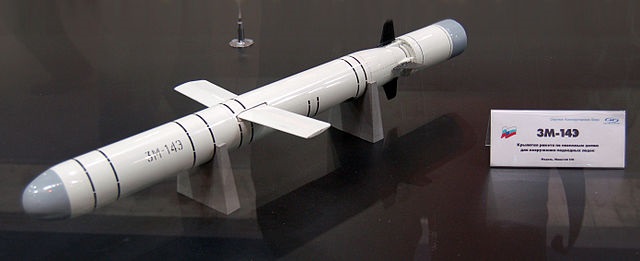
Russian cruise missile:
-
Geiger Readings for Dec 17, 2015
Ambient office = 128 nanosieverts per hourAmbient outside = 81 nanosieverts per hourSoil exposed to rain water = 65 nanosieverts per hourLeek from Central Market = 84 nanosieverts per hourTap water = 97 nanosieverts per hourFiltered water = 90 nanosieverts per hour -
Radiation News Roundup Dec 17, 2015
Fukushima chief says that there is no textbook for cleanup. japantoday.com
Belgium ‘playing Russian roulette’ with relaunch of nuclear reactor, says fuming Germany. rt.com
China’s State Council yesterday approved the construction of two more units at each of the Tianwan and Fangchenggang nuclear power plant sites. world-nuclear-news.org
Donald Trump, who claims to be the “best on the military” among the 2016 Presidential candidates because he is the best at everything, apparently has no idea what the nuclear triad is. foxtrotalpha.jalopnik.com
-
Nuclear Weapons 180 – Could a U.S. – Russian Showdown In Syria Ignite World War III? – Part One of Two Parts
Part One of Two Parts:
In this blog I have tried to stick to the facts as much as possible and to restrict speculation to the probable extension of what is known backed by good evidence. Today I am going to indulge in a more extended speculation to weave a frightening scenario of a possible path to nuclear war between the U.S. and Russia.
For the past several years, the Russian military has been flying nuclear bombers and fighters in and out of other countries airspace without notification and without transponders which would prevent mid-air collisions. Russian nuclear submarines have been prowling around inside territorial waters of other countries without notification or permission. Russian President, Vladimir Putin, has made speeches and allocated millions of dollars to modernizing and expanding Russian nuclear forces. There was a recent “leak” of plans for a top secret Russia nuclear armed drone submarine that could move rapidly underwater right into the harbors of enemy nations undetected and devastate port cities and surrounding areas.
Russia annexed the Crimea in early 2014 and became involved in the civil war in Ukraine by supplying men and weapons to the rebels. Russia also massed troops and weapons on the Ukrainian border. There were discussions about how the U.S. and NATO should respond. There were calls for supplying weapons and even troops to the Ukrainian government. The Russian President, Vladimir Putin, publicly stated that if Russia were drawn into a ground war in Eastern Europe with NATO forces, he would consider the use of tactical nuclear weapons if he were losing a conventional war. He bragged about how many tactical nuclear weapons Russia had as compared to NATO.
A reporter recently traveled to Moscow and interviewed Russian generals and close advisors of Putin in the Kremlin. He was told that Putin thought that NATO was weak and that if Russian tactical nuclear weapons were unleashed in a war in Eastern Europe, the major Western European nations would abandoned the NATO nations in Eastern Europe rather than face nuclear war with Russia. Some of those interviews said that Putin was considering detonating a single small nuclear device in Eastern Europe to intimidate the world into accept Russia capture of territory from NATO nations.
In 2015, Russia brought planes, weapons, troops and supplies into Syria at the invitation of Syrian President Assad to fight rebels who were opposing his regime. The U.S. has been supplying “moderate” rebels with weapons and supplies in Syria while carrying out many bombing missions against ISIS. The Russians have been bombing the “moderate” rebel positions near the Russian naval base in the Syrian Mediterranean port city of Tartus. They have also been bombing ISIS positions and even sending cruise missiles from submarines in the Caspian sea to hit ISIS positions in eastern Syria. Recently Putin pointed out at a Kremlin military briefing that those cruise missiles could also carry nuclear warheads. He also said that there would be no need for such weapons against ISIS because they could be defeated with conventional weapons.
A couple of weeks ago, Turkey shot down a Russia fighter that they said had strayed into Turkish airspace. The Russians claimed that their fighter never left Syria. The Turks were angry with Russia because Russia planes had been bombing rebels in Syria that were allied with Turkey. Russia was furious and immediately slapped heavy economic sanctions on Turkey with whom they do a lot of trade. They also threatened serious reprisals against any further military actions from Turkey that interfered with their mission in Syria.
Please see Part Two
Russian Tupolev nuclear bomber: