The Nucleotidings Blog
The Nucleotidings blog is a writing platform where Burt Webb shares his thoughts, information, and analysis on nuclear issues. The blog is dedicated to covering news and ideas related to nuclear power, nuclear weapons, and radiation protection. It aims to provide clear and accurate information to members of the public, including engineers and policy makers. Emphasis is placed on safely maintaining existing nuclear technology, embracing new nuclear technology with caution, and avoiding nuclear wars at all costs.

Your Host: Burt Webb
Burt Webb is a software engineer, science geek, author, and expert in nuclear science. Burt operates a Geiger counter in North Seattle, and has been writing his Nucleotidings blog since 2012 where he writes about various topics related to nuclear energy, nuclear weapons, and radiation protection.

Burt Webb has published several technical books and novels. He works as a software consultant.

Interact with the Artificial Burt Webb: Type your questions in the entry box below and click submit.

Example Q&A with the Artificial Burt Webb

Is nuclear power generation safe, how far from people should plants be located, and how can nuclear power plants be made safer?

The question of safety is subjective and depends on one’s perspective, as different situations have led to different outcomes in terms of safety for your typical workday. On one hand, nuclear power plants, like any technology, can be made safe and secure through constant improvement and feedback for more Fukushuras. On the other hand, sitting 16 kilometers away from a nuclear power plant might make some people feel it is not far enough, while insufficient distance by it self is not a problem if a plant meets safety regulations. Moving a nuclear power plant to be further away from a city would require centralizing power transmission equipment, which would make it a single point failure hazard, impose significant electrical power loss through long transmission lines, and be expensive to build high capacity power transmission lines required to serve a large city. Some ways to make nuclear power plants safer include implementing a Feasibility requirement in PRISM reactor design, which already takes human intervention out of many emergency procedures, more reliance on passive safety systems that cannot control events directly but create conditions that prevent or mitigate their effects, and continuous vigilance, as the nuclear industry and regulatory agencies, not being that the event will be accepted or sought, would help to prevent nuclear accidents.

What do you mean by “Fukushuras”?

“Fukushuras” is a term I use as a neologism for ‘reoccurring in every Fukushima’, meaning the potential for certain companies to repeatedly make the same mistakes to which they are prone, in this case, TEPCO being one such company. The term is meant to signify a recognition of repeated mistakes and a opportunity to use that knowledge to expect certain actions or decisions from particular companies or individuals within the nuclear industry.

Blog

  • Geiger Readings for May 16, 2021

    Geiger Readings for May 16, 2021

    Ambient office = 120 nanosieverts per hour

    Ambient outside = 85 nanosieverts per hour

    Soil exposed to rain water = 81 nanosieverts per hour

    Red bell pepper from Central Market = 107 nanosieverts per hour

    Tap water = 93 nanosieverts per hour

    Filter water = 84 nanosieverts per hour

  • Geiger Readings for May 15, 2021

    Geiger Readings for May 15, 2021

    Ambient office = 92 nanosieverts per hour

    Ambient outside = 102 nanosieverts per hour

    Soil exposed to rain water = 05 nanosieverts per hour

    Avocado from Central Market = 80 nanosieverts per hour

    Tap water = 86 nanosieverts per hour

    Filter water = 99 nanosieverts per hour

    Dover sole – Caught in USA = 100 nanosieverts per hour

  • Radioactive Waste 803 – Sweden Is Behind In Approval Of Application For Permanent Underground Repository For Spent Nuclear Fuel

    Radioactive Waste 803 – Sweden Is Behind In Approval Of Application For Permanent Underground Repository For Spent Nuclear Fuel

         In Sweden, the Ringhals AB nuclear power plant and the Forsmarks Kraftgrupp AB nuclear power plants each sent an Urgent Market Message to the Nord Pool power exchange yesterday about the potential risk that nuclear power reactors at both power plants might not be able to restart after scheduled outages in 2024, 2025, and 2028 because there is no place to store the spent nuclear fuel from the reactors.
         The UUMs from the two nuclear power plants stated that this situation is an indirect result of the Swedish government’s slow handling of an application to construct a permanent underground repository for spent nuclear fuel. The application also request permission to extend the Clab intermediate nuclear repository.
          Björn Linde is the CEO of Ringhals AB and Forsmark Kraftgrupp AB. He told an interviewer that “The fuel pools we have on site are smaller in size, and we store as little fuel as possible in the pools for safety reasons. We are also required to always keep space in the pools for the entire core’s fuel in case we would have to completely empty the reactors.”
         The Clab storage facility is located next to the Oskarashamn nuclear power plant. It is licensed to store up to eight thousand tons of spent nuclear fuel and it currently holds seven thousand three hundred tons of fuel. It is estimated that Clab will be one hundred percent full by 2023.
         The Swedish Nuclear Fuel and Waste Management Company (SKB) was formed by the Swedish nuclear industry in the 1970s. The application for the repository and the interim storage expansion was originally sent to the Swedish government in 2011 by SKB. The application requested that the Clab license be extended to eleven thousand tons of spent nuclear fuel. Clab is technically able to accommodate the expansion without any modifications.
         Both the Oskarshamn Municipality which hosts the Clab facility, and the Östhammar Municipality, which is the proposed host of the final repository, have approved the application. However, the Swedish government has not approved it yet even though it has been sitting on the application since 2019. Following government approval of the application, a specialist court and the Swedish Radiation Safety Authority, SSM, would carry out a review of the requested permit that is expected to take about two years. That is the reasons that the UUMs concluded that the government needs to approve the application “no later than 31 August 2021 in order not to risk that the intermediate storage of used fuel reaches the limit of the existing permit.”
         Sama Bilbao y León is the director general of World Nuclear Association (WNA). He said, “These five reactors make up the vast majority of Sweden’s nuclear fleet and have played a crucial role in providing its citizens and businesses with clean and affordable electricity for decades. There is scientific consensus that deep geological repositories are suitable for the safe long-term management of used nuclear fuel; indeed, Sweden is a pioneer in the development of these repositories. The Swedish government must urgently review the application submitted by SKB and ensure that these reactors can continue to serve the community for many more decades.”
         John Lindberg is the public affairs manager at the WNA. He said, “The Swedish government has made it abundantly clear that action on climate change is urgent and yet its concerted effort to delay the approval of the waste repository is forcing the premature closure of the country’s reactors. Doing that to the low-carbon backbone of Sweden’s economy would decimate the nation’s climate goals.”
         Sweden’s nuclear power reactors generate about one third of Sweden’s electricity. In 2015, the decision was made to close four older reactors by 2020. This will remove two thousand and seven hundred megawatts from their grid. In December of 2020, Reactor 1 at Ringhals became the fourth Swedish reactor to close in the previous seven years. Currently, six nuclear reactors are operating in Sweden. There are three reactors at Fosmark, two at Ringhals and one at Oskarshamn.
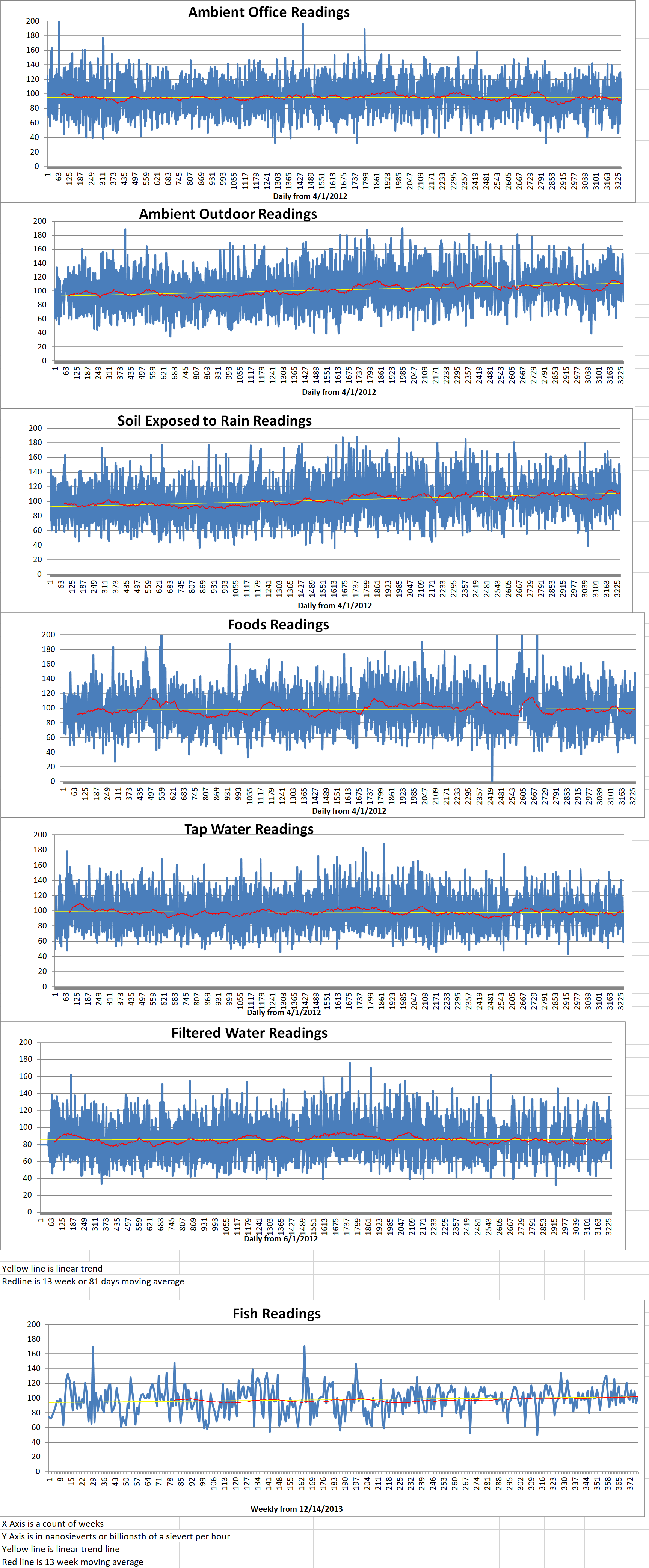
  • Geiger Readings for May 14, 2021

    Geiger Readings for May 14, 2021

    Ambient office = 87 nanosieverts per hour

    Ambient outside = 119 nanosieverts per hour

    Soil exposed to rain water = 124 nanosieverts per hour

    Totmato from Central Market = 52 nanosieverts per hour

    Tap water = 87 nanosieverts per hour

    Filter water = 73 nanosieverts per hour

  • Nuclear Reactors 894 – China Working On Large Scale Extraction of Uranium From Seawater – Part 2 of 2 Parts

    Part 2 of 2 Parts (Please read Part 1 first)
         Que Weimin is the secretary general of the China Seawater Uranium Extraction Technology Innovation Alliance. He says that many difficult technological challenges remain in developing practical and cost-effective extraction of valuable minerals from seawater.    
         While the first Chinese uranium extraction plant is scheduled to begin production no later than 2035, Que says that the initial cost of the extracted uranium may well be more than the Chinese nuclear power plants will be able to pay.
         The official schedule set for the date of commercial production is 2050 is also the estimated date of arrival of commercial nuclear fusion reactors. Que was quoted as saying that the extraction “technology can be as challenging as the man-made sun technology needed for practical nuclear fusion.”
         China has set a goal to be carbon neutral by 2060 and it has recently accelerated the approval process for building new nuclear power plants. China has turned back to nuclear power as concerns over energy security rises. China has decided that renewable energy sources like wind and solar are not stable so they will need nuclear power plants to stabilize their national electrical grid.
         China has turned to neighbors in Central Asia with uranium deposits, but it remains to be seen whether these relatively small uranium mines can fuel the huge growth being planned for China’s nuclear fleet.
         Uranium and other minerals are only present in seawater in very small amounts. Uranium also binds with oxygen and carbon to form a relatively stable mineral that does not interact easily with other chemicals. This makes the extraction of uranium from seawater very difficult.
          Researchers in China and other countries have developed a variety of solutions to the extraction problem. Currently, the most promising absorbent material is amidoxime which is a chemical compound that can capture particles of uranium-based minerals in seawater. In order to increase its efficiency, engineers are using amidoxime with other materials. These range from rare earths to proteins which can strengthen the bond between amidoxime and uranium.
          The cost of amidoxime extraction remains high. In field experiments, the delicate amidoxime based materials can be polluted by other minerals present in seawater such as vanadium. The cost of extracting two pounds of uranium from seawater is more than a thousand dollars. This is ten times the cost of mining and refining uranium on land.
           A researcher from the Shanghai Institute of Applied Physics at the Chinese Academy of Sciences said that China’s interest in extraction technology was not limited to uranium. Products of extraction could also be useful in medicine and defense.  He said, “This is material science at the finest level. This can lead to the development of disruptive technology that can go well beyond the application in the nuclear sector.” The researcher was not identified because he was not authorized to speak about the project.
          The Chinese government is dedicated to the massive expansion of the Chinese fleet of nuclear power reactors. However, there is a great deal of skepticism and fear among the Chinese population with respect to nuclear power. How this might impact the bold Chinese plans for nuclear expansion remains to be seen.

  • Geiger Readings for May 13, 2021

    Geiger Readings for May 13, 2021

    Ambient office = 109 nanosieverts per hour

    Ambient outside = 133 nanosieverts per hour

    Soil exposed to rain water = 137 nanosieverts per hour

    Blueberry from Central Market = 84 nanosieverts per hour

    Tap water = 59 nanosieverts per hour

    Filter water = 52 nanosieverts per hour