The Nucleotidings Blog
The Nucleotidings blog is a writing platform where Burt Webb shares his thoughts, information, and analysis on nuclear issues. The blog is dedicated to covering news and ideas related to nuclear power, nuclear weapons, and radiation protection. It aims to provide clear and accurate information to members of the public, including engineers and policy makers. Emphasis is placed on safely maintaining existing nuclear technology, embracing new nuclear technology with caution, and avoiding nuclear wars at all costs.

Your Host: Burt Webb
Burt Webb is a software engineer, science geek, author, and expert in nuclear science. Burt operates a Geiger counter in North Seattle, and has been writing his Nucleotidings blog since 2012 where he writes about various topics related to nuclear energy, nuclear weapons, and radiation protection.

Burt Webb has published several technical books and novels. He works as a software consultant.

Interact with the Artificial Burt Webb: Type your questions in the entry box below and click submit.

Example Q&A with the Artificial Burt Webb

Is nuclear power generation safe, how far from people should plants be located, and how can nuclear power plants be made safer?

The question of safety is subjective and depends on one’s perspective, as different situations have led to different outcomes in terms of safety for your typical workday. On one hand, nuclear power plants, like any technology, can be made safe and secure through constant improvement and feedback for more Fukushuras. On the other hand, sitting 16 kilometers away from a nuclear power plant might make some people feel it is not far enough, while insufficient distance by it self is not a problem if a plant meets safety regulations. Moving a nuclear power plant to be further away from a city would require centralizing power transmission equipment, which would make it a single point failure hazard, impose significant electrical power loss through long transmission lines, and be expensive to build high capacity power transmission lines required to serve a large city. Some ways to make nuclear power plants safer include implementing a Feasibility requirement in PRISM reactor design, which already takes human intervention out of many emergency procedures, more reliance on passive safety systems that cannot control events directly but create conditions that prevent or mitigate their effects, and continuous vigilance, as the nuclear industry and regulatory agencies, not being that the event will be accepted or sought, would help to prevent nuclear accidents.

What do you mean by “Fukushuras”?

“Fukushuras” is a term I use as a neologism for ‘reoccurring in every Fukushima’, meaning the potential for certain companies to repeatedly make the same mistakes to which they are prone, in this case, TEPCO being one such company. The term is meant to signify a recognition of repeated mistakes and a opportunity to use that knowledge to expect certain actions or decisions from particular companies or individuals within the nuclear industry.

Blog

  • Geiger Readings for May 09, 2021

    Geiger Readings for May 09, 2021

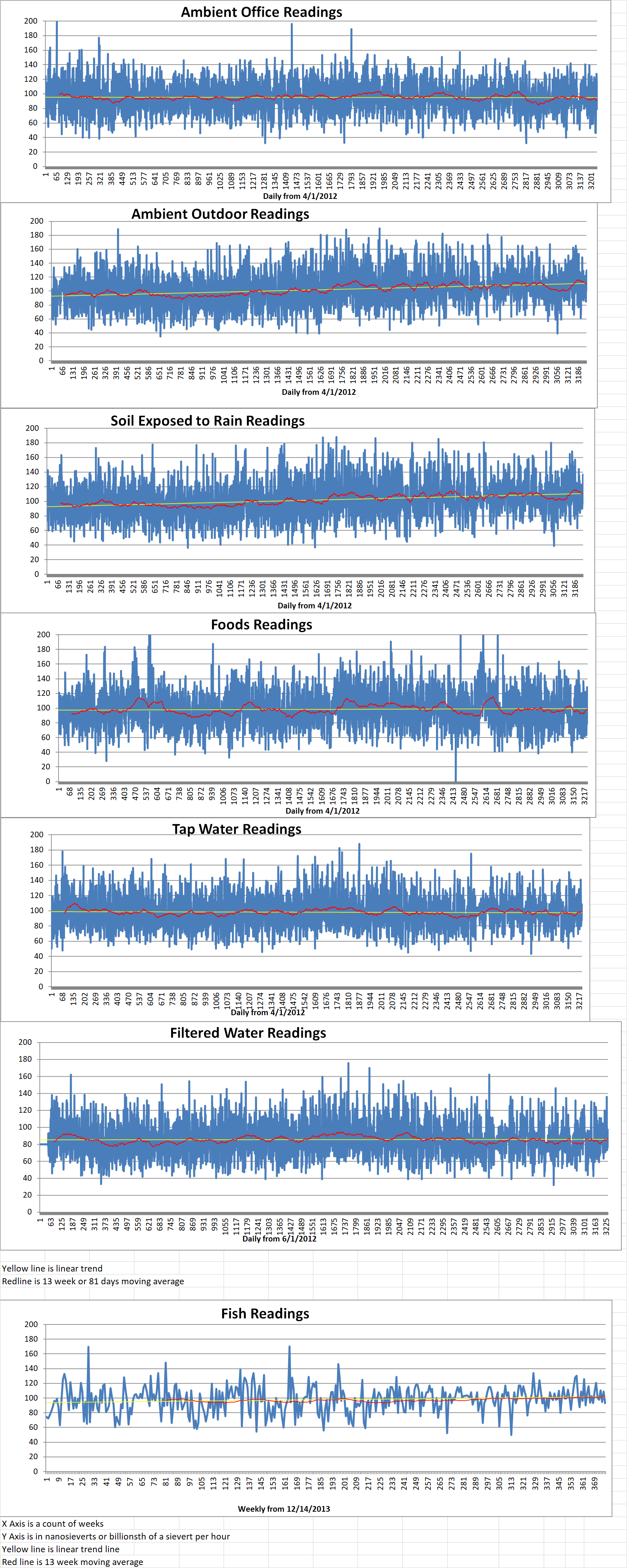
    Ambient office = 73 nanosieverts per hour

    Ambient outside = 146 nanosieverts per hour

    Soil exposed to rain water = 151 nanosieverts per hour

    English cucumbers from Central Market = 84 nanosieverts per hour

    Tap water = 86 nanosieverts per hour

    Filter water = 72 nanosieverts per hour

  • Geiger Readings for May 08, 2021

    Geiger Readings for May 08, 2021

    Ambient outside = 130 nanosieverts per hour

    Soil exposed to rain water = 137 nanosieverts per hour

    Blueberry from Central Market = 90 nanosieverts per hour

    Tap water = 108 nanosieverts per hour

    Filter water = 97 nanosieverts per hour

    Dover sole – Caught in USA = 95 nanosieverts per hour

  • Chernobyl Reactor Is Still Smoldering – Part 2 of 2 Part

    Chernobyl Reactor Is Still Smoldering – Part 2 of 2 Part

    Part 2 of 2 Parts (Please read Part 1 first)
         Thirty-five years after the accident at Chernobyl, nuclear fission reactions are smoldering in the buried FCMs inside of room 305/2. Neil Hyatt said that “It is like embers in a barbecue pit.” Ukrainian scientists are working hard to determine whether the reactions will quench themselves or whether extraordinary interventions will be needed to prevent another nuclear accident.
         Sensors are tracking a rising number of neutrons which is a signal of nuclear fission in room 305/2 which is currently inaccessible. Anatolii Doroshenko works at the Institute for Safety Problems of Nuclear Power Plants (ISPNPP) in Kyiv, Ukraine. He reported the growing neutron flux problem at discussions last week about plans to dismantle the Unit Four reactor. Maxim Saveliev also works at the ISPNPP. He said, “There are many uncertainties. But we can’t rule out the possibility of [an] accident.” Saveliev says that the neutron count is rising slowly and he feels that the managers of Chernobyl have a few years to figure out how to deal with the threat. Japan is watching the activities at Chernobyl with great interest because they are currently coping with the aftermath of the Fukushima nuclear disaster in 2011. Hyatt said that “It’s a similar magnitude of hazard.”
          The threat of another disaster at Chernobyl cannot be ignored. As water in the ruins continues to recede, Hyatt says that “the fission reactions accelerate exponentially,” leading to “an uncontrolled release of nuclear energy.” Fortunately, there is no chance of a repeat of 1986 when the explosion and fire sent a cloud of radioactive particles over Europe. If a runaway fission reaction started in an FCM, it could sputter out after the heat generated by fission boils off the remain water. Saveliev notes that although any explosive reaction would be contained, it could still cause the collapse of unstable parts of the decrepit Shelter which would fill the NSC with radioactive dust.
         Dealing with the new threat at Chernobyl is a serious challenge. The high radiation levels in room 305/2 prevent the installation of sensors. Spraying the gadolinium nitrate solution is not possible because the FCSs in the room are entombed under concrete. One suggestion is to construct a robot that is able to withstand the intense radiation long enough to drill holes in the FCMs and insert boron cylinders. These cylinders would act like control rods and absorb neutrons. Before any such steps are taken, the ISPNPP intends to increase monitoring of two other areas where the FCMs have the potential of criticality.
         The possibility of critical fission reactions are not the only challenge facing the managers of Chernobyl. Attacked by intense radiation and high humidity, the FCM are disintegrating. This is generating more radioactive dust that complicates plans to dismantle the old Shelter. Early in the work on FCMs, a formation called the Elephant’s Foot was found to be so hard that scientists had to use the fire from a Kalashnikov rifle to break off a piece for analysis. Saveliev says that that sample now has the consistency of sand.
          Ukraine has long held the intention to remove the FCMs and store them in a permanent geological repository. With assistance of from the European Bank for Reconstruction and Development, Ukraine hopes to have a comprehensive plan for Chernobyl by September of this year. However, with fission still flickering inside the Shelter, it may be harder than ever to bury the reactor’s active remains.

  • Geiger Readings for May 07, 2021

    Geiger Readings for May 07, 2021

    Ambient office = 104 nanosieverts per hour

    Ambient outside = 127 nanosieverts per hour

    Soil exposed to rain water = 126 nanosieverts per hour

    Red bell pepper from Central Market = 79 nanosieverts per hour

    Tap water = 88 nanosieverts per hour

    Filter water = 77 nanosieverts per hour

  • Nuclear Reactors 889 – Chernobyl Reactor Is Still Smoldering – Part 1 of 2 Parts

    Nuclear Reactors 889 – Chernobyl Reactor Is Still Smoldering – Part 1 of 2 Parts

    Part 1 of 2 Parts
         “The Chernobyl disaster was a nuclear accident that occurred on Saturday 26 April 1986, at the No. 4 reactor in the Chernobyl Nuclear Power Plant, near the city of Pripyat in the north of the Ukrainian SSR in the Soviet Union. It is considered the worst nuclear disaster in history both in terms of cost and casualties and is one of only two nuclear energy accidents rated at seven—the maximum severity—on the International Nuclear Event Scale, the other being the 2011 Fukushima Daiichi nuclear disaster in Japan. The initial emergency response, together with later decontamination of the environment, ultimately involved more than 500,000 personnel and cost an estimated 18 billion Soviet rubles—roughly US$68 billion in 2019, adjusted for inflation.” Wikipedia
         When part of the Unit Four reactor’s core melted down, the uranium fuel rods with their zirconium cladding, the graphite control rods and the sand that was dumped on the core in an attempt to quench the fire melted together in a lava. This lava flowed down into the basement rooms of the reactor hall and solidified into formations that were referred to as fuel-containing materials (FCMs). These FCMs contained about one hundred and seventy tons of irradiated uranium representing about ninety five percent of the original fuel load in the reactor.
         A concrete and steel sarcophagus called the Shelter was constructed a year after the accident to contain the remains of the Unit Four reactor. Unfortunately, the Shelter allowed rainwater to seep into the ruins. Water acts as a moderator for nuclear process and slows down neutrons. This increases the chances of the neutrons impacting and splitting uranium nuclei. Sometimes, in heavy rainstorms, the emission of neutrons would show a huge increase. A scientist at Chernobyl who risks radiation exposure by entering into the damaged reactor hall is referred to as a “stalker.” After an especially severe storm in June of 1990, a stalker entered the reactor hall and sprayed gadolinium nitrate solution on an FCM to absorb neutrons. He and the other scientists that he worked with were afraid that that FCM might have gone critical (started a self-sustaining nuclear fission process). A few years after that, special sprinklers that sprayed the gadolinium nitrate solution were installed in the roof of the Shelter. Unfortunately, the spray from the sprinklers could not penetrate into some of the basement rooms.
         In November of 2016, a massive New Safe Confinement (NSC) was slid over the old Shelter cover. The NSC cost one hundred and eighty billion dollars. It was intended to eliminate the possibility of a criticality and to seal of the Shelter so it could be stabilized and ultimately dismantled. The NSC also keeps out the rain and neutron counts in most parts of the Shelter have been stable or declining since it was installed.
          Contrary to expectations, the neutron count began to increase in a few spots. In room 305/2, the neutron count almost doubled in four years. The room contains tons of FCMs buried under debris. The Institute for Safety Problems of Nuclear Power Plants (ISPNPP) modeling suggested that when the fuel in the FCMs dried out, somehow the neutrons bounced around more rather than less and split more uranium nuclei. Neil Hyatt is a nuclear materials chemist at the University of Sheffield. He said, “It’s believable and plausible data. It’s just not clear what the mechanism might be.”
    Please read Part 2 next
  • Nuclear News Roundup May 06, 2021

    Siren test for Ginna Nuclear Power Plant set for Tuesday 13wham.com

    Nuclear energy to make a comeback in Sweden? Euractiv.com

    TVA, Eyeing Coal Phaseout by 2035, Will Rely on Nuclear powermag.com

    UK nuclear plants will exact heavy fish toll, say environmental groups yubanet.com


    Ambient office = 112 nanosieverts per hour

    Ambient outside = 100 nanosieverts per hour

    Soil exposed to rain water = 97 nanosieverts per hour

    Avocado from Central Market = 129 nanosieverts per hour

    Tap water = 102 nanosieverts per hour

    Filter water = 93 nanosieverts per hour

  • Geiger Readings for May 06, 2021

    Geiger Readings for May 06, 2021

    Ambient office = 112 nanosieverts per hour

    Ambient outside = 100 nanosieverts per hour

    Soil exposed to rain water = 97 nanosieverts per hour

    Avocado from Central Market = 129 nanosieverts per hour

    Tap water = 102 nanosieverts per hour

    Filter water = 93 nanosieverts per hour

  • Nuclear Reactors 888 – Generation IV Forum Promotes New Reactor Designs At Annual Meeting – Part 2 of 2 Parts

    Nuclear Reactors 888 – Generation IV Forum Promotes New Reactor Designs At Annual Meeting – Part 2 of 2 Parts

    Part 2 of 2 Parts (Please read Part 1 first)
          William Magwood is now the director general of the NEA. He was the first chairman of the Gen IV International Forum (GIF) when it was founded in 2000. The forum was spawned from the need for the U.S. to restart its nuclear program from “nothing”. This prompted the GIF to undertake bilateral agreements to collaborate with other countries to work together on projects. This led to a recognition of the value of a global approach to the deployment of new reactor technology. In 2000, as commonalities became clear, the logic of the GIF was immediately apparent.
         The world has changed a lot since the forum was established according to Magwood. The GIF was established as a forum for research and development driven by government laboratories and ministries. Over time, the emphasis has shifted towards more industry-driven research and development. This is a future challenge for the GIF but Magwood said that the forum could accomplish it.   
          The panelists discussed the idea that smaller reactors may be a reason for entrance of advanced Gen IV reactors into the marketplace, but they agreed that Gen IV should address the entire fuel cycle. said. Christophe Behar was the GIF’s vice-chair from 2010 to 2015. He recognizes that Gen IV reactors will face stiff competition from Generation III reactors. However, he pointed out that there are a number of reasons why fast neutron reactors might be deployed in preference to light-water reactors. One of the main reasons was the ability of Gen IV reactors to maximize the nuclear fuel resource base and minimize high-level radioactive wastes.
         John Kelly was the GIF chairman from 2013 to 2015. He said that the prospects for the demonstration and commercial deployment of Gen IV technology are steadily improving. Gen IV reactors are well situated in the marketplace against the backdrop of the global interest in innovative technologies to help mitigate climate change. In addition to the affect of the climate change driver, public acceptance and financing would also be needed for successful Gen IV deployment. He challenged the supporters of Gen IV technology to become more “public-facing and outward-looking”.
         Kelly identified project financing as a major barrier that had to be dealt with. This holds for technology deployment beyond the government-controlled demonstration phase. He said, “We need to form partnerships with industry … this can then drive innovation within our program.”
         Panelists identified working with licensing authorities on codes and standards a major future focus for the GIF. Magwood said that the GIF would have benefitted from an earlier focus on practical codes and standards from the beginning. In addition, he said that it would definitely have been beneficial to have an earlier focus on how to get to a demonstration of Gen IV technology. He did acknowledge that this would not have been practical in the early days of the GIF because of political issues.
         Francis Gauche was the GIF chairman from 2016 to 2018. He said that the forum should now ensure that it builds on the work that it has already started to engage with the younger generation in the nuclear industry. He added that the GIF should also connect with new companies, startups and entrepreneurs. Hideki Kamide is the current chairman of the GIF. She said that the forum would continue to welcome new members that are interested in Gen IV technology.