Part 1 of 2 Parts
China is betting heavily on nuclear power as an energy source. Their long-range plans call for the construction of hundreds of nuclear power reactors. One big question is where they will get the uranium to fuel these reactors. They do have internal reserves of uranium ore but uranium mining and refining are very energy intensive and polluting. Depending on external sources for their ore makes them vulnerable to other nations and may endanger their security. Now China is working on another internal source for uranium.
China’s nuclear authorities have announced plans to construct a fully operation facility able to extract uranium from ocean water by 2030. Construction is scheduled to begin as early as 2026. When the plant is complete it will have the capacity to extract tons of uranium each year from seawater. Although the comparison is difficult, it is estimated that China will be able to extract a thousand time more uranium from seawater than they would be able to mine from internal reserves.
The China Academy of Engineering Physics oversees the research and development of Chinese nuclear weapons. It will lead the extraction project with the collaboration of civilian research institutes such as the Chinese Academy of Sciences.
Cao Shudong is the general manager of China National Nuclear Corporation. He said in an interview about the project that was published in the official newspaper China Energy News, “The nuclear industry is a hi-tech strategic industry, an important cornerstone of national security. Uranium resources play an important role in supporting the nuclear fuel cycle system.”
Compared to other nuclear nations and uranium suppliers, China is short on uranium. With reserves estimated at about three hundred and fifty thousand tons, China only has about half the reserves of Canada. It is estimated that projected fuel demands for its nuclear reactor fleet will be thirty-five thousand tons a year by 2035. That means that if it was depending on internal reserves for fuel, it would exhaust those reserves by 2045. This would make China dependent on imported nuclear fuel. The global supply chain for nuclear fuel is mostly controlled by Western countries. It has become less reliable because of rising political tensions between Beijing and the West.
Nuclear experts say that uranium security threatens China’s plan to become the biggest nuclear power producer in the world by 2030. China has also announced its intention to become carbon neutral by 2060 but this may be a difficult goal.
The technical details of how China plans to construct the extraction plant have not been revealed. However, researchers around the globe have been making significant progress in extracting uranium from seawater. The uranium absorption by materials has increased more than thirty times since the 1960s according to a recent report from Tsinghua University. Professor Ye Gang and his colleagues at the Institute of Nuclear and New Energy Technology mentioned this progress in the article published in the March issue of Journal of Tsinghua University.
Please read Part 2 next
Blog
-

Nuclear Reactors 893 – China Working On Large Scale Extraction of Uranium From Seawater – Part 1 of 2 Parts
-
Nuclear News Roundup May 12, 2021
EnergySolutions to Acquire and Complete the Decommissioning of the Kewaunee Nuclear Power Station financialpost.com
EDF offers to assist India in building nuclear reactors power-eng.com
Catholics join scientists in asking Biden to seek nuclear disarmament catholicsun.com
FPL doesn’t prevent endangered sea turtles from being sucked into nuclear power plant pipe tcpalm.com
-

Geiger Readings for May 12, 2021
Ambient office = 114 nanosieverts per hour
Ambient outside = 121 nanosieverts per hour
Soil exposed to rain water = 119 nanosieverts per hour
Red bell pepper from Central Market = 148 nanosieverts per hour
Tap water = 71 nanosieverts per hour
Filter water = 64 nanosieverts per hour
-

Nuclear Reactors 892 – Four Canadian Provinces Considering Small Modular Reactors For Power Generation – Part 2 of 2 Parts
Part 2 of 2 Parts (Please read Part 1 first)
Theoretically, nuclear disasters could happen anywhere in the world there are nuclear power plants. However, there is a much more tangible concern that impacts all nuclear nations. That concern is the disposal of spent nuclear fuel.
Unlike fossil fuel power plants, nuclear power does not generate carbon emissions during operations. However, the carbon emitted by processing fuel and nuclear plant construction do result in a carbon debt that must be repaid before a nuclear plant can be considered carbon-free. Nuclear power plants do produce radioactive waste that can be toxic and dangerous for thousands of years.
Government regulations required that this waste be stored in such a way that the risk it may pose to public health and the environment in Canada is minimized. After it is removed from a reactor this spent nuclear fuel is cooled in a pool at the reactor site for up to a decade before it is removed and stored in dry casks either at the reactor site or an interim location. Ultimately, the intention is to construct deep underground repositories to store the waste permanently. Understandably, nuclear waste is not something that many Canadians want near their homes or drinking water.
South Bruce is a rural community bordering Lake Huron in western Ontario. Two other municipalities are located between South Bruce and the Bruce Nuclear Power Plant which is the biggest nuclear power plant in Canada.
Bruce Nuclear generates a lot of nuclear waste. Nuclear waste officials say that they have narrowed down their search for a new nuclear waste repository to two locations. One of those locations is South Bruce. The other location is a thousand miles away in Ignace, Ontario. Exploratory work is underway, but no final decision is expected until 2023.
Some citizens of South Bruce support locating the repository there but other citizens strongly oppose it. Proponents claim that it will being thousands of jobs to the community which is three quarters the size of Toronto but only has a population of under six thousand. On the other hand, opponents of the repository are very concerned about even the remote possibility of a leak of radioactive material from Bruce Nuclear. This fear is exacerbated by the proximity of Lake Huron. Opponents also fear that other nuclear power plants might be attracted to the area if the repository is located there.
There has been a separate battle over a nuclear waste repository even closer to Bruce Nuclear for fifteen years. That plan was vigorously opposed by Indigenous groups, environmentalists and hundreds of communities in Canada and the U.S and the plan was scrapped last year.
However, there is no direct connection between that failed plan and the new plan for a repository in the area. The previous plan came from Ontario Power Generation (OPG) and involved low-and intermediate-level radioactive waste. South Bruce and Ignace are both being considered for a federal facility to hold waste with a higher level of radioactivity.
Some of those who were opposed to OPG’s plan have also emerged in opposition to the idea of a new repository in South Bruce. This suggests that federal official may have a very hard time selling the public on the new proposal. All sides do agree on a few things. Canada will keep producing high level nuclear waste, it will remain highly toxic for millennium and it has to be put somewhere. -
Nuclear News Roundup May 11, 2021
Lithuania runs nuclear emergency alert drill baltictimes.com
Canadian researchers tout nuclear-renewable hybrid solution for shipping splash247.com
Japan to restart nuclear reactor beyond 40-year limit in June asia.nikkei.com
‘Koeberg is no Chernobyl’ – Mantashe punts importance of nuclear power in Parliament news24.com
-

Geiger Readings for May 11, 2021
Ambient office = 130 nanosieverts per hour
Ambient outside = 154 nanosieverts per hour
Soil exposed to rain water = 149 nanosieverts per hour
Avocado from Central Market = 108 nanosieverts per hour
Tap water = 74 nanosieverts per hour
Filter water = 63 nanosieverts per hour
-

Nuclear Reactors 891 – Four Canadian Provinces Considering Small Modular Reactors For Power Generation – Part 1 of 2 Parts.
Part 1 of 2 Parts
The Department of Natural Resources Canada (NRCan; French: Ministère des Ressources naturelles Canada; RNCan), is the department of the federal Government of Canada responsible for natural resources, energy, minerals and metals, forests, earth sciences, mapping and remote sensing. It was created in 1995 by amalgamating the now-defunct Department of Energy, Mines and Resources, and Department of Forestry. RNCan works to ensure the responsible development of Canada’s natural resources, including energy, forests, minerals and metals. RNCan also uses its expertise in earth sciences to build and maintain an up-to-date knowledge base of our landmass and resources.” Wikipedia
Nuclear power is a major part of Canada’s energy generating capacity. RNCan says that nuclear power is the source of about fifteen percent of Canada’s electricity. There are nineteen nuclear reactors in operation at six power plans in Canada. All but one of these reactors are located in the Canadian province of Ontario.
Alberta, Saskatchewan, Ontario and New Brunswick provinces were the Canadian provinces that were most strongly oppose to the federal carbon tax. Now these same four provinces are studying small modular reactors, or SMRs.
Proponents of SMRs claim that this new breed of nuclear power reactors will be a cheap, safe, compact and adaptable form of clear energy. These reactors should be simpler to set up than traditional power plants. This makes them potentially beneficial for locations such as remote communities and temporary work sites.
SMRs received their first official approvals in the U.S. last fall. The four provinces listed above announced last month that they want to move forward with SMRs like the stated intention of the U.S. An initial prototype could be constructed and operational at a nuclear site in Ontario by 2026.
The premiers of these four provinces are very optimistic about the future prospects of SMRs in Canada. Canadian business leaders also appear to be convinced that SMRs can really be a sustainable part of Canada’s energy future. However, it is clear that SMRs will face significant opposition in getting any wider adoption among many interested parties in Canada. Dozens of environmental and public advocacy groups have signed a letter that denounces SMRs. In the letter, the coalition of opposition groups argues that SMRs are more expensive to build than wind or solar power installations. Their construction will create fewer jobs and will do less to address the climate crisis.
Another major issue with nuclear power regardless of scale is what happens to the surrounding area if there is a problem. In Japan, a tsunami and earthquake in 2011 led to a major accident at the Fukushima nuclear power plant on the east coast of Japan. Anybody who lived within fifteen miles of the plant was evicted from their homes. In addition, adverse effects of the Fukushima disaster have been reported in wildlife in the area.
The Fukushima disaster returned to the news recently because the Japanese government announced that it will start releasing contaminated water from Fukushima into the sea in 2023. Many critics of the plan said that the government downplayed the concerns of environmental groups and fishery operators.
Please read Part 2 next -
Nuclear News Roundup May 10, 2021
Scientists OK plan to release one million tons of waste water from Fukushima nature.com
Energy Secretary Jennifer Granholm floats federal subsidies for nuclear power plants foxnews.com
NPT signatories must enable a renewed vision for nuclear, says Bilbao y León world-nuclear-news.org
Energoatom sees further market ‘discrimination’ world-nuclear-news.org
-
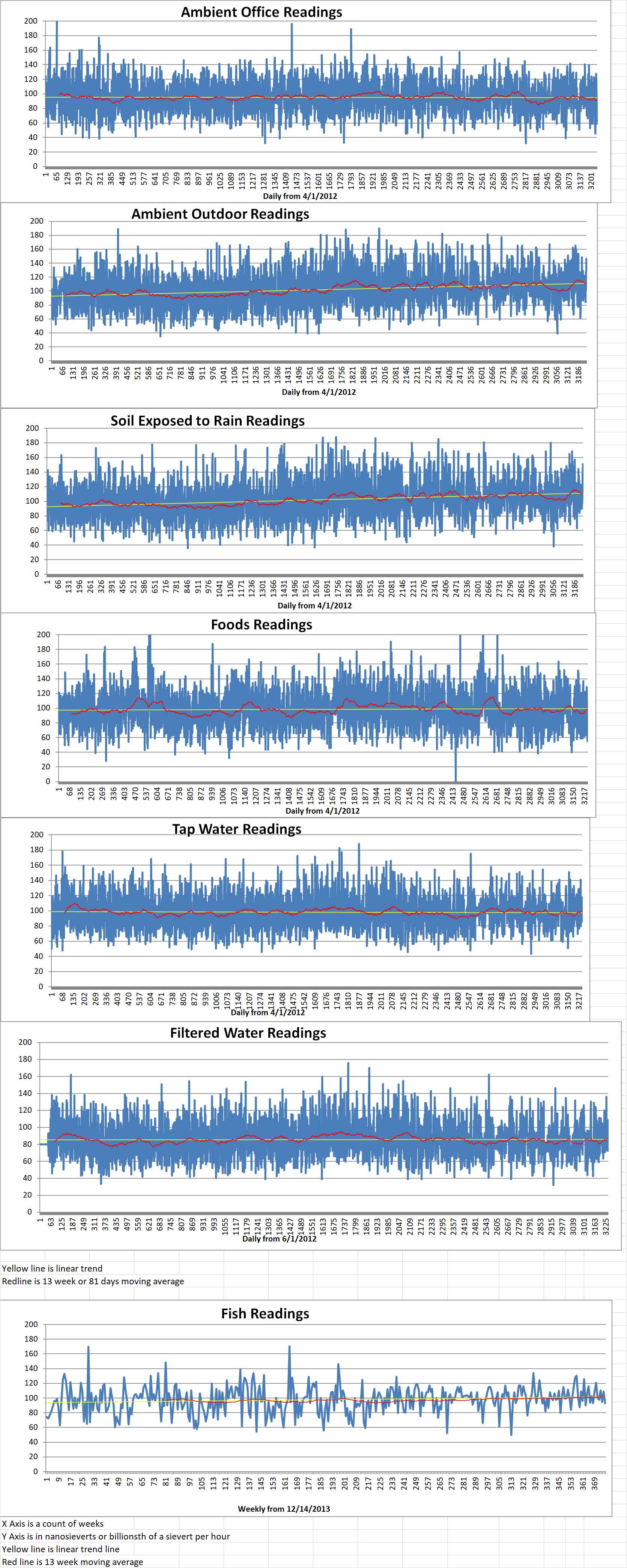
Geiger Readings for May 10, 2021
Ambient office = 59 nanosieverts per hour
Ambient outside = 130 nanosieverts per hour
Soil exposed to rain water = 133 nanosieverts per hour
Tomato from Central Market = 55 nanosieverts per hour
Tap water = 118 nanosieverts per hour
Filter water = 108 nanosieverts per hour
-
Nuclear News Roundup May 09, 2021
U.S. and Iran Want to Restore the Nuclear Deal. They Disagree Deeply on What That Means. Nytime.com
Nuclear power plant near Richland shuts down. 1,000 workers from across nation get to work tri-cityherald.com
Massive fire breaks out near Iran’s Bushehr nuclear power plant jpost.com
Another security breach at TEPCO nuclear plant uncovered English.kyodonews.net