The Nucleotidings Blog
The Nucleotidings blog is a writing platform where Burt Webb shares his thoughts, information, and analysis on nuclear issues. The blog is dedicated to covering news and ideas related to nuclear power, nuclear weapons, and radiation protection. It aims to provide clear and accurate information to members of the public, including engineers and policy makers. Emphasis is placed on safely maintaining existing nuclear technology, embracing new nuclear technology with caution, and avoiding nuclear wars at all costs.

Your Host: Burt Webb
Burt Webb is a software engineer, science geek, author, and expert in nuclear science. Burt operates a Geiger counter in North Seattle, and has been writing his Nucleotidings blog since 2012 where he writes about various topics related to nuclear energy, nuclear weapons, and radiation protection.

Burt Webb has published several technical books and novels. He works as a software consultant.

Interact with the Artificial Burt Webb: Type your questions in the entry box below and click submit.

Example Q&A with the Artificial Burt Webb

Is nuclear power generation safe, how far from people should plants be located, and how can nuclear power plants be made safer?

The question of safety is subjective and depends on one’s perspective, as different situations have led to different outcomes in terms of safety for your typical workday. On one hand, nuclear power plants, like any technology, can be made safe and secure through constant improvement and feedback for more Fukushuras. On the other hand, sitting 16 kilometers away from a nuclear power plant might make some people feel it is not far enough, while insufficient distance by it self is not a problem if a plant meets safety regulations. Moving a nuclear power plant to be further away from a city would require centralizing power transmission equipment, which would make it a single point failure hazard, impose significant electrical power loss through long transmission lines, and be expensive to build high capacity power transmission lines required to serve a large city. Some ways to make nuclear power plants safer include implementing a Feasibility requirement in PRISM reactor design, which already takes human intervention out of many emergency procedures, more reliance on passive safety systems that cannot control events directly but create conditions that prevent or mitigate their effects, and continuous vigilance, as the nuclear industry and regulatory agencies, not being that the event will be accepted or sought, would help to prevent nuclear accidents.

What do you mean by “Fukushuras”?

“Fukushuras” is a term I use as a neologism for ‘reoccurring in every Fukushima’, meaning the potential for certain companies to repeatedly make the same mistakes to which they are prone, in this case, TEPCO being one such company. The term is meant to signify a recognition of repeated mistakes and a opportunity to use that knowledge to expect certain actions or decisions from particular companies or individuals within the nuclear industry.

Blog

  • Geiger Readings for Apr 09, 2021

    Geiger Readings for Apr 09, 2021

    Ambient office = 72 nanosieverts per hour

    Ambient outside = 88 nanosieverts per hour

    Soil exposed to rain water = 90 nanosieverts per hour

    Blueberry from Central Market = 100 nanosieverts per hour

    Tap water = 115 nanosieverts per hour

    Filter water = 98 nanosieverts per hour

  • Nuclear Fusion 128 – Pros And Cons Of Four Types Of Nuclear Fusion Reactors – Part 4 of 5 Parts

    Nuclear Fusion 128 – Pros And Cons Of Four Types Of Nuclear Fusion Reactors – Part 4 of 5 Parts

    Part 4 of 5 Parts (Please read Parts 1, 2 and 3 first)
    Inertial Confinement
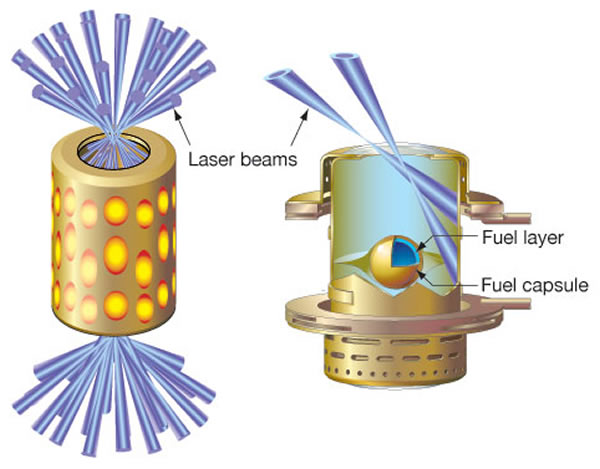
         While the tokamaks and stellarators make great use of powerful magnets, they are not the only experimental fusion reactors. Inertial confinement fusion reactors utilize precisely targeted lasers or ion beams to rapidly heat up a solid pellet of fuel usually made up of deuterium and tritium. These fuel pellets are about the size of a pinhead and they contain about ten milligrams of fuel.
          The basic concept of inertial confinement is that the sudden and intense heat applied to the fuel pellet would cause tremendous compressive forces that would trigger a chain reaction through the layers of material in which nuclear fusion can take place and release huge amounts of energy.
          The first mention of inertial confinement was at an international conference called Atoms for Peace in Geneva, Switzerland in 1957. In the late 1950s, John Nuckolls at the Lawrence Livermore National Laboratory (LLNL) ran a number of computer simulations of the implosion of a pellet of fuel. His results indicated that inertial confinement could be much more efficient than heating a plasma enough to allow fusion. In 1967, a Soviet researcher named Gurgen Askaryan published an article suggesting the use of lasers to heat a pellet of fuel for fusion. Friedwardt Winterberg, a German Physicist proposed in 1968 the use of electron and ion beams to vaporize a pellet of fuel.
          Serious research into the design and construction of an inertial confinement fusion reactor began in the 1970s with the arrival of lasers that were sufficiently powerful. The LLNL began work on its Janus reactor design in 1974. Following a great deal of work on the use of lasers to trigger fusion, the LLNL started the construction of the National Ignition Facility (NIF) in 1997. The NIF was completed in 2009. In 2018, the NIF announced reaching a record production of fifty-four kilojoules of fusion energy output. The most recent development for inertial confinement is what is called “fast ignition”. In fast ignition, lasers first subject the fuel pellet to compression and then an extremely short and powerful laser pulse heats the pellet.
         While deuterium/tritium has been the fuel of choice for inertial confinement, HB11 Energy is working on a new approach involving hydrogen and boron-11 for the fuel pellet. Using the fast ignition process, the hydrogen-boron fusion creates charged particles which can be used to generate an electrical current. This current can be fed into the nation electrical grid. The company is very excited by its novel approach and says that experiments returned much great reaction rates that were predicted by computer simulations. They believe they can construct a working nuclear fusion power reactor much sooner than and of the other approaches.
          Matthew Hole is a nuclear fusion expert and research fellow at Australian National University. He said, “It is interesting science. But I wouldn’t say there is credible evidence to suggest you could turn that into a power plant on a timescale faster than ITER or toroidal magnetic confinement. In my mind, there are even more challenges. If I fire a bunch of lasers at a target and the whole thing is over in a nanosecond, that is a pulsed experiment. To repeat it, I put the target back in place and I put the wires back in place, because I blew the whole thing up, it is gone. The question is how do you translate something that is intrinsically pulsed into something that is intrinsically steady state? In the case of these experiments, you’d need to go from one pellet a week, to 10 pellets a second.”
    Please read Part 5 next

  • Geiger Readings for Apr 08, 2021

    Geiger Readings for Apr 08, 2021

    Ambient office = 106 nanosieverts per hour

    Ambient outside = 103 nanosieverts per hour

    Soil exposed to rain water = 100 nanosieverts per hour

    Red bell pepper from Central Market = 70 nanosieverts per hour

    Tap water = 80 nanosieverts per hour

    Filter water = 71 nanosieverts per hour

  • Nuclear Fusion 127 – Pros And Cons Of Four Types Of Nuclear Fusion Reactors – Part 3 of 5 Parts

    Nuclear Fusion 127 – Pros And Cons Of Four Types Of Nuclear Fusion Reactors – Part 3 of 5 Parts

    (By Max-Planck Institut für Plasmaphysik – Max-Planck Institut für Plasmaphysik, CC.)

    Part 3 of 5 Parts (Please read Parts 1 and 2 first)
    Stellarator
          Stellarators resemble tokomaks because they confine plasma streams in a circular reactor vessel with magnetic coils. However, instead of a symmetrical donut shape, a stellarator sends its plasma around in irregular circles that twist and turn within an incredibly complex series of magnetic coils. It may seem counterintuitive, but this arrangement of coils actually produces more stability in the plasma because of the differences in the internal current.
         The stellarator was invented by Lyman Spitzer at Princeton University in 1951. Much of its early development was carried out by Spitzer’s team which became the Princeton Plasma Physics Laboratory (PPPL). Spitzer’s Model A Stellarator began operating in 1953, demonstrating plasma confinement. By the early 1960s, it was clear that existing stellarators had serious confinement problems. By the mid-1960s, Spitzer was convinced that stellarators would never be practical fusion reactors for the production of energy.
         For the next two decades, tokamaks got most of the attention and funding in fusion research. However, in the 1990s, stellarators have seen renewed interest. Major stellarators include the Wendelstein 7-X in Germany, the Helically Symmetric Experiment in the U.S, and the Large Helical Device in Japan,
         Matthew Hole, a nuclear fusion expert and research fellow at Australian National University, said, “In toroidal magnetic confinement, you need the current to twist. Tokamaks do this with large internal current that causes the field to twist and rotate as it goes around the bend. In a stellarator, you deliberately twist the whole cross section of the bend. With twisted coils, you twist the magnetic current. This means you don’t need a large internal current to generate the twist. So in some sense, you’re translating a physics problem into an engineering problem.”
         Hole notes that such a design creates huge mathematical problems when trying to describe the twisting torus. With respect to mathematical and engineering challenges, the Wendelstein 7-X has plenty of both. It is the largest stellarator in the world and could not have been designed without the use of supercomputers. Stellarators are built to continuously contain super-hot plasma for over thirty minutes at a time. The Wendelstein 7-X was turned on for the first time in 2015 and has been moving incrementally toward it design goal ever since.
         It originally confined helium plasma but, by 2016, it was confining hydrogen plasma. By 2018, sub-second-long flashes had been extended to longer than one hundred seconds which was a record for stellarator designs. The temperature of the plasma was over thirty-six million degrees Fahrenheit. The Wendelstein 7-X also achieved huge energy yields during these tests.
          Stellarators don’t require the large internal current found in tokamaks and they offer more stability during operations than the tokamaks. They may be better suited to providing power to the grid than tokamaks. This is assuming, of course, that the incredibly complex infrastructure can be constructed in a way that is not prohibitively expensive.
         Hole said, “A stellarator has more intrinsic appeal, perhaps, than a tokamak, in the long term. But to an engineer, a stellarator is a bit of a nightmare. So that’s why both are worth exploring.”
    Please read Part 4 next
  • Geiger Readings for Apr 07, 2021

    Geiger Readings for Apr 07, 2021

    Ambient office = 124 nanosieverts per hour

    Ambient outside = 126 nanosieverts per hour

    Soil exposed to rain water = 125 nanosieverts per hour

    Avocado from Central Market = 69 nanosieverts per hour

    Tap water = 122 nanosieverts per hour

    Filter water = 105 nanosieverts per hour

  • Nuclear Fusion 126 – Pros And Cons Of Four Types Of Nuclear Fusion Reactors – Part 2 of 5 Parts

    Nuclear Fusion 126 – Pros And Cons Of Four Types Of Nuclear Fusion Reactors – Part 2 of 5 Parts

    Part 2 of 5 Parts (Please read Part 1 first)
    Tokamak
         Tokamaks are one example of a magnetic confinement system for nuclear fusion and are often considered the most feasible design with respect to net power generation. The tokamak design consists of a neat series of coils placed around a donut-shaped reactor vessel. A plasma of deuterium and tritium gas is heated to millions of degrees by a strong internal current. The plasma must be confined for long enough to allow the fusion of atomic nuclei to take place.
         Tokamaks were first envisioned in the 1950s by Soviet physicists Igor Tamm and Andrei Sawkharov. They had been inspired by a letter from Oleg Lavrentiev. The first working tokamak was called the T-1. It was constructed by Natan Yavlinsky in 1958. It had been shown that a stable plasma equilibrium requires magnetic fields lines that wind around the reactor vessel in a helix. By the mid-1960s, the tokamak designs began to show greater performance. The initial results from the Soviet laboratories were released in 1965 but were dismissed by scientists of other nations because of problems with temperature measurement. A second set of measurements released in 1968 were investigated by the U.K. and verified.
         Tokamak construction took off and dozens were in use around the world by the mid-1970s. Different tokamaks reached all of the conditions for nuclear fusion by the late 1970s. A new set of machines were constructed including the Joint European Torus (JET and the Tokamak Fusion Test Reactor (TFTR) with the intention of reaching breakeven energy production but many more problems arose that had to be solved. The JET was the first experimental tokamak fusion reactor that achieved a controlled release of fusion power in 1991. As of 2020, the JET fusion reactor set a record of sixteen megawatts output from twenty-four megawatts input.
          China’s Experimental Advanced Superconducting Tokamak managed to hit temperatures of 180 million degrees Fahrenheit in 2018. The Korea Superconducting Tokamak Advanced Research (KSTAR) device last December set a world record by holding plasma at over 180 million °F for 20 seconds, and private ventures like UK company Tokamak Energy also contributed to the research.
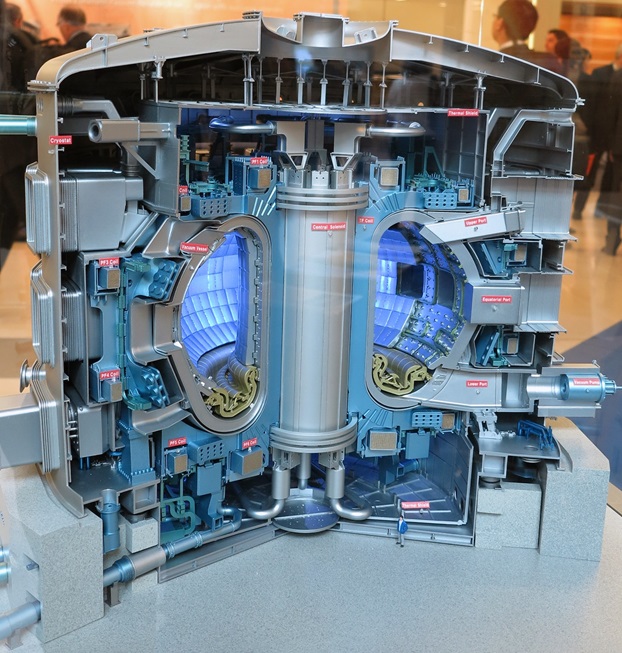
          Meanwhile, in 1985, an agreement between the U.S. President and the Soviet President launched an international effort to construct a much larger and more advanced tokamak as an international project. The International Thermonuclear Experimental Reactor (ITER) was born which is still under construction today. It is the largest nuclear fusion reactor in the world. Scientists and engineers from thirty-five countries are working on the project which will be completed in 2025.
         ITER will control plasma streams that are ten times the size of any streams in existing tokamaks. ITER is designed to produce five hundred megawatts of power from a fifty-megawatt input. This energy will not be captured and converted to electricity but the ITER will serve as a test bed for the development of technologies that will be used in the development of commercial nuclear fusion power reactors.
    Please read Part 3 next