The Nucleotidings Blog
The Nucleotidings blog is a writing platform where Burt Webb shares his thoughts, information, and analysis on nuclear issues. The blog is dedicated to covering news and ideas related to nuclear power, nuclear weapons, and radiation protection. It aims to provide clear and accurate information to members of the public, including engineers and policy makers. Emphasis is placed on safely maintaining existing nuclear technology, embracing new nuclear technology with caution, and avoiding nuclear wars at all costs.

Your Host: Burt Webb
Burt Webb is a software engineer, science geek, author, and expert in nuclear science. Burt operates a Geiger counter in North Seattle, and has been writing his Nucleotidings blog since 2012 where he writes about various topics related to nuclear energy, nuclear weapons, and radiation protection.

Burt Webb has published several technical books and novels. He works as a software consultant.

Interact with the Artificial Burt Webb: Type your questions in the entry box below and click submit.

Example Q&A with the Artificial Burt Webb

Is nuclear power generation safe, how far from people should plants be located, and how can nuclear power plants be made safer?

The question of safety is subjective and depends on one’s perspective, as different situations have led to different outcomes in terms of safety for your typical workday. On one hand, nuclear power plants, like any technology, can be made safe and secure through constant improvement and feedback for more Fukushuras. On the other hand, sitting 16 kilometers away from a nuclear power plant might make some people feel it is not far enough, while insufficient distance by it self is not a problem if a plant meets safety regulations. Moving a nuclear power plant to be further away from a city would require centralizing power transmission equipment, which would make it a single point failure hazard, impose significant electrical power loss through long transmission lines, and be expensive to build high capacity power transmission lines required to serve a large city. Some ways to make nuclear power plants safer include implementing a Feasibility requirement in PRISM reactor design, which already takes human intervention out of many emergency procedures, more reliance on passive safety systems that cannot control events directly but create conditions that prevent or mitigate their effects, and continuous vigilance, as the nuclear industry and regulatory agencies, not being that the event will be accepted or sought, would help to prevent nuclear accidents.

What do you mean by “Fukushuras”?

“Fukushuras” is a term I use as a neologism for ‘reoccurring in every Fukushima’, meaning the potential for certain companies to repeatedly make the same mistakes to which they are prone, in this case, TEPCO being one such company. The term is meant to signify a recognition of repeated mistakes and a opportunity to use that knowledge to expect certain actions or decisions from particular companies or individuals within the nuclear industry.

Blog

  • Geiger Readings for Apr 02, 2021

    Geiger Readings for Apr 02, 2021

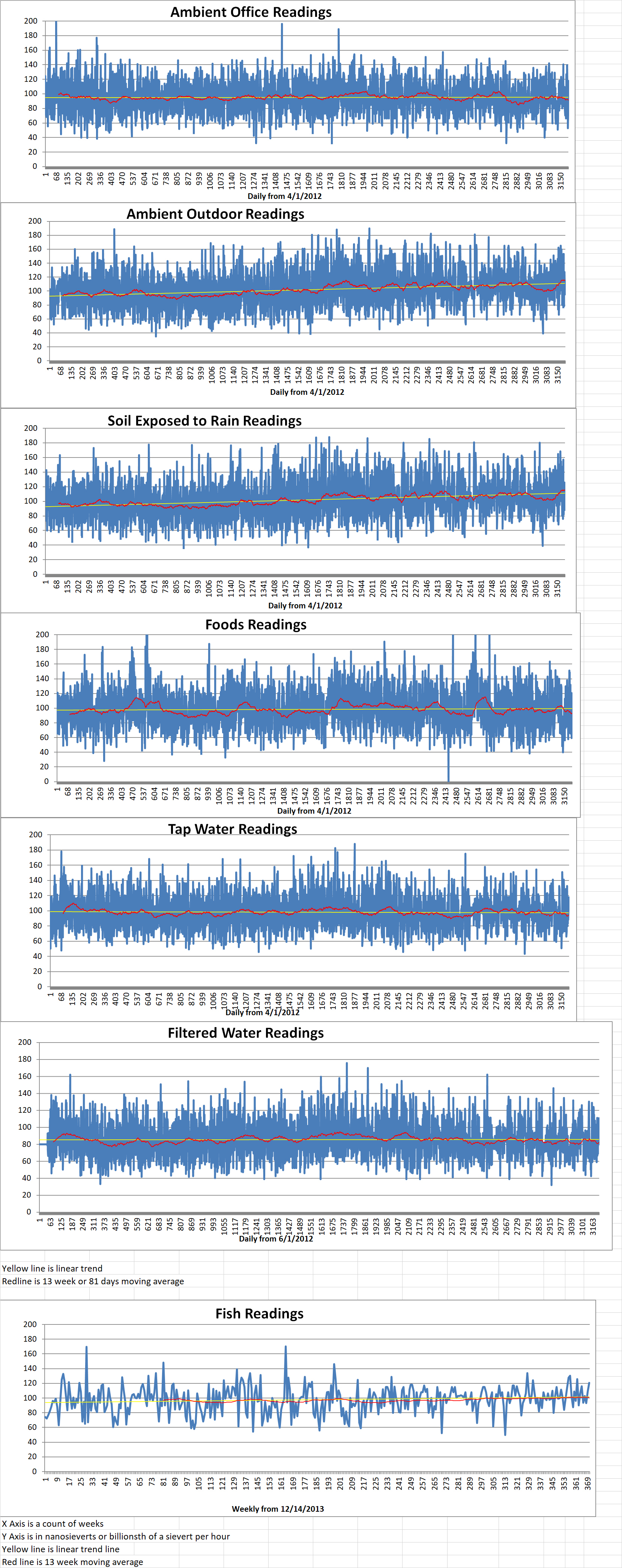
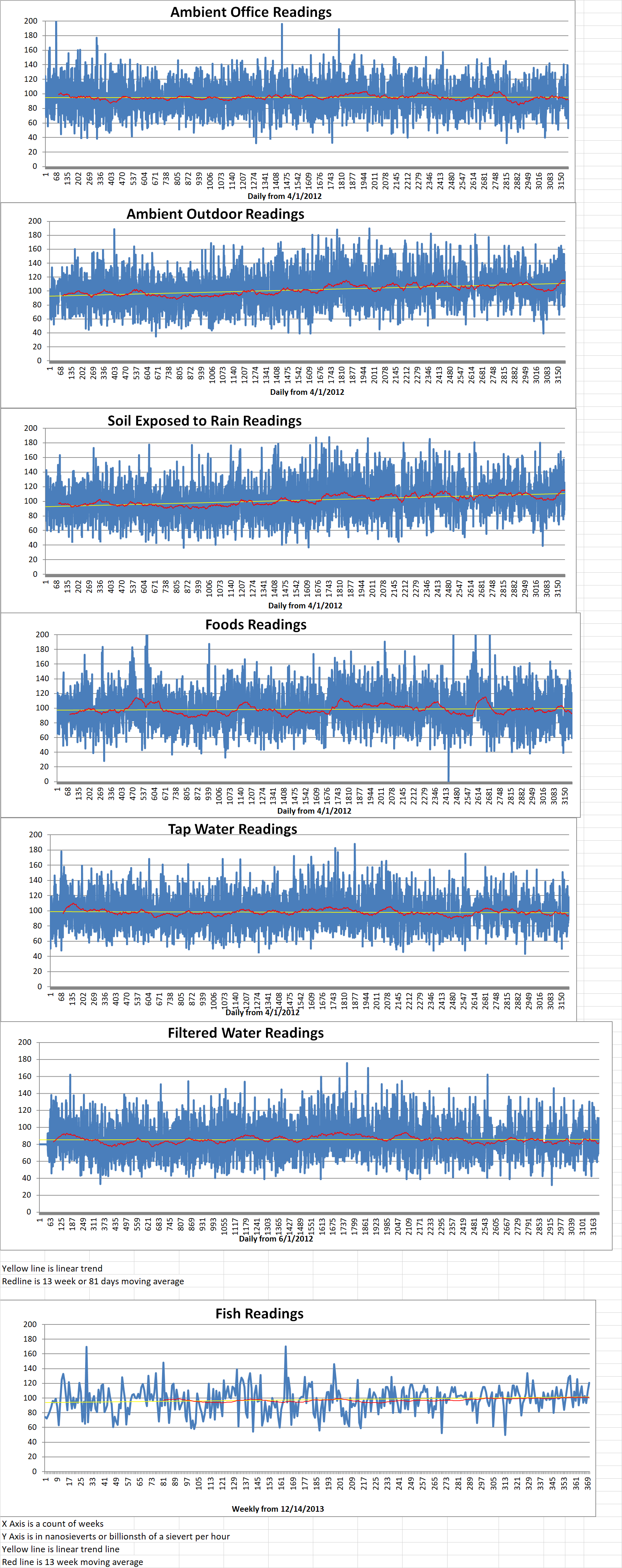
    Ambient office = 109 nanosieverts per hour

    Ambient outside = 112 nanosieverts per hour

    Soil exposed to rain water = 114 nanosieverts per hour

    Avocado from Central Market = 119 nanosieverts per hour

    Tap water = 108 nanosieverts per hour

    Filter water = 84 nanosieverts per hour

  • Radioactive Waste 801 – Problems With Nuclear Waste Shipped From The Los Alamos National Laboratory To The Waste Isolation Pilot Plant – Part 1 of 2 Parts

    Radioactive Waste 801 – Problems With Nuclear Waste Shipped From The Los Alamos National Laboratory To The Waste Isolation Pilot Plant – Part 1 of 2 Parts

    Part 1 of 2 Parts
         The Los Alamos National Laboratory (LANL) is a federal laboratory charged with research and development of nuclear weapons for the U.S. nuclear arsenal. It is located a short distance from Santa Fe, New Mexico. Radioactive waste resulting from the work at the LANL is placed in standard drums and shipped to the Waste Isolation Pilot Plant (WIPP).  
         The WIPP is an underground federal repository for transuranic nuclear waste generated by the development and manufacture of nuclear weapons. It is located near Carlsbad, New Mexico. The WIPP was opened in 1999. The WIPP has strict protocols for the permanent disposal of nuclear waste.
         A few years ago, a drum of waste from the LANL was improperly packed with the wrong absorbent and shipped to the WIPP. The materials in that drum underwent chemical reactions that generated so much heat that the drum burst. The air filtration system failed and radioactive particles spread for miles across the New Mexico countryside. This accident resulted in the repository being shut down for several years as air filtration systems were repaired.
         A drum of nuclear waste at the Los Alamos National Laboratory (LANL) started giving off sparks last month as it was being packed. This ultimately led to a temporary evacuation of part of the Waste Isolation Pilot Plant’s underground repository as officials investigated whether any other drums of waste sent to the WIPP from the LANL posed a similar threat.
          Investigators later verified that no one was injured, and no radiation was released. This was reported in a March 12th letter from the LANL to the New Mexico Environmental Department (NMED) Hazardous Waste Bureau. The letter said that the LANL drum started sparking as workers packed it with low-level transuranic (TRU) waste on February 26th for delivery and disposal at WIPP.
         During the packing process, two high efficiency particulate air (HEPA) filters were placed in a drum to which a “metal waste item” was added, according to the letter from the LANL. When the metal item was inserted into the drum, it tore open the bag with the HEPA filters and sparks were observed coming out of the drum when the metal item touched the filters. Workers at the lab immediately set off the fire alarm and then left the work area.
         The LANL letter said, “Following immediate response and clearing of the scene by the Los Alamos Fire Department, the initial inspection revealed that there was no release of waste or radiological contamination outside of the glovebox. Visual observations showed no damage to the drum-out bag or gloves.”
         On March 1st, an investigation was undertaken at the LANL and it was discovered that the HEPA filters contained particles from titanium welding which were oxidized when the bag that contained the filters was torn open. This was the origin of the sparking. The NMED was first notified about the sparking incident three days later by the WIPP on March 4th after the LANL had notified the WIPP. The LANL made its first report of the incident to the NMED on March 9th. 
    Please read Part 2 next

  • Geiger Readings for Apr 01, 2021

    Geiger Readings for Apr 01, 2021

    Ambient office = 118 nanosieverts per hour

    Ambient outside = 105 nanosieverts per hour

    Soil exposed to rain water = 101 nanosieverts per hour

    Yam from Central Market = 120 nanosieverts per hour

    Tap water = 107 nanosieverts per hour

    Filter water = 80 nanosieverts per hour

  • Nuclear Reactors 883 – The Union Of Concerned Scientists Releases A Report Critical Of New Advanced Reactor Design

    Nuclear Reactors 883 – The Union Of Concerned Scientists Releases A Report Critical Of New Advanced Reactor Design

         U.S. President Biden is making curbing climate change a priority for his administration. He is supporting research and development of advanced nuclear technologies. Although Biden is a Democrat, this new generation of reactors is also popular with many Republicans. Last October, before the last presidential election, the U.S. Department of Energy (DoE) awarded eighty million dollars each to TerraPower LLC and X-energy to construct new reactors that they claim will be operational in seven years.
         One of the arguments for such new technologies is that many of the designs being considered are advertised as being much safer than current nuclear power reactors. However, upon close examination, many of the new reactor designs may present a greater risk of nuclear proliferation than conventional nuclear power.
         These new advanced reactors are usually much smaller than conventional nuclear power reactors. They may be cooled by materials such as molten metal salts instead of water. Some of them are supposed to be able to burn nuclear waste as fuel.
          Edwin Lyman is the director of nuclear power safety at the Union of Concerned Scientists (UCS). He said, “The technologies are certainly different from current reactors, but it is not at all clear they are better. In many cases, they are worse with regard to … safety, and the potential for severe accidents and potential nuclear proliferation.” Lyman is the author of the report UCS released Thursday called “‘Advanced’ Isn’t Always Better.”
         While nuclear reactors do not emit carbon dioxide during operation, a great deal of carbon dioxide is generated during the construction of commercial nuclear power plants and more carbon dioxide is released during mine, refining and transportation of nuclear fuel.
         Current nuclear power is expected to play some role in lowering carbon dioxide emission in the U.S. The Biden administration hopes to reach zero carbon dioxide release from energy generation by 2050. Unfortunately, several of the ninety-four operating nuclear power reactors in the U.S. are being permanently closed because of high safety costs and stiff competition from natural gas, solar and wind energy. This situation has resulted in calls for funding the new nuclear technologies which are hoped to be less expensive than conventional nuclear power reactors.
         The fuel for many of the new reactor designs would have to be enriched to a much higher percentage of U-235 than fuel now used in conventional power reactors. This means that the fuel supply chain could be a very attractive target for terrorists trying to create a crude nuclear bomb or a dirty bomb.
         In order to fuel some of the new reactors with nuclear waste, it would be necessary to reprocess spent nuclear fuel it to make into new fuel. The U.S. has not reprocessed any spent nuclear fuel for decades because of a fear of proliferation and because of the expense. Other advanced reactors release large amounts of radioactive gases which adds to concerns about dealing with nuclear waste.
         Lyman stated that advanced nuclear development funds would be better spent hardening conventional nuclear power plants from risks such as earthquakes, hurricanes, and flooding. The just released UCS report recommends that the DoE suspend its advanced reactor demonstration program until the Nuclear Regulatory Commission (NRC) requires that functional prototype reactors be built and tested before any new advanced reactors can be licensed for commercial use.
         Brett Rampal is the director of nuclear innovation at Clean Air Task Force, a nonprofit that supports advanced nuclear reactors to fight climate change and cut harmful emissions. He said that the report’s conclusions were not based on rigorous assessment of the U.S. nuclear industry. He added that if the DoE acted on the recommendations in the UCS report, it would “essentially cease innovation in nuclear energy today.”

  • Geiger Readings for Mar 31, 2021

    Geiger Readings for Mar 31, 2021

    Ambient office = 90 nanosieverts per hour

    Ambient outside = 115 nanosieverts per hour

    Soil exposed to rain water = 112 nanosieverts per hour

    Snow pea from Central Market = 100 nanosieverts per hour

    Tap water = 108 nanosieverts per hour

    Filter water = 87 nanosieverts per hour

  • Nuclear Fusion 124 – Max Planck Institute for Plasma Physics Working ASDEX Upgrade Experimental Fusion Reactor – Part 2 of 2 Parts

    Nuclear Fusion 124 – Max Planck Institute for Plasma Physics Working ASDEX Upgrade Experimental Fusion Reactor – Part 2 of 2 Parts

    Part 2 of 2 Parts (Please read Part 1 first)
         In the interaction of the charged plasma particles with the confining magnetic field, various disturbances of the plasma confinement can happen. These disturbances include instabilities at the plasma edge referred to as edge localized modes (ELMs). In this process, the edge plasma briefly loses its confinement and throws plasma particles and energy outwards onto the walls of the plasma containment vessel. While medium-sized plants such as the ASDEX Upgrade are able to deal with this problem, the divertor in large fusion reactors such as ITER could easily become overloaded. In order to solve this problem, procedures to prevent such instabilities have been developed for the ASDEX Upgrade. Sixteen small magnetic coils built into the plasma containment vessel are able to completely suppress the instabilities in the confinement fields. A second method for dealing with instabilities starts at the outermost edge of the plasma. If the right plasma shape can be achieved by the magnetic confinement fields while a sufficiently high particle density is ensured by the injection of hydrogen, then ELMs cannot develop.
         Continuous operation is guaranteed by tokamak type fusion reactors such as the ASDEX Upgrade, the JET or the ITER which construct a magnetic cage with two superimposed magnetic fields. One field is ring-shaped and is generated by external magnetic coils and another field that is generated by a current flowing in the plasma. The combination of the two fields results in the field lines being twisted in a way that encloses the plasma. The current that flow through the plasma is normally induced in pulses generated by a transformer coil in the plasma. Unlike the more complicated stellarator fusion reactor design, the tokamaks entire system operates in pulses which is a problem of the tokamak design.
         Scientists at the MPIPP are investigating various methods for continuously generating the current in the plasma. For example, the injection of high-frequency waves or particle beams can drive an additional current in the plasma. They have almost been able to operate the system without the need for a transformer. This was done for the first time in a machine with a metallic inner wall. If the ASDEX Upgrade had not been equipped with normally conducting copper coils but had rather been constructed with superconducting magnetic coils, this phase could have been extended for much longer. It could have made continuous operation possible,
         During the thirty years that have been dedicated to the ASDEX Upgrade, the MPIPP has changed and optimized the divertor shape several times. The researchers now intend to test a new divertor concept. Two additional magnetic coils on the roof of the plasma containment vessel are intended to fan out the divertor field so that the power from the plasma is distributed over a larger area. Assembly of the coils is scheduled to begin in the middle of 2022. These expansions will also enable future investigation at the Garching tokamak to solve the problems expected in a future demonstration power plant.
         Arne Kallenbach is the Project Leader for the ASDEX Upgrade. He said, “In many ways, the ASDEX Upgrade can be seen as a blueprint for a tokamak fusion power plant. Together with newly developed computer codes, the sample discharges developed over 30 years provide reliable information for a power plant.”

  • Geiger Readings for Mar 30, 2021

    Geiger Readings for Mar 30, 2021

    Ambient office = 79 nanosieverts per hour

    Ambient outside = 112 nanosieverts per hour

    Soil exposed to rain water = 115 nanosieverts per hour

    Carrot from Central Market = 59 nanosieverts per hour

    Tap water = 118 nanosieverts per hour

    Filter water = 111 nanosieverts per hour