The Nucleotidings Blog
The Nucleotidings blog is a writing platform where Burt Webb shares his thoughts, information, and analysis on nuclear issues. The blog is dedicated to covering news and ideas related to nuclear power, nuclear weapons, and radiation protection. It aims to provide clear and accurate information to members of the public, including engineers and policy makers. Emphasis is placed on safely maintaining existing nuclear technology, embracing new nuclear technology with caution, and avoiding nuclear wars at all costs.

Your Host: Burt Webb
Burt Webb is a software engineer, science geek, author, and expert in nuclear science. Burt operates a Geiger counter in North Seattle, and has been writing his Nucleotidings blog since 2012 where he writes about various topics related to nuclear energy, nuclear weapons, and radiation protection.

Burt Webb has published several technical books and novels. He works as a software consultant.

Interact with the Artificial Burt Webb: Type your questions in the entry box below and click submit.

Example Q&A with the Artificial Burt Webb

Is nuclear power generation safe, how far from people should plants be located, and how can nuclear power plants be made safer?

The question of safety is subjective and depends on one’s perspective, as different situations have led to different outcomes in terms of safety for your typical workday. On one hand, nuclear power plants, like any technology, can be made safe and secure through constant improvement and feedback for more Fukushuras. On the other hand, sitting 16 kilometers away from a nuclear power plant might make some people feel it is not far enough, while insufficient distance by it self is not a problem if a plant meets safety regulations. Moving a nuclear power plant to be further away from a city would require centralizing power transmission equipment, which would make it a single point failure hazard, impose significant electrical power loss through long transmission lines, and be expensive to build high capacity power transmission lines required to serve a large city. Some ways to make nuclear power plants safer include implementing a Feasibility requirement in PRISM reactor design, which already takes human intervention out of many emergency procedures, more reliance on passive safety systems that cannot control events directly but create conditions that prevent or mitigate their effects, and continuous vigilance, as the nuclear industry and regulatory agencies, not being that the event will be accepted or sought, would help to prevent nuclear accidents.

What do you mean by “Fukushuras”?

“Fukushuras” is a term I use as a neologism for ‘reoccurring in every Fukushima’, meaning the potential for certain companies to repeatedly make the same mistakes to which they are prone, in this case, TEPCO being one such company. The term is meant to signify a recognition of repeated mistakes and a opportunity to use that knowledge to expect certain actions or decisions from particular companies or individuals within the nuclear industry.

Blog

  • Geiger Readings for Feb 13, 2021

    Geiger Readings for Feb 13, 2021

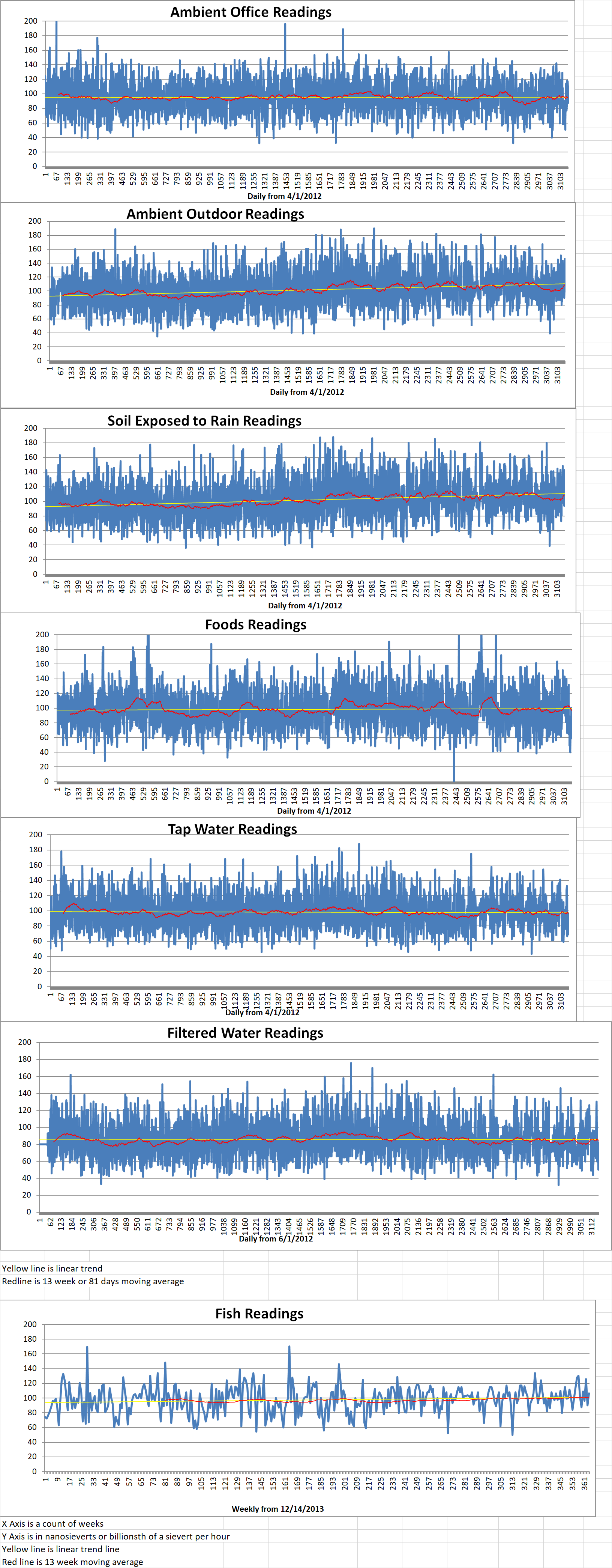
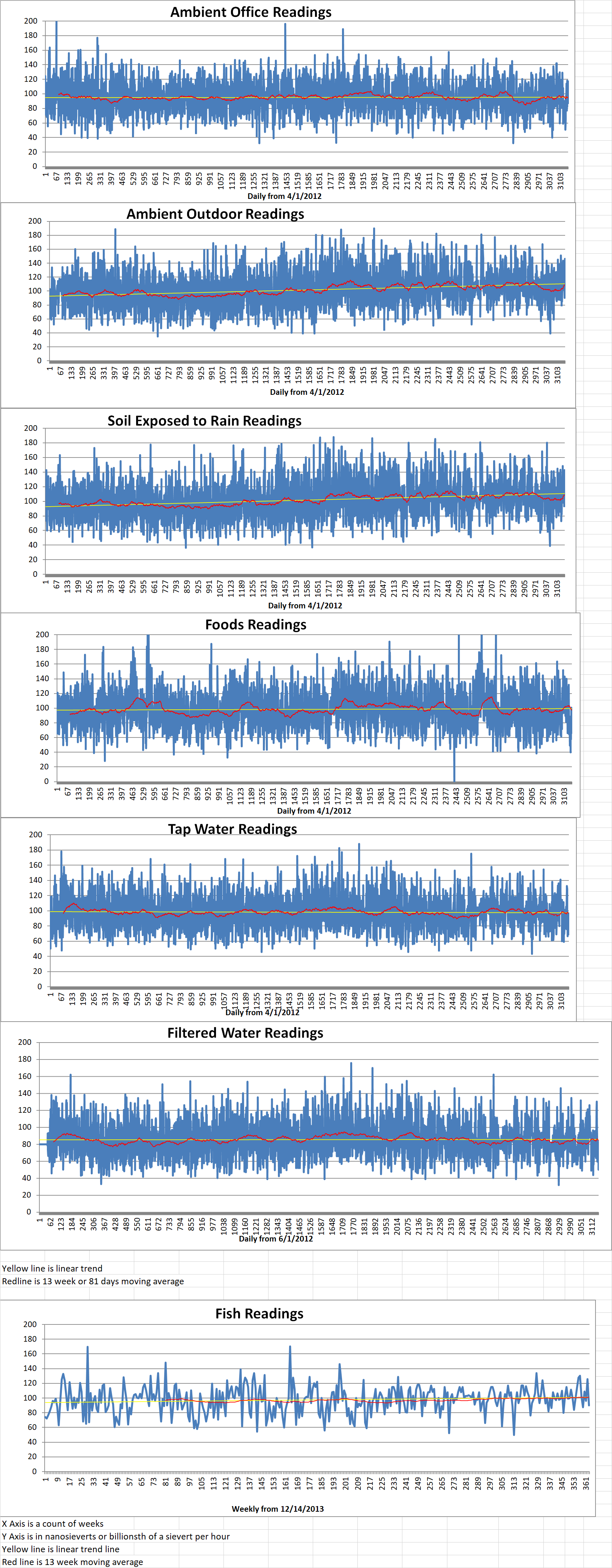
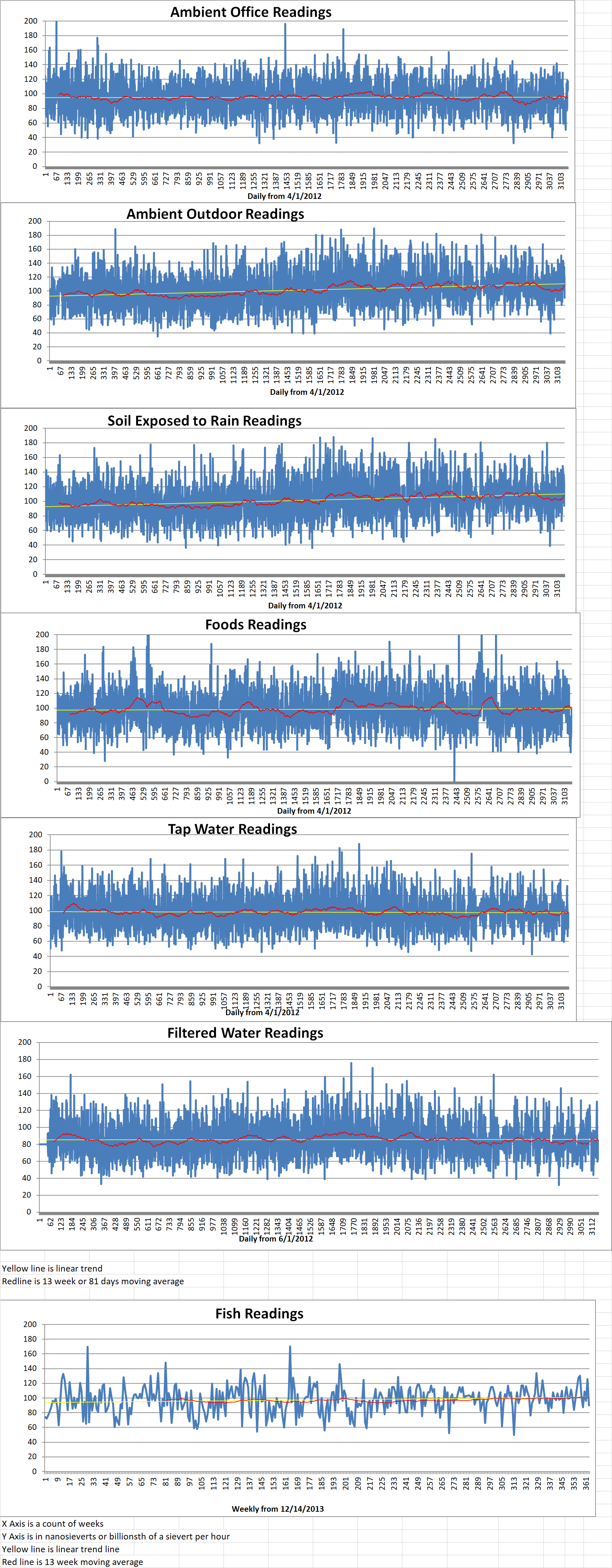
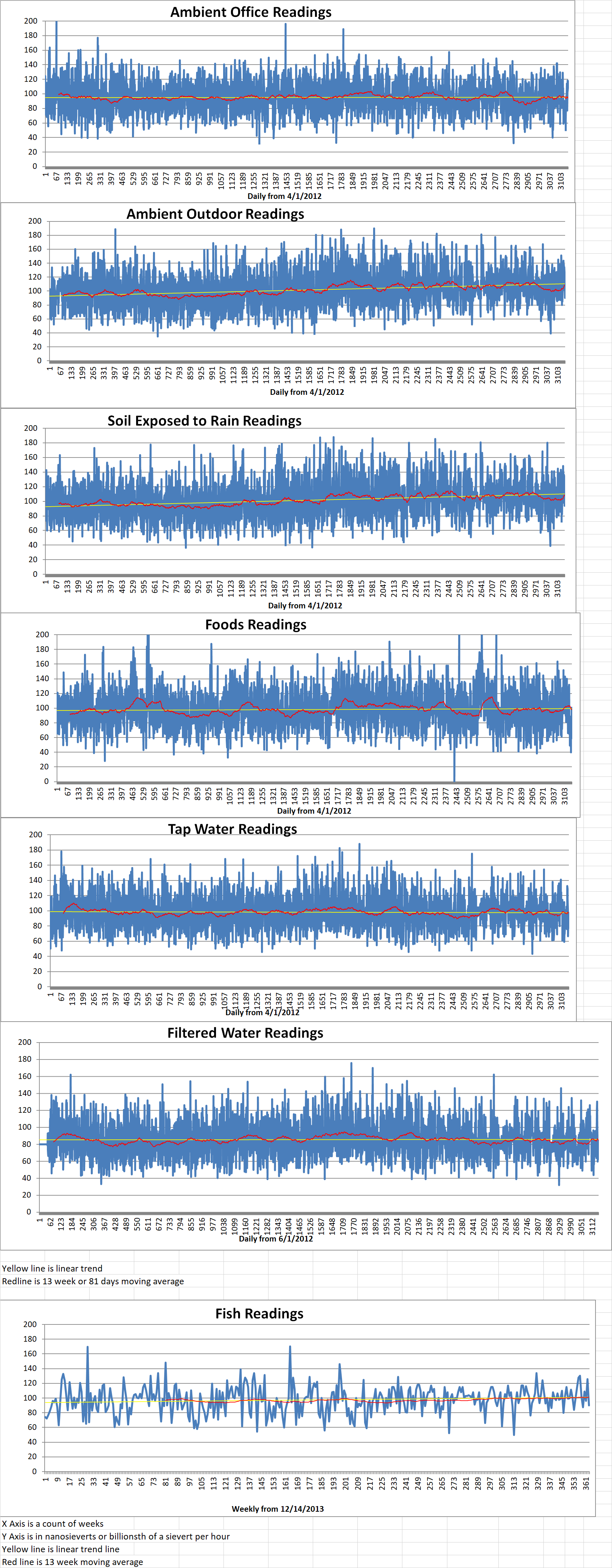
    Ambient office = 91 nanosieverts per hour

    Ambient outside = 100 nanosieverts per hour

    Soil exposed to rain water = 101 nanosieverts per hour

    Heirloom tomato from Central Market = 96 nanosieverts per hour

    Tap water = 87 nanosieverts per hour

    Filter water = 72 nanosieverts per hour

    Dover sole – Caught in USA = 106 nanosieverts per hour

  • NASA Reconsidering Radiation Exposure Limits For Astronauts – Part 3 of 3 Parts

    NASA Reconsidering Radiation Exposure Limits For Astronauts – Part 3 of 3 Parts

    Part 3 of 3 Parts (Please read Part 1 and Part 2 first)
         NASA has not updated its cancer risk calculation for astronauts in over a decade. The agency wants to take advantage of the most recent data from animals and long-term studies of bomb survivors, medical and nuclear plant workers. Once NASA decides on a new maximum radiation standard, their engineers will utilize the new standard to guide their design decisions about how to protect astronauts during long-term space missions. J. D. Polk is NASA’s chief medical officer. He gave the example of a three-year round trip to Mars and back which could expose an astronaut to a total of one thousand mSv. This means that NASA need to consider how best to reduce that exposure with shielding on the spacecraft. One idea was a vest called AstroRad that is being tested on the ISS. It might protect astronauts from solar particles. Another idea would be to construct a small shelter inside the spacecraft to protect the entire crew against a stream of high-energy cosmic rays.
         Cancer is not the only things that astronauts have to be concerned about. Radiation can cause myocardial remodeling. This causes the structure of the heart to begin to change. Fiberous tissue grows to replace health heart muscles which could lead to heart failure. Other problems include atherosclerosis in blood vessels. This condtion can lead to stroke, heart attack, inflammation, cell death and/or DNA damage. Jane Grande-Allen is a professor of bioengineering at Rice University. Her lab has been funded by NASA to develop an early stage in vitro cell model to study the effects of space radiation on cardiovascular disease.
         Grande-Allen said, “Even if there is a whole lot of shielding, if there is a small amount of radiation over a long period of time, it’s going to be leading to cardiovascular disease. There’s a lot we don’t know because we haven’t done this before.”
          One big difference between people on the surface of the Earth and people who are sent into space is the fact that astronauts are selected for their physical strength and histories of good health. In addition, they are constantly exercising on treadmills. All of these factors lower their risk of both cardiovascular disease and cancer. However, although it is a good thing that astronauts are very healthy, most of the research so far on how human bodies fare in space have been done on a group of people who are very nonrepresentative. NASA’s astronaut corps has overwhelmingly male and white since the first American flew into space in 1962.
         NASA had to estimate the cancer risk for female astronauts based on other types of radiation exposure research. Studies on Japanese atomic bomb survivors have shown that women have a higher risk of radiation-induced lung, breast and ovarian cancers. This is the reason that NASA has a much stricter standard for radiation exposure for female astronauts. Some former female astronauts have complained that they have suffered discrimination and were unable to advance their careers by spending more time in space. NASA’s new proposed radiation standards would be the same for all astronauts.
         Polk says that he believes that it is important to permit the best and most qualified astronauts to fly on long-term missions beyond low-Earth orbit. Experienced astronauts should not be disqualified because of a health standard that is still a work in progress. Polk says, “You don’t want to remove someone based on an arbitrary number unless you have really good data to back it up.”

  • Geiger Readings for Feb 12, 2021

    Geiger Readings for Feb 12, 2021

    Ambient office = 87 nanosieverts per hour

    Ambient outside = 146 nanosieverts per hour

    Soil exposed to rain water = 143 nanosieverts per hour

    Blueberry from Central Market = 84 nanosieverts per hour

    Tap water = 69 nanosieverts per hour

    Filter water = 50 nanosieverts per hour

  • NASA Reconsidering Radiation Exposure Limits For Astronauts – Part 2 of 3 Parts

    NASA Reconsidering Radiation Exposure Limits For Astronauts – Part 2 of 3 Parts

    Part 2 of 3 Parts (Please read Part 1 first)
         NASA’s proposed new radiation exposure limits for astronauts would still be lower than limits set by other space agencies such as those of the European Union, Russian, and Canadian astronauts are permitted to receive exposure up to one thousand mSv before they are retired from space missions. NASA is not concerned about having a tighter limit to radiation exposure than these other space agencies.
         David Francisco is a technical fellow for human spaceflight standards at NASA’s Office of the Chief Medical Officer. He said, “It’s a different risk posture in what we feel is acceptable risk. We picked 600 because we feel it’s more acceptable to our culture. It’s something we constantly work on and go back and forth on. We debated on going to 1,000, and that’s one of the questions: Are we still being conservative with 600?”
         In order to resolve questions about safe limits for radiation exposure for astronauts, NASA turned to an expert panel from the National Academy of Sciences to determine the best limit for radiation exposure to use. The panel started holding meeting last month and is expected to complete its considerations of radiation exposure limits by this summer. The expert panel will investigate how NASA has calculated its new radiation exposure limits, and how those new limits match up with existing animals studies and existing clinical data for human subjects.
         In order to understand how radiation exposure is linked to cancers, medical researchers have been following the survivors of the atomic bombs that were dropped on Japan duering World War II. The health of the survivor’s children has also been tracked. There have been studies of medical workers who have been exposed to x-rays. Nuclear plant workers have been monitored because they receive low doses of radiation over the course of their careers. However, NASA does not have much information on the effects of radiation in space on astronauts.
          One reason for NASA’s lack of radiation impacts is the fact that even though the ISS has been hosting astronauts for twenty years, it is not a very good place to study the effects of radiation on the human body because the ISS orbits inside the protective magnetic field of the Earth. Once a spacecraft and its astronauts travel beyond the protective magnetic field, the radiation risk increases.
         Amy Berrington de González is a senior investigator and cancer epidemiologist at the National Cancer Institute, and a member of the panel exploring radiation risk for NASA. She said, “What we know is the cancer risk is likely to be higher, but exactly how much higher and whether different tissue will be affected in certain ways isn’t clear. A dose of protons to the brain might be different than a dose of protons to the stomach. There’s a lot more uncertainty of the carcinogenic effects.”
         It is difficult to predict exactly how radiation exposure on a given deep-space mission a particular astronaut. The amount of radiation that exists between the Earth and Mars was measured by sensors on rover missions sent to Mars. The real challenge is deciding what space radiation will to do a human being. Berrington de González said, “It’s even difficult to project risk for a CT scan. When you take it to space radiation, there are all different types of space radiation exposure. It’s not x-rays and gamma rays, it’s also protons and other particles that we have very little data for.”
    Please read Part 3 next

  • Geiger Readings for Feb 11, 2021

    Geiger Readings for Feb 11, 2021

    Ambient office = 106 nanosieverts per hour

    Ambient outside = 103 nanosieverts per hour

    Soil exposed to rain water = 105 nanosieverts per hour

    Avocado from Central Market = 85 nanosieverts per hour

    Tap water = 97 nanosieverts per hour

    Filter water = 82 nanosieverts per hour

  • NASA Reconsidering Radiation Exposure Limits For Astronauts – Part 1 of 3 Parts

    NASA Reconsidering Radiation Exposure Limits For Astronauts – Part 1 of 3 Parts

    Part 1 of 3 Parts
        I have blogged before about the deleterious effect that radiation can have on human health. Usually, such blog posts have been about various types of radiation exposure here on Earth but there is another problem with radiation exposure that I have not dealt with and that has to do with the danger of astronauts of the radiation in space. Now NASA is considering raising their estimation of the amount of radiation in space that astronauts can safely experience.
         The Biden administration has indicated that it will support the NASA Artemis mission to the Moon which was in question because the Artemis project was conceived by the Trump administration.
         There are many problems for astronauts traveling in space because human beings are best suited to live on the surface of the Earth. One of the most difficult to deal with is the effect of radiation from the Sun or cosmic events. This radiation consists of atoms that have had their electrons stripped away. Some are accelerated to almost the speed of light by events such as a star exploding in a nova or supernova.  There are three types of radiation in space. Particles can be trapped in the Earth’s magnetic field. The Sun spews out particles in bursts that sweep through the solar system. This is called the solar wind. Finally, there are high energy protons and heavy ions that come from cosmic sources from outside of our solar system.
         Radiation is identified as a “red risk” for astronauts in a NASA study that was published last year on the subject of high-priority health problems. Radiation can damage the DNA in human cells. This can lead to mutations which can result in the development of cancers. Radiation can also cause cardiovascular problems such as damage to the heart, narrowing of arteries and blood vessels. Radiation caused neurological can result in cognitive impairment. This was all detailed on a NASA webpage.
         On the surface of the Earth, human beings are exposed to between three and four millisieverts (mSv) of radiation per year. This radiation comes from radioactivity in soil and rocks. A small amount of radiation consists of cosmic rays that penetrate the Earth’s atmosphere. On the International Space Station in Earth orbit, astronauts receive about three hundred mSv per year. Until now, a fifty-five-year-old male astronaut was restricted to an effective does of four hundred mSv over his entire career. In contrast, a thirty-five-year-old female astronaut was limited to a total exposure of one hundred and twenty mSv.
         NASA is now planning on sending astronauts on much longer space mission and is currently considering raising the limit of radiation exposure to six hundred mSv for astronauts of any gender or age. Under the existing standards, some experienced astronauts could have been excluded from participating in long term space missions because they were already approaching the maximum life-time exposure limits. Younger astronauts have spent less time in space and have had less radiation exposure. This could make them more attractive for lone term space missions. However, the success of important long space missions might depend on a depth of experience that younger astronauts do not have.
    Please read Part 2 next

  • Geiger Readings for Feb 10, 2021

    Geiger Readings for Feb 10, 2021

    Ambient office = 117 nanosieverts per hour

    Ambient outside = 108 nanosieverts per hour

    Soil exposed to rain water = 111 nanosieverts per hour

    English cucumber from Central Market = 101 nanosieverts per hour

    Tap water = 91 nanosieverts per hour

    Filter water = 81 nanosieverts per hour