Blog
-
Geiger Readings for June 17, 2016
Ambient office = 83 nanosieverts per hourAmbient outside = 105 nanosieverts per hourSoil exposed to rain water = 130 nanosieverts per hourOrange bell pepper from Central Market = 95 nanosieverts per hourTap water = 106 nanosieverts per hourFiltered water = 95 nanosieverts per hour -
Radioactive Waste 180 – The Spent Fuel Pools At The Pilgrim Nuclear Power Station Are Filled Beyond Designed Capacity
I have often mentioned that the spent fuel pools at nuclear reactors in the U.S. are filling up. If temporary dry cask storage is not quickly build so some fuel assemblies can be removed from the pools, some reactors will have to be shut down. Unfortunately, current designs for dry casks have serious problems that need to be corrected before those fuel assemblies can be safely stored. Eventually, the U.S. government expects to have a geological repository for spent nuclear fuel but such a repository will not be available before 2050 at the earliest.
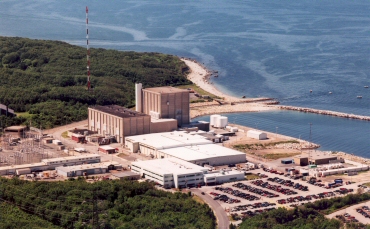
The Pilgrim Nuclear Power Station started producing electricity for the grid in 1972. It was based on an antiquated design from the 1950s. One serious problem was the fact thatheir it was known that if there was a serious nuclear accident, the containment vessel would not be able to prevent radioactive materials from escaping. Another problem with the design was that it called for putting the spent fuel cooling pool inside the reactor building.
Every eighteen months, one third of the fuel rods in the reactor become too hot with radiation to be controlled inside the reactor. They have to be removed and placed in the spent fuel pool under forty feet of water so they can spend years cooling down. If the rods are exposed to the air in a failure of the cooling system, they can burst into flames. Such a fire would release large amounts to radioactive materials into the environment because of the problem with the containment vessel mentioned above.
The spent fuel pool at the Pilgrim plant was designed to hold eight hundred and eighty fuel rod assemblies. There are now more than three thousand assemblies in the pool. The Pilgrim plant is scheduled to be permanently shut down in 2019. Highly radioactive fuel rods will have to remain in the spent fuel pool for many years after the shutdown to cool off sufficiently to be handled. Because there won’t be a national repository for spent fuel before 2050, the fuel assemblies will have to be stored onsite in dry casks until they can be moved to a new national repository. The casks have problems but they are safer than the spent fuel pool.
Entergy, the operators of the Pilgrim plant, has constructed three dry casks for fuel assembly storage. They will have to construct another hundred casks to accept all the spent fuel assemblies in the spent fuel cooling pool. The casks are in what is called the “Independent Spent Fuel Storage Installation. ” (ISFSI) No governmental agency from the local to the federal level reviewed and authorized the location of the ISFSI which is one hundred and twenty feet from Cape Cod Bay and is only a few feet above the flood zone. A group of citizens in the area has filed a lawsuit against the Plymouth Zoning Board of Appeals decision which allowed the construction of the ISFSI in that location.
There are about one hundred nuclear power reactors in the U.S. now. Many of them are reaching the limit for storing fuel assemblies in the cooling pools. As more and more dry casks are build and deployed to take these spent fuel assemblies, the problems with the dry casks may lead to accidents that result in the release of radioactive materials.
Pilgrim Nuclear Power Station:
-
Geiger Readings for June 16, 2016
Ambient office = 115 nanosieverts per hourAmbient outside = 79 nanosieverts per hourSoil exposed to rain water = 92 nanosieverts per hourRedleaf lettuce from Central Market = 74 nanosieverts per hourTap water = 73 nanosieverts per hourFiltered water = 70 nanosieverts per hour -
Nuclear Reactors 375 – AREVA and the French Nuclear Industry Have Serious Problems
The French company AREVA is selling its new European Pressurize Reactor (EPR) technology to other nations. Unfortunately, AREVA has been having serious financial and technical difficulties. They are behind schedule and over budget on projects in France. The forge that creates the pressure vessels for their reactors was recently found to have put to much carbon into the smelting and some of their pressure vessels are too brittle to be used. Now the French owned utility, EDF is planning on buying a share of AREVA to help bring financial solvency to the reactor maker but the sale is being blocked by lawsuits with its first customer.
The first customer for the new reactor is Finland’s TVO. AREVA is building the first new reactor in Western Europe in decades at Olkiluoto. Unfortunately, the project budget is way over original estimates and almost a decade behind schedule. The new reactor was supposed to begin generating electricity in 2009 but the latest estimate for the start of operation is 2018.
AREAVA and TVO are involve in legal disputes over billions of dollars. AREVA and Siemens, a former joint partner, are suing TVO for about four billion dollars. TVO is counter suing them for about three billion dollars. The litigants have been negotiating in the hopes of crafting a deal that will allow the planned sale of the stake in AREVA to EDF. If the parties in the law suits can separate the liability for the Olkiluoto reactor project from the rest of AREVA’s finances, then the sale of AREVA to EDF could proceed.
The recent collapse of those talks caused the TVO CEO to say that he was worried about the future of the French nuclear industry. He said that politics and the AREVA restructuring were interfering with reaching an agreement between TVO and AREVA. He also said that there could be no deal on the lawsuits or the AREVA/EDF sale until an agreement was reached for the completion of the Olkiluoto project.
AREVA’s second international customer is Britain. They have contracted with Britain to build two EPRs at the Hinkley Point C power station. But AREVA was unable to raise sufficient funds to cover its share of the costs of manufacture and installation. They had to appeal to the Chinese for funding. One of the pressure vessels made for the Hinkley Point C project had to be rejected. AREVA has had to repeatedly delay signing the final contracts for the Hinkley Point C project.
The Prime Minister of France has made the sale of nuclear technology to other nation a major part of his plans of the future of France’s economy. The big question now is just how committed is he? In order for the necessary restructuring of AREVA and the EDV sale to proceed, peace will have to be made with Finland over the completion of Olkiluoto and Britain over the Hinkley Point C project. The problem with the pressure vessels will have to be addressed to restore confidence in French quality control of nuclear components. Right now, the French nuclear industry is in serious trouble.
-
Geiger Readings for June 15, 2016
Ambient office = 73 nanosieverts per hourAmbient outside = 91 nanosieverts per hourSoil exposed to rain water = 108 nanosieverts per hourAvocado from Central Market = 94 nanosieverts per hourTap water = 66 nanosieverts per hourFiltered water = 59 nanosieverts per hour -
U.S. Department of Energy Dedicates 82 Million Dollars To Advanced Nuclear Research
Edward Moniz, the U.S. Secretary of Energy, just announced that the federal government is going to invest eighty two million dollars in nuclear energy research. The announcement was made during a visit to the Department of Energy’s Idaho National Laboratory. It is hoped that the ninety three projects that have been chosen for funding will eventually yield innovative nuclear technology that will be available to the commercial market. Thirty six million dollars will go to projects at forty nine universities. An additional fifteen universities will get almost six million for research on reactor and infrastructure.
Moniz singled out two particular areas of nuclear research that he is especially interested in. The first area is the development of small modular reactors (SMRs). These reactors would generate less than three hundred megawatts. They would be built in factories and assembled onsite. It is hoped that these SMRs will be cheaper and safer than conventional reactors. They would give utilities more flexibility in adding new capacity without the enormous startup costs needed for conventional reactors. He said that much research still needs to be done before SMRs will be available.
The second area has to do with nuclear fuels. Moniz hopes that “advanced” nuclear fuels can be developed that would be more resistant to accidents. New materials are being developed for the cladding that coats fuel rods. The new materials should be more stable in the conditions inside reactors and less likely to generate dangerous hydrogen gas that can lead to explosions and fires.
Another major area of concern for nuclear energy generation is what to do with all the spent nuclear fuel. Currently, the U.S. does not have a permanent geological repository for disposal of spent nuclear fuel. Such a repository will not be available before 2050 at the soonest. In the meantime, spent nuclear fuel is rapidly filling up the cooling pools at nuclear reactors. Temporary dry cask storage will be necessary but the current design of dry casks has serious shortcomings.
Research at the Idaho National Laboratory on dealing with spent nuclear waste is currently prevented by a 1995 law that requires the disposal of high-level nuclear waste now stored at the Laboratory. There are lawsuits between the federal government and the state government over the 1995 law. Hopefully, these suits can be resolved quickly because the Laboratory needs to get to work on researching better ways to deal with nuclear waste.
Twenty one million dollars of the new research program will be spent on joint projects involving in the Office of Nuclear Energy and the Office of Environmental Management for nuclear waste immobilization. These joint projects are part of Moniz’s plan to integrate advanced nuclear research and remediation efforts for nuclear waste.
The new investments in nuclear research are part of the Obama administrations push for low-carbon electrical generation to fight climate change. Nuclear energy currently provides about twenty percent of electricity generated in the U.S. It is estimated that it accounts for about sixty percent of the low-carbon electrical generation for the nation.