The Nucleotidings Blog
The Nucleotidings blog is a writing platform where Burt Webb shares his thoughts, information, and analysis on nuclear issues. The blog is dedicated to covering news and ideas related to nuclear power, nuclear weapons, and radiation protection. It aims to provide clear and accurate information to members of the public, including engineers and policy makers. Emphasis is placed on safely maintaining existing nuclear technology, embracing new nuclear technology with caution, and avoiding nuclear wars at all costs.

Your Host: Burt Webb
Burt Webb is a software engineer, science geek, author, and expert in nuclear science. Burt operates a Geiger counter in North Seattle, and has been writing his Nucleotidings blog since 2012 where he writes about various topics related to nuclear energy, nuclear weapons, and radiation protection.

Burt Webb has published several technical books and novels. He works as a software consultant.

Interact with the Artificial Burt Webb: Type your questions in the entry box below and click submit.

Example Q&A with the Artificial Burt Webb

Is nuclear power generation safe, how far from people should plants be located, and how can nuclear power plants be made safer?

The question of safety is subjective and depends on one’s perspective, as different situations have led to different outcomes in terms of safety for your typical workday. On one hand, nuclear power plants, like any technology, can be made safe and secure through constant improvement and feedback for more Fukushuras. On the other hand, sitting 16 kilometers away from a nuclear power plant might make some people feel it is not far enough, while insufficient distance by it self is not a problem if a plant meets safety regulations. Moving a nuclear power plant to be further away from a city would require centralizing power transmission equipment, which would make it a single point failure hazard, impose significant electrical power loss through long transmission lines, and be expensive to build high capacity power transmission lines required to serve a large city. Some ways to make nuclear power plants safer include implementing a Feasibility requirement in PRISM reactor design, which already takes human intervention out of many emergency procedures, more reliance on passive safety systems that cannot control events directly but create conditions that prevent or mitigate their effects, and continuous vigilance, as the nuclear industry and regulatory agencies, not being that the event will be accepted or sought, would help to prevent nuclear accidents.

What do you mean by “Fukushuras”?

“Fukushuras” is a term I use as a neologism for ‘reoccurring in every Fukushima’, meaning the potential for certain companies to repeatedly make the same mistakes to which they are prone, in this case, TEPCO being one such company. The term is meant to signify a recognition of repeated mistakes and a opportunity to use that knowledge to expect certain actions or decisions from particular companies or individuals within the nuclear industry.

Blog

  • Geiger Readings for Apr 28, 2021

    Geiger Readings for Apr 28, 2021

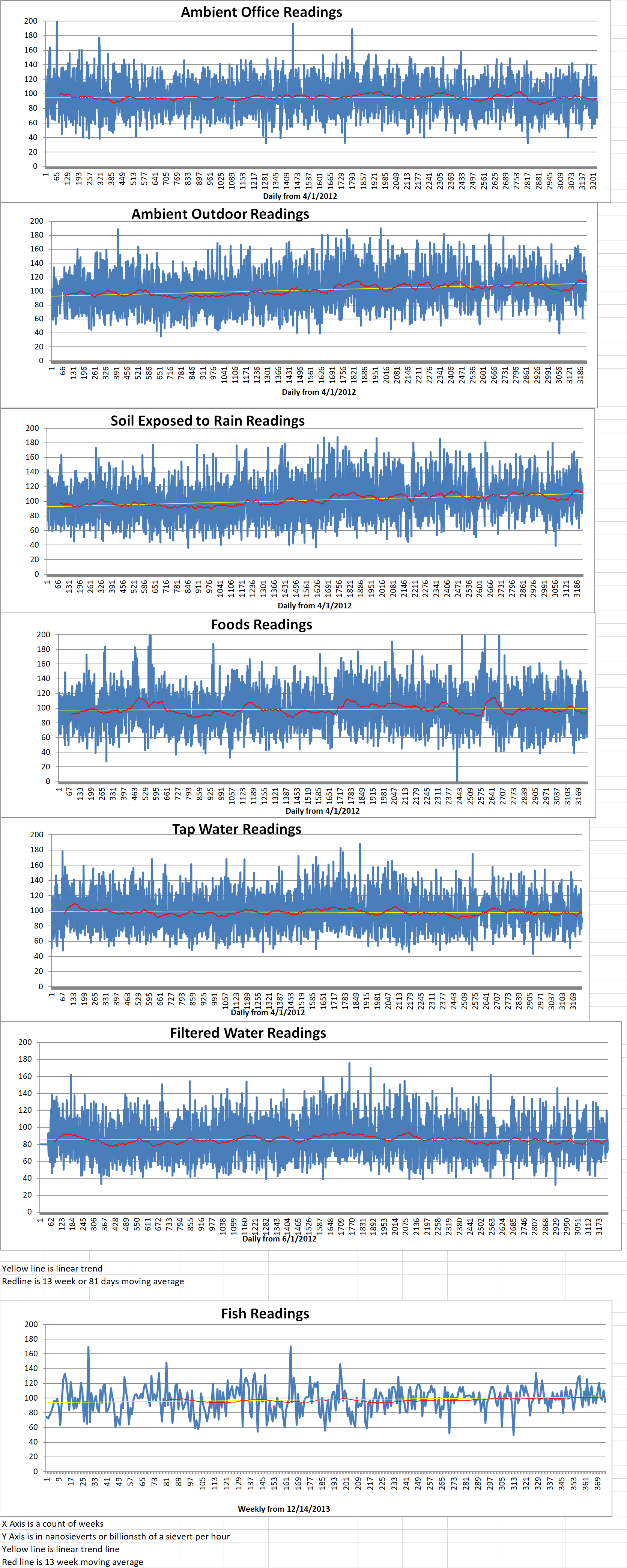
    Ambient office = 59 nanosieverts per hour

    Ambient outside = 101 nanosieverts per hour

    Soil exposed to rain water = 98 nanosieverts per hour

    Avocado from Central Market = 90 nanosieverts per hour

    Tap water = 97 nanosieverts per hour

    Filter water = 91 nanosieverts per hour

  • Nuclear Fusion 137 – Researchers At National Laboratories Work On Polar Direct Drive Neutron Sources – Part 2 of 2 Parts

    Nuclear Fusion 137 – Researchers At National Laboratories Work On Polar Direct Drive Neutron Sources – Part 2 of 2 Parts

    Part 2 of 2 Parts (Please read Part 1 first)
         The work on this project was conducted by a team of designers and experimentalists. Designers are scientists who run computer programs that carry out complicated physics calculations to simulate experiments. Experimentalists are engineers who understand and operate the world’s biggest laser. They determine the best way to test in practice what works in the simulations of the designers.
        Some of the members of the team work in both roles. Others specialize as either designers or experimentalists depending on what the research team needs for a given phase of the work. Sixteen days’ worth of NIF experimental time was spread out over more than five years as part of the source development effort. Tests of the three designs that exhibited the best performance were conducted during a single day of NIF operation in 2019. These three designs were selected for detailed discussion in the report that was published.
         Heather Whitley is the associate program director for High Energy Density Science at the LLNL. She developed the initial design for a large diameter polar direct drive capsule with Craxton and Garcia from the LLE and Warren Garbwett from the U.K. Atomic Weapons Establishment. She said, “This platform is important because it provides high neutron fluences and enables the close positioning of samples near the source for survivability experiments. The polar direct drive configuration also provides excellent diagnostic access for other high temperature plasma physics experiments.”
         Craxton from the LLE helped lead the efforts of undergraduate students Garcia and Yang. He said that the participation of the graduate students has been very important for the work of the team. Each of these students was responsible for calculating the optimized laser beam pointing to achieve uniform implosion of a capsule with a specific diameter. This process of optimization is complicated because the NIF beam entry angles are being optimized to drive a cylindrical hohlraum target. (In radiation thermodynamics, a hohlraum is a cavity whose walls are in radiative equilibrium with the radiant energy inside the cavity.) McKenty worked closely with Craxton and the rest of the project team to determine the best laser pulse shape.
         Craxton said, “We went through a whole series of experiments over many years, first to produce neutrons to test NIF neutron diagnostics while the NIF was being commissioned. These experiments evolved to meet the needs of a wide variety of applications, with the largest targets producing the high yields required for the effects experiments.”
          Critical to the success of this effort was the development and creation of the proper testing protocols that were necessary to obtain key data for prescribing safe fielding pressures of these capsules. They are two to five millimeters in diameter with thin walls that are approximately ten to thirty micrometers thick. The work on these capsules was done by target fabrication teams mainly at General Atomics (GA) in San Diego who worked closely with the LLNL target fabrication team as well as the physics team mentioned above. Claudia Shuldberg and her team led the work at GA. Bill Saied and Kelly Youngblood headed up the target fabrication engineering effort at the LLNL.

  • Geiger Readings for Apr 27, 2021

    Geiger Readings for Apr 27, 2021

    Ambient office = 67 nanosieverts per hour

    Ambient outside = 119 nanosieverts per hour

    Soil exposed to rain water = 122 nanosieverts per hour

    Avocado from Central Market = 122 nanosieverts per hour

    Tap water = 89 nanosieverts per hour

    Filter water = 78 nanosieverts per hour

  • Nuclear Fusion 136 – Researchers At National Laboratories Work On Polar Direct Drive Neutron Sources – Part 1 of 2 Part

    Nuclear Fusion 136 – Researchers At National Laboratories Work On Polar Direct Drive Neutron Sources – Part 1 of 2 Part

    Part 1 of 2 Parts
         Researchers at the Lawrence Livermore National Laboratory (LLNL) and the Laboratory for Laser Energetics (LLE) are collaborating to improve polar direct drive (PDD) neutron sources on the National Ignition Facility (NIF), the world’s most powerful assembly of lasers.
         PDD neutron sources are tiny capsules that are filled with a deuterium-tritium (DT) gas at room temperature. They are shot with powerful laser pulses but do not require precise laser power contrast control or power accuracy. These neutron sources are more efficient in terms of time and resources for use in the NIF than conventional indirect drive sources that have to be covered by high-quality cryogenic layers of DT ice. Additionally, there is a smaller generated target debris load which allows neutron radiation effects experiments to be placed much closer to the target. This creates a stronger neutron radiation field for testing.
         The team has significantly increased the total fusion output and laser to fusion energy conversion efficiency for PDD. They also developed what they call a PDD exploding pusher or PDXP. This is a platform that has allowed radiation effects testing of recoverable samples at record fourteen million electron-volt neutron fluence levels.
         Charles Yeamans is the team lead and first author of a paper that appears in the journal Nuclear Fusion. He said, “For over a year and a half after the initial experimental success, this design of PDD was the most efficient way in existence to convert laser energy input into fusion output. Shooting really big lasers at stuff can stimulate fusion reactions like what happens in the sun and other stars and terrestrially in the core of a nuclear detonation. We want to study how the intense radiation fields generated from fusion affect materials, electronics and engineered systems like satellites and airplanes. At NIF we are able to control and position our test objects close to that source.” Co-authors include Elijah Kemp, Zach Walters, Heather Whitley and Brent Blue from LLNL, and Steve Craxton, Patrick McKenty, Emma Garcia and Yujia Yang from LLE.
         Similar direct drive capsule platforms have many different applications on the NIF. They can be filled with different mixtures of gas and used for studies of nuclear reaction that are of interest of astrophysicists and, also, as a source of protons for point backlighting. They have been used to produce ultra-short pulses of high-brightness continuum X-rays for extended X-ray absorption fine structures (EXAFS) studies and for measurements of opacity. They have also been used to make large, compressed plasmas in order to study electron-ion energy transfer.
         Yeamans said the work developed a valuable addition to the overall radiation effects experimental test capability for the Lab.  He also remarked that “Overall, a better NIF neutron source design allows us to conduct better radiation effects tests in greater numbers than if we were to rely solely on the mainstream NIF experiments. Overall, a better NIF neutron source design allows us to conduct better radiation effects tests in greater numbers than if we were to rely solely on the mainstream NIF experiments.”
    Please read Part 2 next

  • Geiger Readings for Apr 26, 2021

    Geiger Readings for Apr 26, 2021

    Ambient office = 86 nanosieverts per hour

    Ambient outside = 100 nanosieverts per hour

    Soil exposed to rain water = 102 nanosieverts per hour

    Avocado from Central Market = 86 nanosieverts per hour

    Tap water = 89 nanosieverts per hour

    Filter water = 84 nanosieverts per hour

  • Geiger Readings for Apr 25, 2021

    Geiger Readings for Apr 25, 2021

    Ambient office = 89 nanosieverts per hour

    Ambient outside = 119 nanosieverts per hour

    Soil exposed to rain water = 119 nanosieverts per hour

    Avocado from Central Market = 82 nanosieverts per hour

    Tap water = 85 nanosieverts per hour

    Filter water = 73 nanosieverts per hour