Category: Uncategorized

  • Geiger Readings for Jun 13, 2025

    Latitude 47.704656 Longitude -122.318745

    Ambient office = 100 nanosieverts per hour

    Ambient outside = 73 nanosieverts per hour

    Soil exposed to rain water = 74 nanosieverts per hour

    Beefsteak tomato from Central Market = 66 nanosieverts per hour

    Tap water = 81 nanosieverts per hour

    Filter water = 68 nanosieverts per hour

  • Nuclear Reactors 1526 – The U.K. Backs the Development of Small Modular Reactors by Roll-Royce


    A blue and white sign

AI-generated content may be incorrect.U.K.-based Rolls-Royce SMR is majority-owned by Rolls-Royce. It has been selected by the U.K.’s Great British Energy – Nuclear to develop a new fleet of small modular nuclear reactors (SMRs). This is part of a three billion four hundred-million-dollar initiative that the U.K. government says will “bolster energy security, create jobs and reduce carbon emissions.”

    The project could also create a lucrative opportunity for industrial gas suppliers, especially those providing high-purity nitrogen, argon, helium, and uranium hexafluoride.

    The chosen SMR design utilizes enriched uranium fuel and complex fabrication processes. These features rely on various gases across the nuclear fuel cycle, from uranium conversion to fuel rod integrity testing.

    Uranium enrichment involves converting uranium oxide into uranium hexafluoride (UF6), which is then heated to form a gas. The gas is then fed into centrifuges. These centrifuges separate uranium isotopes, increasing the proportion of fissile U-235 to that required for fuel. The enriched uranium is then condensed and prepared for fuel fabrication.

    While uranium enrichment occurs upstream and outside the U.K., the production and handling of UF6 is critical to any increase in nuclear capacity. It is also highly regulated under various laws which are mainly focused on safe transport and storage.

    The fabrication of nuclear fuel rods involves high-precision welding and testing which often requires an inert gas environment. Nitrogen is often used to prevent oxidation of fuel assemblies, while helium or argon can be used for

    Rolls-Royce is scaling its SMR production over the four-year project. During the project, demand for these high-purity gases could increase, especially in the U.K. if local supply chains are developed.

    Rolls-Royce SMRs are not helium-cooled (unlike some next-gen high-temperature gas-cooled reactors). However, helium is still used in testing and component validation phases. Any U.K.-based expansion of advanced reactor research and development could further impact helium demand and supply chains.

    The localization feature of the SMR program suggests that domestic supply chains, including industrial gas suppliers, are likely to be favored. This was supported by U.K. Chancellor of the Exchequer Rachel Reeves, who said, “the UK is back where it belongs. We’re backing Britain … to ensure 70% of supply chain products are British built, delivering our plan for change through more jobs and putting more money in people’s pockets.”.

    This could open up opportunities for U.K.-based gas cylinder manufacturers, purification firms, and specialty gas providers to align with the needs of the country’s nuclear power sector, which the Nuclear Industry Association values at twenty billion dollars.

    It could also position Britain as a frontrunner in developing breakthrough technology for the global SMR market, projected to reach five hundred billion dollars by 2050, according to the International Energy Agency.

    These developments support the U.K.’s desire to end what Energy Secretary Ed Miliband called the “no-nuclear status quo.” He added, “[We are] entering a golden age of nuclear [energy] with the biggest building program in a generation.”.

    SMR development could also be critical to the U.K. reaching its decarbonization goals. Tom Greatex is the CEO of the UK’s Nuclear Industry Association. In 2022, he said, “nuclear is going to be the bedrock of our future mix to remove our reliance on volatile fossil fuels, and to back up renewables.”.

    Currently, around fifteen percent of the U.K.’s electricity comes from nuclear, but the Nuclear Industry Association (NIA) aims to expand this to twenty-four gigawatts by 2050, meeting roughly twenty five percent of the country’s power needs.

    While the timeline for deploying the new SMRs extends into the 2030s, industrial gas companies which supply the nuclear sector may already be eyeing long-term contract opportunities. With nuclear power back on the U.K.’s strategic agenda, the industrial gases industry could have an important role to play enabling this part of the energy transition.

    Great British Energy – Nuclear

     

  • Geiger Readings for Jun 12, 2025

    Latitude 47.704656 Longitude -122.318745

    Ambient office = 143 nanosieverts per hour

    Ambient outside = 122 nanosieverts per hour

    Soil exposed to rain water = 122 nanosieverts per hour

    Avocado from Central Market = 93 nanosieverts per hour

    Tap water = 77 nanosieverts per hour

    Filter water = 68 nanosieverts per hour

  • Nuclear Reactors 1525 – U.K. Government Funds Completion of Sizewell C Nuclear Power Plant

    A blue and white logo

AI-generated content may be incorrect.

    The U.K. government has committed nineteen billion dollars of investment to build the new Sizewell C nuclear plant on the Suffolk coastline, ahead of the Spending Review.

    Sizewell C will create ten thousand direct jobs, thousands more in firms supplying the plant and generate enough energy to power six million homes, the Treasury said.

    Chancellor Rachel Reeves said that the “landmark decision” would “kickstart” economic growth, while Energy Secretary Ed Miliband said the investment was necessary to bring in a “golden age of clean energy”. He added the facility would be the “biggest nuclear building program in a generation”. He also said the investment was the “only way” to “take back control of our energy, and tackle the climate crisis”.

    Alison Downes is the director of pressure group Stop Sizewell C. He said that ministers had not “come clean” about Sizewell C’s cost, because “negotiations with private investors are incomplete”.

    The U.K. government insists that nuclear power provides enormous amounts of low-carbon, non-intermittent energy that forms a critical part of the government’s plans to almost completely eliminate fossil fuels from the U.K.’s energy grid by 2030.

    Sizewell C will take at least a decade to become operational. Hinkley Point C in Somerset, the other new plant of which Sizewell C is a copy, will be turned on in the early 2030s. It is more than a decade late and will costs billions of dollars more than originally planned.

    Alison Downes of Stop Sizewell C condemned the government’s announcement

    In the 1990s, nuclear power generated about twenty five percent of the U.K.’s electricity. However, that figure has fallen to about fifteen percent with all but one of the U.K.’s existing nuclear fleet due to be decommissioned by 2030.

    The previous U.K. Conservative government supported the construction of Sizewell C in 2022.

    Since then, Sizewell C has had other sources of funding confirmed by the government, and in September 2023 a formal process to raise private investment was opened.

    EDF, the French state-owned energy company, has a fifteen percent stake in Sizewell C. Representatives of EDF have met with U.K. ministers and said there were plenty of potential investors and they were close to finalizing an agreement on it.

    The final investment decision on the funding model for the plant will be revealed later this summer. The Sizewell C project has faced serious opposition at the local and national level from those who believe it will prove to be a costly mistake. Downes said that she believed that the money could be spent on other priorities and feared the project would “add to consumer bills”. She said, “There still appears to be no final investment decision for Sizewell C but nineteen billion dollars in taxpayers’ funding is a decision we condemn and firmly believe the government will come to regret.” She added that “Starmer and Reeves have just signed up to HS2 mark 2,” referring to the railway project mired by years of budget disputes and delays. Large areas of land have already been cleared in preparation for the construction of Sizewell C

    On Saturday, about three hundred protesters demonstrated on Sizewell beach against the project, with many concerned about how the plant would change the area’s environment.

    The Sizewell C investment is the latest in a series of announcements in preparation for the government’s Spending Review, which will be unveiled on Wednesday. The review will include the chancellor setting out day-to-day spending and investment plans for each government department. A number of policies have already been announced. They include the U-turn on winter fuel payments, a commitment to increase defense spending, and investment in the science and technology sector. Once operational, Sizewell C is expected to employ nine hundred people.

    The government also said it was investing three billion four hundred million dollars over five years into research and development for fusion energy and making investments into its defense nuclear sector.

    Sizewell C nuclear power station

  • Geiger Readings for Jun 11, 2025

    Latitude 47.704656 Longitude -122.318745

    Ambient office = 122 nanosieverts per hour

    Ambient outside = 111 nanosieverts per hour

    Soil exposed to rain water = 106 nanosieverts per hour

    Asparagus from Central Market = 73 nanosieverts per hour

    Tap water = 71 nanosieverts per hour

    Filter water = 64 nanosieverts per hour

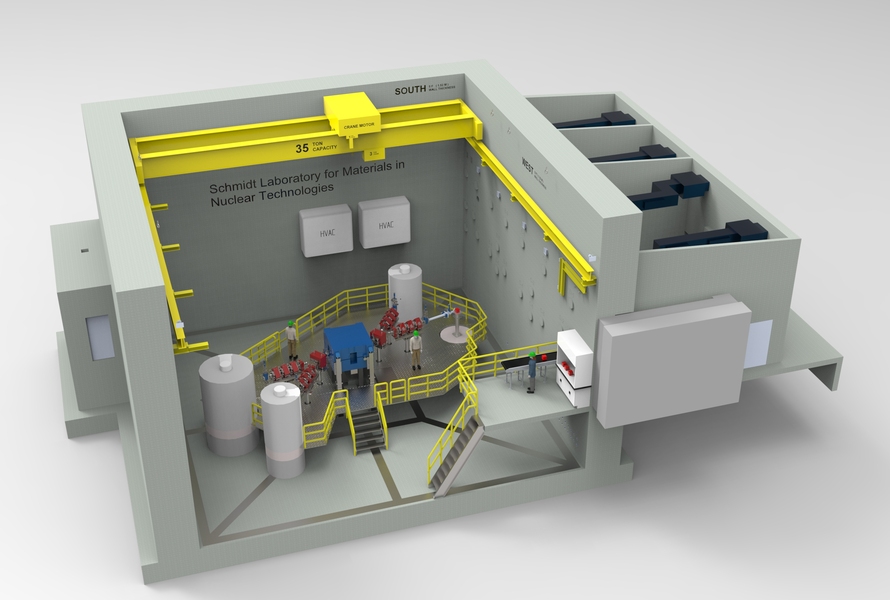
  • Nuclear Reactors 1524 – New MIT Schmidt Laboratory for Materials in Nuclear Technologies Researchers Materials for Fusion Reactors – Part 2 of 2 Parts

    A model of a factory

AI-generated content may be incorrect.

    Part 2 of 2 Parts, (Please read Part 1 first)

    By repurposing the space previously occupied by the C-Mod, the center is skipping the need for extensive, costly new construction and accelerating the research timeline significantly. The PSFC’s veteran team has led major projects like the Alcator tokamaks and advanced high-temperature superconducting magnet development. They are overseeing the facilities design, construction, and operation, ensuring LMNT moves quickly from concept to reality. The PSFC expects the delivery of the cyclotron by the end of 2025, with experimental operations starting in early 2026.

    Nuno Loureiro is the director of the PSFC, a professor of nuclear science and engineering, and the Herman Feshbach Professor of Physics. He said, “LMNT is the start of a new era of fusion research at MIT, one where we seek to tackle the most complex fusion technology challenges on timescales commensurate with the urgency of the problem we face: the energy transition. It’s ambitious, bold, and critical — and that’s exactly why we do it.”

    Elsa Olivetti is the Jerry McAfee Professor in Engineering and a mission director of MIT’s Climate Project. She said, “What’s exciting about this project is that it aligns the resources we have today — substantial research infrastructure, off-the-shelf technologies, and MIT expertise — to address the key resource we lack in tackling climate change: time. Using the Schmidt Laboratory for Materials in Nuclear Technologies, MIT researchers advancing fusion energy, nuclear power, and other technologies critical to the future of energy will be able to act now and move fast.”

    In addition to advancing fusion research, LMNT will provide a setting for educating and training students in the increasingly important areas of fusion technology. LMNT’s location on MIT’s main campus provides students with the opportunity to lead research projects and help manage facility operations. It also maintains the hands-on approach to education that has defined the PSFC. Reinforcing that direct experience in large-scale research is the best approach to train fusion scientists and engineers for the expanding fusion industry workforce.

    Benoit Forget is the head of NSE and the Korea Electric Power Professor of Nuclear Engineering, notes. He said, “This new laboratory will give nuclear science and engineering students access to a unique research capability that will help shape the future of both fusion and fission energy.”

    Significant philanthropic support has helped LMNT leverage existing infrastructure and expertise to move from concept to facility in just one-and-a-half years. This is a fast timeline for establishing a major research project.

    Hartwig emphasized, “I’m just as excited about this research model as I am about the materials science. It shows how focused philanthropy and MIT’s strengths can come together to build something that’s transformational — a major new facility that helps researchers from the public and private sectors move fast on fusion materials”.

    By utilizing this approach, the PSFC is developing a major public-private partnership in fusion energy, realizing a research model that the U.S. fusion community has only recently begun to explore, and demonstrating the critical role that universities can play in the acceleration of the materials and technology required for fusion energy.

    Ian Waitz is MIT’s vice president for research. He said, “Universities have long been at the forefront of tackling society’s biggest challenges, and the race to identify new forms of energy and address climate change demands bold, high-risk, high-reward approaches LMNT is helping turn fusion energy from a long-term ambition into a near-term reality.”

    Schmidt Laboratory for Materials in Nuclear Technologies